Roman Gofman
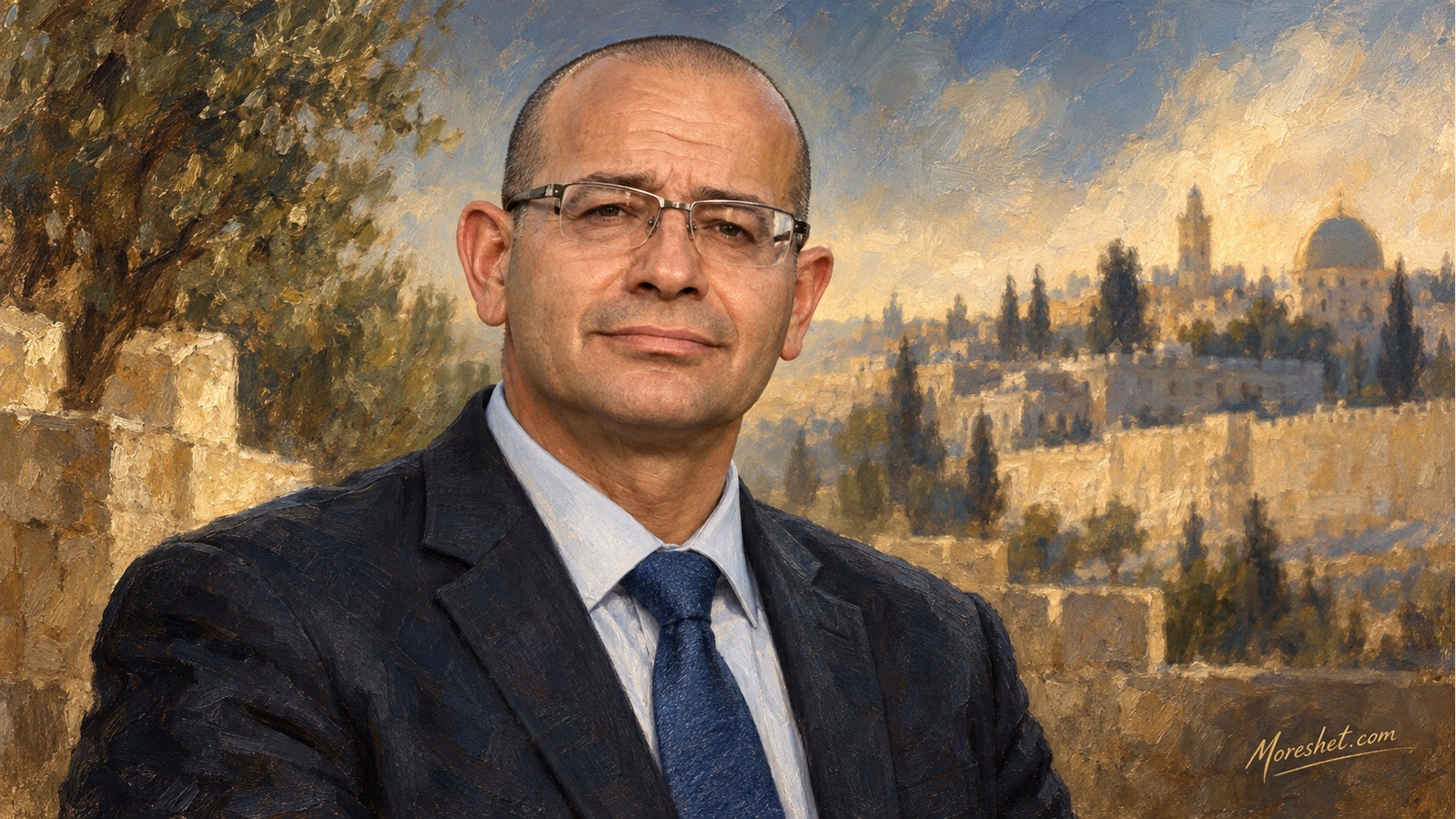
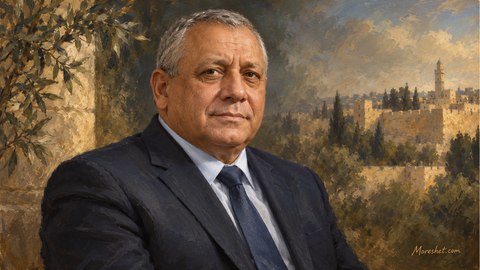
Roman Gofman — AI-generated artistic portrait · Moreshet.com
Israel’s 14th Mossad director, major general and commander whose path links Soviet aliyah, armored command, battlefield leadership and national intelligence
Roman Gofman is the director of the Mossad, a former IDF major general and an Israeli commander whose public and security career reflects an unusual path of immigration, integration, combat, command and arrival at one of the most sensitive positions in the State of Israel. Born in the Soviet Union, he immigrated to Israel as a teenager, grew up in Ashdod, joined the Armored Corps, commanded combat units and senior formations, was seriously wounded during the battles of October 7, served as military secretary to the prime minister, and on June 2, 2026, became the 14th director of the Mossad.
Gofman’s importance for Israeli heritage lies not only in the office he now holds, but in the path that brought him there. He represents a generation of immigrants from the former Soviet Union who entered deeply into Israeli society, carried the burden of security, passed through the combat-command track and reached the center of national decision-making. His story connects personal aliyah, social adjustment, military discipline, battlefield command, state responsibility and intelligence leadership at a time when Israel faces complex regional threats.
Childhood in Soviet Belarus and aliyah to Ashdod
Roman Gofman was born on November 30, 1976, in Mazyr, in Soviet Belarus, then part of the Soviet Union. His mother was a teacher and his father a physician. In 1990 he immigrated to Israel with his family as a boy of about 13 or 14, and the family settled in Ashdod. The move came during the great immigration wave from the former Soviet Union, which changed Israeli society, education, the economy, science, culture and the Israel Defense Forces.
In Ashdod, Gofman studied at the ORT Ashdod Nautical Officers School. According to the supplied material, his teenage years as a new immigrant included alienation and even violence from other boys, and he began training in boxing. This is more than a sporting anecdote: it shows the need to build resilience, cope with foreignness and turn hardship into strength. Later, that resilience would be visible in long combat service and a willingness to move toward real danger.
Gofman later completed a bachelor’s degree in political science at Ashkelon Academic College and a master’s degree in political science and national security at the University of Haifa. During a period of study through the army, he also studied at the Bnei David Mechina in Eli. This combination of civilian education, national security, values-based study and military service reflects an Israeli path in which a combat commander needs not only operational skill, but also political, social and strategic understanding.
The beginning of the path in the Armored Corps
In 1995 Gofman enlisted in the IDF and joined the Armored Corps, serving in the 53rd Battalion of the 188th Armored Brigade. He completed combat training, a tank commanders’ course and officers’ training, and later moved to the 71st Battalion. As a tank platoon commander he took part in combat in southern Lebanon during the security-zone years, one of the arenas that shaped a generation of Israeli field commanders before the IDF withdrawal from Lebanon in 2000.
He later served as a company commander in the 71st Battalion and participated in combat in the Gaza Strip and Judea and Samaria during the Second Intifada and Operation Defensive Shield. This was a period in which IDF commanders had to operate in a complex reality of terrorism, built-up areas, protection of civilians, focused use of force and public and international pressure. That service shaped Gofman as a field commander who knew operational friction from the most tactical level.
He subsequently served as deputy commander of the 71st Battalion, deputy commander of a training battalion in the 460th Brigade and operations officer of the Ga’ash Formation. These posts gradually moved him from direct command of soldiers to planning, training, force building and the management of larger systems. For an armored commander, that transition is especially important: it requires understanding technology, maneuver, intelligence, logistics, firepower, command and control, and the ability to translate doctrine into action.
Battalion commander, brigade commander and division commander
In 2010 Gofman was promoted to lieutenant colonel and appointed head of the Armored Corps branch at the National Center for Ground Training. In 2011 he was appointed commander of the 75th Battalion in the 7th Armored Brigade, and from 2013 to 2015 he served as operations officer of the Ga’ash Formation. These positions deepened his place in the core of Israel’s armored and training systems, at a time when the army was dealing with questions of ground readiness, maneuver, fighting non-state armed organizations and the capacity for decision.
On August 30, 2015, he was promoted to colonel and appointed commander of the Etzion Brigade. The brigade operates in a sensitive sector of Judea and Samaria, where military command is not only about combat but also about daily security responsibility, contact with civilian populations, counterterrorism, work with the Shin Bet, police and civil administration, and preservation of a complex fabric of life. In 2017 he was appointed commander of the 7th Armored Brigade, one of the central and symbolic armored brigades in the IDF.
At a senior IDF command conference in 2018, Gofman spoke in favor of more frequent and meaningful operational use of ground forces. This reflected a view that the IDF cannot rely only on standoff firepower, intelligence and technology, but must preserve and develop ground maneuver capability. After completing his command of the 7th Brigade, he studied at the National Security College, which prepares senior officers to understand the link among army, society, policy and strategy.
In 2020 he was promoted to brigadier general and appointed commander of the Bashan Division, responsible for the Golan Heights sector. In this arena, the IDF has had to deal with challenges along the Syrian border, Iranian entrenchment efforts, armed organizations and coordination among intelligence, firepower, ground forces and covert activity. He later became commander of the National Center for Ground Training, a post of broad importance for IDF force building and the readiness of ground units.
October 7, 2023: initiative under fire and severe injury
On the morning of October 7, 2023, as the Hamas assault on southern Israel began, Gofman drove from his home in Ashdod toward Sderot after receiving reports of terrorist infiltration. According to the supplied material, he picked up Israel Police volunteers, reached the Sha’ar HaNegev junction, encountered terrorists, struck two of them and was seriously wounded in the knee during the exchange of fire.
This episode became a central part of his public image. Gofman was a senior officer who did not wait for a complete operational picture or formal deployment, but moved toward the fighting during the first chaotic hours. In terms of values and heritage, it reflects the image of the Israeli commander in IDF security tradition: reaching the place where responsibility is required, even at serious personal cost.
After recovering from his injury, he served for several months as chief of staff to the Coordinator of Government Activities in the Territories. This role moved him from direct battlefield action to a sensitive area of security, humanitarian and civilian policy at a time when Israel was conducting a complex war in Gaza and facing international pressure, questions of civilian aid, coordination with foreign actors and governmental responsibility.
Military secretary to the prime minister
In May 2024, Gofman was promoted to major general and entered the role of military secretary to Prime Minister Benjamin Netanyahu. This is one of the most sensitive positions at the interface between the military and the political leadership. The military secretary is not merely a liaison officer; he sits close to the prime minister, helps process security information, coordinates among systems, conveys the situation picture and assists the prime minister in understanding military and intelligence developments.
His service took place during the Swords of Iron War and at a time when Israel had to make difficult decisions in Gaza, Lebanon, Syria, Iran, Judea and Samaria, and in its relations with the United States and other countries. The military secretary’s role in such a period requires understanding of the battlefield, intelligence, policy, interagency dialogue and the way security decisions are translated into action.
In this role, two features of Gofman’s path came together: deep familiarity with combat command and ground forces on one hand, and direct exposure to cabinet discussions, the prime minister, the defense establishment and strategic questions on the other. The transition from field commander to military secretary paved his way toward the highest level of national intelligence.
Appointment as director of the Mossad
In December 2025, the prime minister announced his intention to appoint Gofman as director of the Mossad, after the end of David Barnea’s term. The appointment went through public and legal review, including examination by the Senior Appointments Advisory Committee and petitions to the Supreme Court. On June 1, 2026, the Supreme Court rejected the petitions against the appointment, and on June 2, 2026, Gofman entered office as the 14th director of the Mossad.
The appointment was somewhat unusual because Gofman came mainly from a military-command track rather than from inside the Mossad. Still, there is clear logic to such a path: a Mossad director must lead a secret intelligence organization, but also understand the use of force, wartime decision-making, coordination with the IDF, Shin Bet, intelligence community, political leadership and foreign intelligence partners. Gofman came to the post after years of command, operational planning, familiarity with border arenas and very close experience at the national decision-making table.
The Mossad is one of the most sensitive and important institutions in Israel’s defense establishment. Much of its activity is secret by nature, and responsible public documentation must therefore distinguish verified career facts from speculation about operations. What can be said clearly is that Gofman assumed leadership of an organization central to Israel’s struggle against Iran, regional terrorism, strategic threats, hostages, intelligence partnerships and the wider covert campaign.
A Mossad director in a turbulent regional period
In his first months in office, Gofman led the Mossad during a period in which Iran, its regional proxies and the campaign surrounding Gaza stood at the center of Israel’s security agenda. According to current reporting, he visited Washington in July 2026 and met with the CIA director and other American officials for discussions concerning Iran, the nuclear program and the war. Such a visit reflects the Mossad’s place not only as an operational organization, but also as a central body in the intelligence relationship between Israel and the United States.
An Israeli Mossad director always operates on two levels: secrecy, intelligence collection, operations and technological capabilities on one side; covert diplomacy, dialogue with foreign intelligence services, strategic assessment and advice to the political leadership on the other. For Gofman, who came from the military and the prime minister’s office, the challenge is to translate command and strategic experience into the world of covert intelligence, where success is sometimes measured precisely by what is never published.
Command philosophy and military thought
In 2021 Gofman published an article titled The Theater of Generalship in the IDF journal Bein HaKtavim. According to the supplied material, the article presented a view of the commander as an active shaper of reality rather than only an executor of orders. Such an approach places initiative, understanding of the political leadership’s intent, responsibility under uncertainty and the commander’s need to interpret reality, not merely react to it, at the center.
This approach can generate debate, but it is important for understanding him. Gofman belongs to a tradition of commanders who see command as both an intellectual and practical craft: understanding the battlefield, translating political objectives into operational language, identifying opportunities and using force in a way that seeks to influence a wider reality. As Mossad director, such a view takes on additional meaning, because a covert intelligence organization must not only know what is happening, but also shape possible courses of action for the state.
Personal life
Gofman lives in Ashdod, the city where he grew up after immigrating to Israel. He is married and has three daughters. This returns his story to its starting point: a young immigrant who arrived in a large Israeli port city, faced the difficulties of absorption, built his path inside the IDF, and repeatedly returned to Ashdod as home.
His personal story illustrates one of the important phenomena of modern Israel: the ability of immigration to become leadership. Like many members of the aliyah from the former Soviet Union, Gofman did not enter Israeli society with a path already prepared for him. He had to prove himself in language, society, the army and command. The road he traveled from Mazyr to Ashdod, from the Armored Corps to the prime minister’s office, and from there to the leadership of the Mossad, is part of the broader story of immigrant integration into the security and public core of Israel.
Why this legacy belongs in Moreshet
Roman Gofman merits inclusion in Moreshet because his story connects Jewish immigration from the former Soviet Union, integration into Israeli society, long combat service, command of armored and ground forces, injury in the fighting on October 7, close work with the political leadership and the leadership of the Mossad during one of the most sensitive security periods in Israel’s history.
Moreshet.com documents Gofman because Israeli and Jewish heritage includes not only the state’s founders and earlier generations, but also the generation that continues to carry responsibility for national security, intelligence and Israel’s ability to confront changing threats. Roman Gofman’s place in Moreshet rests on the way a young immigrant from Ashdod became a senior commander, a trusted figure near the center of decision-making and director of the Mossad — a path that expresses service, integration, personal courage and national responsibility in the State of Israel in the 21st century.