Gadi Eisenkot
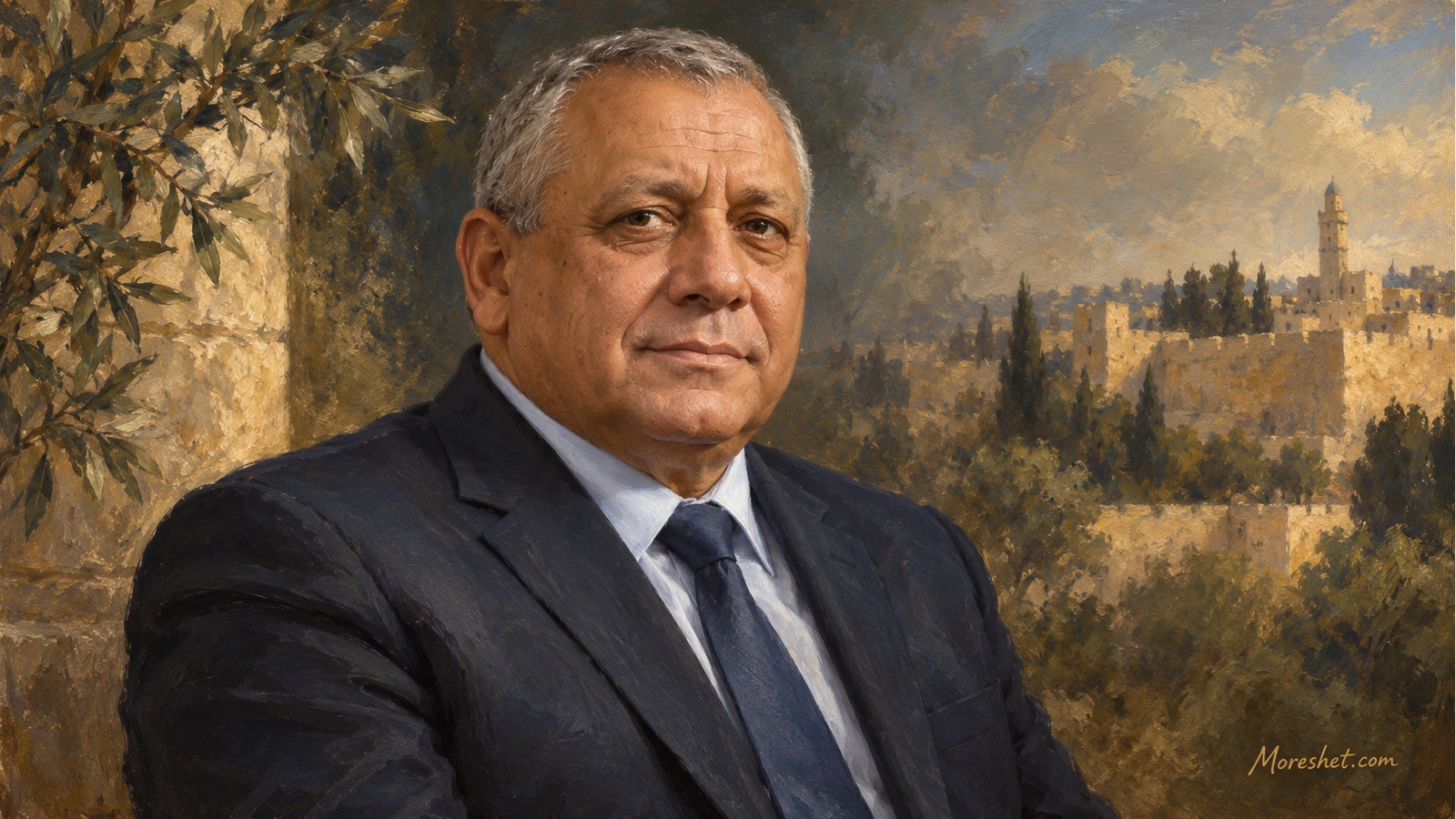
Gadi Eisenkot — AI-generated artistic portrait · Moreshet.com
The IDF’s 21st chief of staff, Israeli security leader and politician who shaped military doctrine, force-building and public debate
Gadi Eisenkot, born Gad Eisenkot, is a retired Israeli general, the 21st chief of the General Staff of the Israel Defense Forces, public figure and politician. Over more than four decades of military service, he moved from the combat track of the Golani Brigade to the highest levels of IDF command, and later into the Knesset, the government and the war cabinet. His public story connects field command, national-security doctrine, force-building, state responsibility and profound personal loss after his son and nephews were killed during the Swords of Iron War.
Eisenkot is regarded as one of the commanders who influenced Israeli security thinking in recent decades. As chief of staff, he led the Gideon multi-year plan, published the IDF Strategy document, strengthened the campaign between wars, dealt with Hamas and Hezbollah tunnel threats, and worked to improve the readiness of Israel’s ground forces. After leaving the IDF, he entered public life, was elected to the Knesset, served as a minister without portfolio and observer in the war cabinet after October 7, and later founded the Yashar! with Eisenkot party.
Childhood, family and education
Gadi Eisenkot was born in Tiberias on May 19, 1960, to a Jewish family that had immigrated to Israel from Morocco. His parents, Meir and Esther Eisenkot, were part of the story of North African Jewish immigration and integration in Israel. When he was one year old, the family moved to Eilat, the developing southern border city where he grew up. His Eilat childhood, far from the center of the country, contributed to his public image as a figure who rose from Israel’s periphery through service, discipline and hard work.
Eisenkot studied at Goldwater High School in Eilat, majoring in maritime studies, and later completed his matriculation examinations. After years in the security establishment, he also pursued higher education: a bachelor’s degree in general history from Tel Aviv University and a master’s degree in political science from the University of Haifa. He also studied military and security affairs at the United States Army War College in Carlisle, Pennsylvania, deepening his familiarity with strategic military thinking and the security doctrines of Israel’s central ally.
Golani and the making of a commander
In 1978 Eisenkot enlisted in the IDF and was assigned to the 51st Battalion of the Golani Brigade. He completed the combat track, squad-commanders course and officers course, and returned to the brigade as a commander. Already in his early years he confronted combat, injury and return to service, experiences that shaped him as a field commander. During the First Lebanon War, he commanded a company after its commander was wounded and participated in difficult battles in Lebanon.
He later commanded Golani’s anti-tank company, served as brigade operations officer, commander of the 13th Battalion, deputy brigade commander and, in 1997, commander of the Golani Brigade. As Golani commander, he worked to change internal norms, strengthen discipline and professionalism, and improve the brigade’s combat capability during the fighting in southern Lebanon. Golani was not only a biographical station for him, but a command home in which his ideas about commanders’ responsibility, IDF values and the need to combine operational determination with an ethical framework were formed.
Senior command, Lebanon and the northern front
After command roles in the Carmeli and Ephraim brigades, Eisenkot was appointed military secretary to Prime Minister and Defense Minister Ehud Barak, later serving under Ariel Sharon as well. The role of military secretary placed him at the direct interface between the military and political leadership, giving him close exposure to how security decisions are made at the top of the state.
In 2003 he was appointed commander of the Judea and Samaria Division during the Second Intifada. In this role he was part of a broad effort to reduce suicide terrorism coming from the West Bank through continuous operations, intelligence, raids and the dismantling of terrorist infrastructure. He was later appointed head of the Operations Directorate in the General Staff, and during the Second Lebanon War was among the senior officers involved in planning and managing IDF operations.
After the Second Lebanon War, Eisenkot was appointed head of Northern Command. His years in Northern Command focused on restoring readiness, training, force-building and deterrence against Hezbollah and Syria. During this period, a doctrine of significant force against an enemy’s centers of gravity was also developed and deepened, a concept publicly associated with the “Dahiya doctrine.” For supporters, it was a deterrence concept intended to prevent another war; for critics, it raised difficult questions about the scope and cost of force. From the perspective of security heritage, it illustrates Israel’s attempt to confront heavily armed non-state enemies operating from within civilian environments.
Deputy chief of staff and the road to the General Staff
After Northern Command, Eisenkot dealt with staff work that led to the establishment of the Depth Corps, intended to concentrate capabilities for action in distant strategic arenas. In 2013 he was appointed deputy chief of staff under Chief of Staff Benny Gantz and served in the role during Operation Protective Edge. The deputy role allowed him to influence force-building, priorities, multi-year plans and coordination among branches of the military.
In 2014 he was chosen as the 21st chief of staff of the IDF, entering office on February 16, 2015. His appointment was the natural continuation of the path of a field commander who had passed through almost every key point in the IDF: battalion, brigade, division, command, General Staff and deputy chief of staff. He entered office at a time when the IDF had to confront lone-wolf terrorism, tunnel threats, Iranian entrenchment in Syria, Hezbollah and Hamas armament, and a technological and intelligence revolution in warfare.
Chief of staff: the Gideon plan and IDF Strategy
As chief of staff, Eisenkot led the Gideon multi-year plan, designed to reshape the IDF for future challenges. The plan addressed personnel, force structure, training, maneuver capabilities, cyber and intelligence investment, reduction of redundancies and the creation of new frameworks. At its center was the understanding that the IDF had to become sharper, more efficient, more prepared and more relevant against enemies changing quickly.
In 2015, the IDF Strategy document was published, one of the most important public documents on the military’s concept for the use of force. The document emphasized the need to shorten campaigns, achieve decisive and deterring outcomes, combine rapid ground maneuver with precise fire and high-quality intelligence, and act against enemies hiding among civilian populations. Its publication contributed to unusual transparency about Israeli military thinking and presented the chief of staff not only as an operational commander, but as a shaper of security doctrine.
One of the concepts most associated with his tenure is the campaign between wars. This doctrine seeks continuous action below the threshold of war in order to reduce threats, delay enemy force-building, strike infrastructure and push the next war farther away. During Eisenkot’s term, IDF activity against Iranian entrenchment in Syria and weapons transfers to Hezbollah expanded. The campaign between wars thereby became a central tool in Israeli security policy.
Tunnels, borders and home-front defense
During his term, Eisenkot placed significant emphasis on the tunnel threat. In the south, the IDF worked to detect and neutralize Hamas tunnels through a combination of sensing technologies, intelligence, engineering and operational activity. In the north, the IDF launched Operation Northern Shield, aimed at exposing and neutralizing Hezbollah cross-border tunnels. The operation ended shortly before the conclusion of his term as chief of staff and showed the IDF’s transition from reactive response to a planned effort combining intelligence, technology and engineering.
The tunnel challenge illustrates the features of the new warfare Eisenkot had to confront. The enemy is not always standing in an open field; it builds hidden capabilities, operates from civilian areas, uses the underground, rockets, communications systems and the battle of perception. Against such challenges, Eisenkot sought to build a military capable of exposing, disrupting, maneuvering and deterring even in campaigns unlike the wars of the past.
IDF values and military state-mindedness
Eisenkot’s tenure as chief of staff also included difficult questions of values and command. In the Elor Azaria affair, he presented a clear position that the IDF must act according to orders, values and law, even under public and political pressure. His position provoked broad controversy, but it reinforced his image as a commander who viewed ethical discipline as part of military strength, not an obstacle to it.
Military state-mindedness was one of the prominent features of his approach. Eisenkot sought to preserve the IDF as a people’s army, a professional body subordinate to the political echelon but not partisan, and a system whose use of force is grounded in law, responsibility, training and professionalism. This approach gained special significance in years when Israel’s political debate became more severe and the army found itself at the center of public disputes.
From the military to public life
After retiring from the IDF in 2019, Eisenkot joined the Washington Institute for Near East Policy, became a senior research fellow at the Institute for National Security Studies, held civilian and public roles, and received the Knight of Quality Government award in the military and security category. This activity allowed him to continue engaging with questions of national security, strategy, U.S.-Israel relations and regional challenges outside the military framework.
In 2022 he entered politics with the National Unity alliance and was elected to the 25th Knesset. In the Knesset he focused on security, national-security doctrine and force-building. He chaired a subcommittee of the Foreign Affairs and Defense Committee on security doctrine and force-building, and helped advance an initiative requiring the government to formulate and publish a national-security concept. In doing so, he continued the line that characterized him as chief of staff: an effort to turn security thinking into an orderly organizational and political framework.
October 7, the war cabinet and personal loss
After the October 7, 2023 attack, National Unity joined the emergency government, and Eisenkot was appointed minister without portfolio and observer in the war cabinet. He brought to the cabinet table long experience in the use of force, force-building, deterrence and intelligence, but also the civilian position of an elected public official during a deep national crisis. He supported the need to defeat Hamas, while also supporting pauses and arrangements intended to enable the return of hostages.
In December 2023, his youngest son, Master Sergeant Gal Meir Eisenkot, was killed in combat in Gaza. Shortly afterward, his nephew Sergeant Maor Cohen Eisenkot was killed, and in November 2024 another nephew on his wife’s side, Captain Yogev Pazy, was also killed. This heavy personal loss turned Eisenkot into a symbol of the tragic connection between security leadership and the price of war. He was not only a decision-maker or security commentator; he was also a bereaved father within the very campaign over whose management the whole country was arguing.
In 2024, National Unity withdrew from the government, and Eisenkot left his ministerial role. In 2025 he announced his departure from National Unity and resigned from the Knesset. He later founded the Yashar! with Eisenkot party, and in 2026 led it in the election campaign. This transition reflects his attempt to translate security and state-minded experience into an independent political program.
Security and public worldview
Eisenkot is associated with a security approach that is pragmatic, firm and state-minded. He emphasizes preserving the IDF’s freedom of action, deterrence against Iran, Hezbollah and Hamas, strengthening the ground army, improving reserve readiness and dealing seriously with Haredi conscription. For him, Israel’s security is not only firepower or intelligence, but also social cohesion, governmental stability, public trust and a functioning decision-making system.
In civic debate he has presented a view that Israel must preserve its Jewish and democratic identity, separation of powers and judicial independence, alongside a hard national-security policy and military freedom of action. He sees internal polarization as a strategic threat, because a divided society struggles to make decisions in wartime and project strength toward its enemies. In this way he seeks to connect security, society, law and state responsibility.
Personal life
Eisenkot lives in Herzliya. He is married to Hannah, an architect, and they have five children. His life story includes social mobility through the army, long service, security leadership, entry into politics and deep family loss during war. For many Israelis, this combination gives his public figure an emotional and civic weight beyond formal positions alone.
Why this legacy belongs in Moreshet
Gadi Eisenkot merits inclusion in Moreshet because his story reflects several central axes of the State of Israel: the immigration and integration of North African Jewry, combat service in the Golani Brigade, decades of IDF command, the shaping of security doctrine, leadership of the army during a period of changing threats, transition from military command into the democratic arena, and personal and public confrontation with the cost of war.
Moreshet.com documents Eisenkot because Israeli and Jewish heritage includes the people who shaped the way the State of Israel defends itself, uses force, educates commanders and manages the tension among security, morality and state responsibility. Gadi Eisenkot’s place in Moreshet rests on the connection between battlefield command, strategic thinking, civic responsibility, participation in public debate and the personal price he bore within the war of his generation.