Aharon Barak
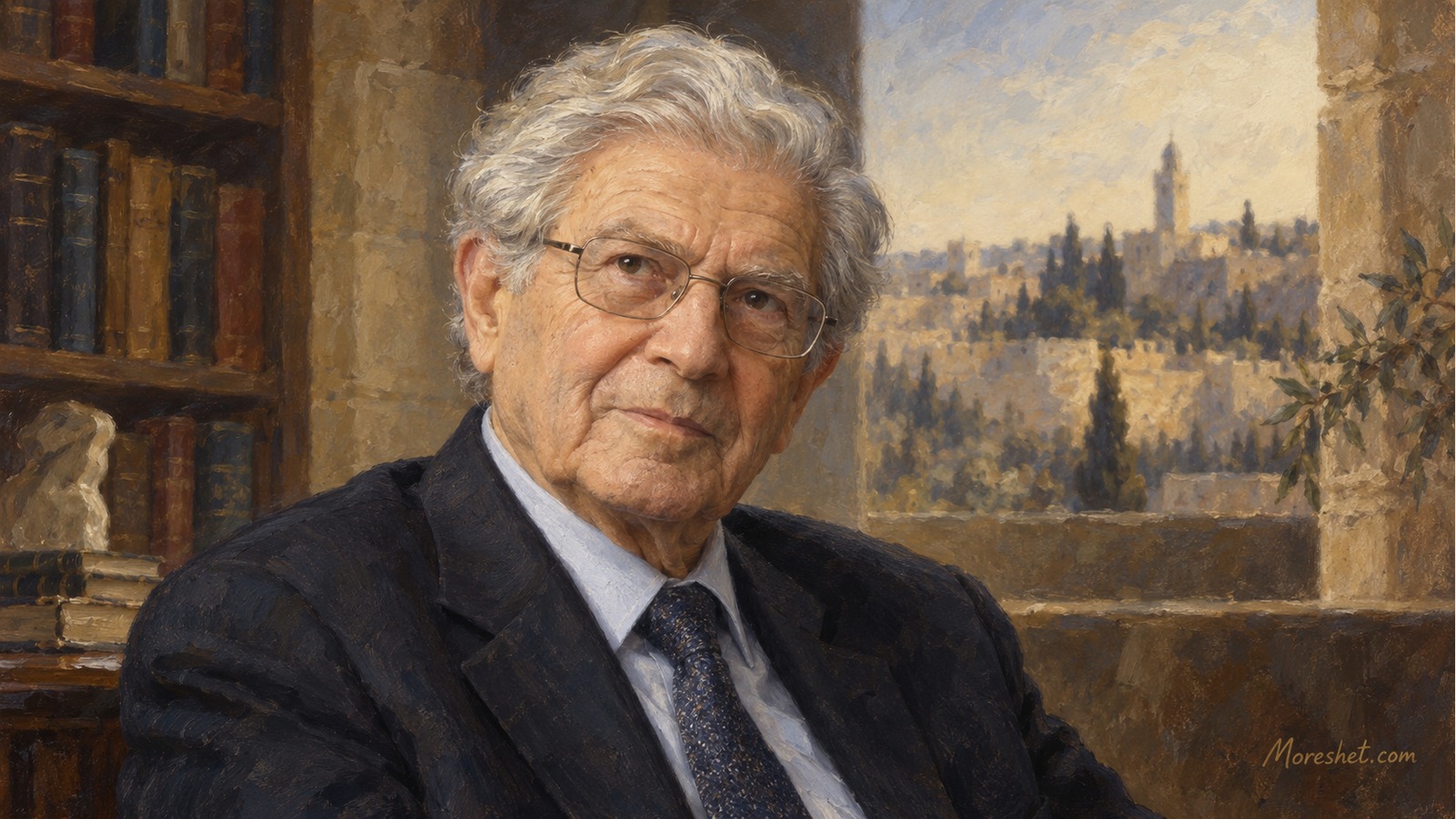
Aaron Barak — AI-generated artistic portrait · Moreshet.com
Israeli jurist, Holocaust survivor, former President of the Supreme Court of Israel, former Attorney General, legal scholar and Israel Prize laureate who reshaped Israeli constitutional and public law
Aharon Barak, born Erik Brick in Kaunas, Lithuania, is an Israeli jurist, Holocaust survivor, professor of law, former Attorney General of Israel, former Justice and President of the Supreme Court of Israel, and recipient of the Israel Prize in legal sciences. For more than half a century he was one of the central figures in shaping the language of Israeli law: from the young Hebrew University legal academy, through questions of law and government in the 1970s, the Camp David Accords, and finally the Supreme Court and Israel’s Constitutional Revolution. Few Israeli jurists have had comparable influence on the way citizens, government, the Knesset, the army, judges and lawyers understand the rule of law, human rights, state authority and the role of the court in a Jewish democracy.
Barak’s importance does not rest only on the offices he held, but on the rare connection between a Jewish historical life story and institutional legal creation. As a child who survived the Kovno Ghetto and the children’s Aktion, and as someone who reached the Land of Israel after a long journey of displacement in Europe, he carried with him a deep personal memory of a world in which formal law could become an instrument of persecution. As a jurist in the State of Israel, he sought to build a legal language in which law was not merely the command of power, but a framework of justice, rights, purpose, reasonableness, proportionality and public responsibility. For this he has been deeply admired and sharply criticized; but both supporters and critics agree that modern Israeli law cannot be understood without understanding Aharon Barak.
Childhood in Kaunas, Zionist family roots and the Holocaust
Barak was born in Kaunas on September 16, 1936, the only son of Zvi Brick, a lawyer and Zionist activist, and Leah Brick, a teacher. His family belonged to the educated and Zionist world of Lithuanian Jewry. His father worked in the Palestine Office in Kaunas, dealing with immigration certificates to the Land of Israel and connecting Jewish life in Lithuania to the Zionist project before the Second World War. His mother came from a family with rabbinic and educational roots and combined Jewish tradition with general education.
After Nazi Germany invaded the Soviet Union in 1941, the Jews of Kaunas were forced into the Kovno Ghetto. Barak, still a small child, saw the Lithuanian Jewish world collapse around him: pogroms, hunger, terror, deportations and the murder of children. His parents hid him during the Aktionen, his mother taught him to read and write, and he was given raised shoes to make him appear older than he was. In 1944 he was smuggled out of the ghetto in a sack on a cart of straw, together with his mother, and hidden in the home of Lithuanian farmers later recognized as Righteous Among the Nations.
The time in hiding was formative. The child Erik and his mother hid behind a double wall in a poor farmhouse, while danger remained constant. His mother continued to teach him mathematics, geography and fluent Lithuanian, and also taught the children of the family that was hiding them. Barak later described this period as a reality in which formal rule of law existed in appearance, while everything functioned through murderous orders. That memory explains a central part of his outlook: law detached from values, rights and human dignity can lose its moral meaning.
Escape from Europe and aliyah to the Land of Israel
After the liberation of Kaunas, Barak and his mother were reunited with his father, but the family understood that Soviet rule would not allow them free lives. Using false documents, they moved through Vilnius, Białystok, Warsaw, Romania, Hungary and Austria, until they met members of the Jewish Brigade. From there they were smuggled into Italy, which had become a transit point for many Jewish refugees after the Holocaust.
In Rome, Barak first studied in a school framework, but still inside the world of refugees, where children of different ages learned together in Yiddish. In 1947 the family immigrated to the Land of Israel. They first reached Haifa, then Tel Aviv, and later Jerusalem. There the child who did not yet speak Hebrew began to build a new life in the country whose law, language and Jewish statehood would become the center of his life.
Aliyah to the Land of Israel is not merely a biographical detail. It connects the destruction of European Jewry with the construction of Israeli society. Barak belongs to the generation that moved from destruction to sovereignty, from the ghetto to the Supreme Court, from the hiding place of a persecuted child to one of the central institutions of the Jewish state. This is one of the keys to his place in Israeli and Jewish heritage.
Studies, the IDF and the Hebrew University
Barak studied at the Hebrew University Secondary School in Jerusalem and then studied law at the Hebrew University of Jerusalem through the academic reserve program. In 1958 he completed a master’s degree in law, while also studying economics and international relations. From 1958 to 1960 he served in the IDF in the office of the financial adviser to the chief of staff, completed command and officer training, and then returned to his studies and legal path.
He first interned with Attorney General Gideon Hausner, but when Hausner began work on the Eichmann trial, Barak, as a Holocaust survivor, asked not to be involved. He moved to the State Attorney’s Office, worked in several departments, qualified as an attorney, and in 1963 completed with distinction a doctorate on vicarious liability and the employer’s benefit, supervised by Professor Gad Tedeschi.
Already at this stage two qualities that would accompany him throughout his life were visible: exceptional intellectual precision and the belief that law is not merely a technical profession but a language of social order. He was especially interested in civil law, corporate law, interpretation, legislation and the way legal rules translate values into practical reality.
Academic career and a new generation of Israeli law
In 1966 Barak became a senior lecturer at the Hebrew University, and in 1966–1967 completed postdoctoral research at Harvard Law School. At Harvard he was exposed to the Socratic method, American thinking about the role of institutions and the legal-process school. This exposure influenced his view of the relationship among law, institutions, interpretation and judicial discretion.
Upon returning to the Hebrew University, he became part of a young generation of jurists seeking to refresh the law faculty and the legal language of Israel. In 1968 he became an associate professor, founded the journal Mishpatim, and in 1974 was appointed dean of the Faculty of Law. At a relatively young age he was already considered one of Israel’s leading legal scholars, especially in civil law, interpretation, corporate law and negotiable instruments.
In 1975, at the age of 38, he received the Israel Prize in legal sciences. In the same year he was elected to the Israel Academy of Sciences and Humanities. These honors were not merely personal recognition; they marked Barak as a figure connecting original Israeli legal scholarship with the aspiration to place Israeli law alongside leading legal traditions in the world.
Attorney General and the test of rule of law
From 1975 to 1978 Barak served as Attorney General of Israel. It was an especially turbulent period in Israeli politics, and Barak quickly became a symbol of an attorney general who did not merely provide legal opinions, but saw himself as a guardian of the rule of law. During his tenure, decisions were made that influenced the office of the attorney general for generations.
In the Asher Yadlin affair, Barak ordered a criminal investigation into the director general of Clalit Health Services and nominee for governor of the Bank of Israel. Yadlin was convicted of bribery and sent to prison. Around this affair, the expression Buzaglo test was coined to express the principle that a public official should be treated like an ordinary citizen before the law. The phrase has itself generated criticism over possible ethnic undertones, but the legal principle associated with it became one of the best-known expressions of equality before the law in Israel.
In the Leah Rabin dollar-account affair, Barak decided to prosecute the prime minister’s wife, a decision that led Yitzhak Rabin to resign from the leadership of the Labor Alignment before the 1977 election. The decision illustrated Barak’s view that even a prime minister and his family are not above the law. It also placed him at the center of one of the dramatic moments in Israeli political history, when a legal decision changed a national political path.
Camp David and law in the service of peace
After Menachem Begin came to power, Barak continued to serve as attorney general and gained the trust of the new prime minister. In 1978 he joined the Israeli team in the negotiations with Egypt and helped shape the Camp David Accords. In this role, Barak was not merely a lawyer drafting clauses, but a figure helping translate diplomatic and security disputes into legal language that could be signed.
In the negotiations he worked with leaders, ministers, diplomats and legal advisers from the different sides. He helped find formulations that allowed Begin, Sadat and Carter to move forward even when the talks reached crises. The ability to create legal wording that preserved diplomatic room while enabling practical agreement was one of his distinctive talents.
The Camp David chapter shows another important element of his legacy: law is not only a tool for limiting power, but also a tool for building peace. A peace agreement, like a judgment, depends on words, authority, commitments, interpretation and trust. Barak participated in one of the greatest diplomatic achievements in Israel’s history and brought to it the tool that shaped his whole life: legal precision.
Supreme Court Justice and the Kahan Commission
In 1978 Barak was appointed to the Supreme Court of Israel. He was the youngest justice at the time of his appointment and served on the court for 28 years. In his early years on the court he dealt with a wide range of civil, administrative, constitutional, criminal and public-law matters. He brought to the court a rich theoretical language, a precise analytical structure and a desire to place general principles behind concrete decisions.
In 1982–1983 he served on the Kahan Commission, the state commission of inquiry into the Sabra and Shatila massacre. The commission examined the responsibility of Israeli actors for the terrible events that occurred in the refugee camps in Beirut. Its conclusions included severe criticism of senior figures, above all Defense Minister Ariel Sharon, who was removed from office following the report.
Barak’s participation in the Kahan Commission strengthened his standing as a public jurist willing to examine the responsibility of senior officials even in sensitive security matters. It also illustrated a principle that later became central in Israeli law: national security is an existential need, but it too exists within a framework of responsibility, review and public morality.
Standing, justiciability and reasonableness
One of the central innovations associated with Barak is the opening of the gates of the High Court of Justice. In the past, a petitioner was generally required to show direct personal harm before the court would hear a petition. Barak supported expanding standing, especially in public and principled matters, based on the view that the court should protect the rule of law even when no single person has been harmed in a private and exclusive way.
Alongside this, Barak broadened the concept of justiciability, the question of which matters are suitable for legal adjudication. His outlook, associated with the idea that law fills the whole world, emphasized that almost every action of a public authority can be examined according to legal standards. Supporters saw this as opening the gates of justice to the public; critics saw it as excessive involvement by the court in political issues.
Barak also advanced reasonableness as a tool for judicial review of administrative decisions. In his view, a governmental decision is not examined only by formal authority, but also by the question of whether it falls within a range of reasonable possibilities. This doctrine became one of the most controversial in Israeli law, but also one of the most influential in administrative law and in shaping the responsibility of public authorities.
The Constitutional Revolution and human rights
In the 1990s Barak stood at the center of what became known as Israel’s Constitutional Revolution. After the enactment of Basic Law: Human Dignity and Liberty and Basic Law: Freedom of Occupation, he developed the view that the Basic Laws grant human rights superior normative status and allow courts to strike down legislation that violates them unlawfully. The United Mizrahi Bank judgment was a cornerstone of this process.
Barak saw the State of Israel as a constitutional parliamentary democracy, even though it has no complete constitution in a single document. In his view, the Basic Laws form a constitutional framework binding the Knesset, the government and the courts. This approach changed the relationship between the Knesset and the Supreme Court and made the court a more central actor in the protection of rights.
The impact was enormous. It strengthened legal discourse on human dignity, liberty, equality, freedom of expression, freedom of occupation and proportionality. At the same time, it generated deep controversy over the boundaries of judicial power and whether the court had taken on powers that should have remained with the Knesset. In this sense, the Constitutional Revolution is both Barak’s greatest achievement and a central source of debate around him.
Purposive interpretation, good faith and civil law
Alongside public law, Barak deeply influenced Israeli civil and commercial law. He advanced purposive interpretation, under which a statute or contract should be interpreted according to its subjective and objective purpose, not only its literal language. This approach appeared in many judgments and became central to the teaching of law in Israel.
In the Apropim judgment, Barak dealt with contract interpretation and adopted a broader approach to understanding the parties’ intention and the circumstances of the agreement. In the Kibbutz Hatzor tax case, he emphasized the importance of legislative purpose in tax law. In corporate and banking cases he addressed duties of control, loyalty and fairness. His approach expanded the role of general principles such as good faith, reasonableness and fairness inside private law as well.
Here too critics argued that broad interpretation could harm legal certainty. Yet there is no doubt that Barak made Israeli civil law a richer language of purposes, principles and balances. He sought not to stop at the text as text, but to understand what a law or contract is meant to achieve in human society.
President of the Supreme Court
In 1995 Barak became President of the Supreme Court of Israel, serving until his retirement in 2006. During this period he was not only a central judge but the institutional leader of the judiciary. The Supreme Court under his leadership dealt with a wide range of subjects: human rights, security, religion and state, administrative law, public appointments, economics, the army, education, family and the territories.
Barak saw the court as an institution whose role was to decide disputes, but also to preserve the fundamental principles of democracy. In his view, a judge in a democratic state does not legislate in place of the Knesset, but must interpret the law in a way that protects the basic values of the system. This outlook was also expressed in his books, including Judicial Discretion, Purposive Interpretation in Law, The Judge in a Democracy, Proportionality and other writings.
When he retired, incoming Supreme Court President Dorit Beinisch said that at the center of the development of Israeli law stands Aharon Barak, and that the law after his term differed in purpose from the era that preceded it. That sentence captures the depth of his influence: even where one debates the direction, it is clear that a turning point took place.
Academia, writing and international influence
After retiring from the Supreme Court, Barak continued his academic work. He joined the faculty of Reichman University’s law school and taught or lectured at international institutions including Yale, Toronto, Georgetown and others. The Aharon Barak Center for Interdisciplinary Legal Research at the Hebrew University was established in honor of his contribution to Israeli law and to the faculty where he studied and taught.
His books have been translated into English and have influenced lawyers, constitutional scholars and judges beyond Israel. His work on interpretation, proportionality, judicial discretion and human dignity is especially studied. Barak is not only a former Israeli judge; he is one of the few Israeli jurists whose name is recognized in international legal discourse.
In 2006 he received the Gruber Justice Prize, in 2007 the EMET Prize, and in 2023 he was elected a Corresponding Fellow of the British Academy. Over the years he has received honorary degrees and recognition from academic and legal institutions in Israel and abroad. This recognition reflects his standing as an international figure in constitutional and administrative law.
Ad hoc judge at the International Court of Justice
In January 2024 the State of Israel appointed Barak as an ad hoc judge at the International Court of Justice in The Hague, in the case brought by South Africa against Israel under the Genocide Convention during the Swords of Iron War. The appointment was symbolically charged: a Holocaust survivor, senior Israeli jurist and figure identified with human rights and the rule of law sat on an international bench hearing the gravest allegations against the State of Israel.
In this role, Barak expressed independent legal positions and joined certain humanitarian directions, while opposing allegations and measures he believed were not supported by the required evidentiary foundation. In June 2024 he resigned for personal and family reasons. This short chapter also demonstrated his distinctive place: Israeli law, Holocaust memory, international responsibility and the defense of Israel in a global legal arena met in one person.
Personal life and family
Barak was married to Elisheva Barak-Ussoskin, a jurist who served as vice president of the National Labor Court, from 1957 until her death in 2024. The couple had four children, all trained in law. The family combined academic, legal and public life and was part of Israel’s legal elite for decades.
Alongside his immense public standing, Barak retained the image of a legal scholar: a person of books, lectures, judgments and concepts. He was not a politician, yet his influence on Israeli politics was profound. He did not lead a party, yet his image became one of the central axes in the debate over the character of Israeli democracy.
Esteem, controversy and historical complexity
Barak’s figure continues to generate deep admiration and fierce controversy. To supporters, he was a defender of the rule of law, human rights, judicial independence and substantive democracy. To critics, he expanded the power of the court too far and harmed the balance among the branches of government. The controversy around him is not marginal; it is part of the great question of the State of Israel: how to combine Jewish sovereignty, parliamentary democracy, human rights, majority rule, protection of minorities and judicial review.
For precisely that reason, Barak is a heritage figure of the first order. Heritage is not only consensus; it is also the memory of junctions at which a society chooses how to understand itself. Barak did not merely write judgments. He gave words, concepts and rules to the Israeli debate over justice, law, sovereignty, liberty and human dignity.
Why this legacy belongs in Moreshet
Aharon Barak merits inclusion in Moreshet because his story connects the Holocaust of Lithuanian Jewry, rescue by Righteous Among the Nations, aliyah to the Land of Israel, the building of Israeli legal academia, public service, the peace treaty with Egypt, the Supreme Court, the Constitutional Revolution and the continuing struggle over the identity of Israel as a Jewish and democratic state. He is one of the people who turned the memory of destruction into a language of law, and Israeli law into a central instrument for shaping the responsibility of the state toward its citizens and values.
Moreshet.com documents Barak because Jewish and Israeli heritage includes not only soldiers, political leaders and cultural figures, but also jurists who built the tools through which a society protects liberty, dignity, public order and governmental responsibility. Aharon Barak’s place in Moreshet rests on his immense influence on law, legal education, human rights, the rule of law, religion and state, the relationship between the Knesset and the Supreme Court, and Israel’s standing in the world. The controversy around him is also part of the proof of his importance: he shaped the questions Israel still asks about itself.