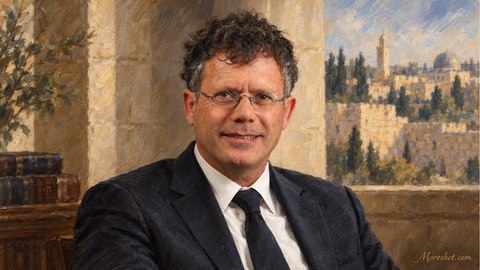
Hugo Preuß
The German Jewish jurist who laid the constitutional foundations of the Weimar Republic
Hugo Preuß (28 October 1860 – 9 October 1925) was a German Jewish jurist, scholar of public law, municipal reformer, and liberal politician. His defining historical achievement came after the collapse of the German Empire, when he was entrusted with preparing the draft from which the Weimar Constitution was developed. Adopted by the National Assembly and brought into force in August 1919, it established the constitutional order of Germany's first republic.
Preuß did not arrive at that task as an abstract theorist. He had spent decades studying constitutional law, municipal government, and local self-government while serving in Berlin civic life. He sought to transform Germany from an authoritarian state, in which political authority flowed from the crown and its bureaucracy, into a democratic state based on popular sovereignty, federal organization, and the rule of law. His career made him one of the most consequential Jewish participants in the institutional development of early twentieth-century European democracy.
Education and the study of public law
Preuß was born in Berlin, then the capital of the Kingdom of Prussia, to Levin Preuß, the Jewish owner of a lithography business, and Minna, née Israel. His father died when Hugo was very young. In 1863 his mother married Leopold Preuß, her late husband's brother and a prosperous grain merchant. Raised in western Berlin, Hugo began university studies in 1878 at Berlin and Heidelberg. He studied law and political science, supplemented by history and philosophy—a combination that encouraged him to understand the state as both a legal structure and a product of historical development.
In 1883 he passed the first state examination in law and received a doctorate in law from the University of Göttingen. After a period of legal training, he chose an academic career in 1886. His study Gemeinde, Staat, Reich als Gebietskörperschaften, examining municipalities, states, and the Reich as territorial public bodies, earned him his habilitation in 1889 and enabled him to lecture at the University of Berlin.
Although his scholarship was respected, his Jewish background and democratic-liberal convictions obstructed his advancement at the conservative university. He did not receive a full professorship until 1906, when he joined the newly founded Berlin School of Commerce. He taught there through 1918 and became its head that year. His experience reflects both the prominence achieved by educated Jews in German intellectual and public life and the barriers that continued to restrict them despite recognized professional merit.
The city as a school of democracy
For Preuß, democracy was not built only in a national parliament. It began in towns and cities, where citizens encountered public institutions in daily life and could assume responsibility for shared affairs. Local self-government therefore occupied a central place in both his scholarship and his public service.
In 1895 he joined the municipal representative body of Charlottenburg, then an independent city and later part of Berlin. From 1910 to 1918 he served as an honorary city councillor for the Progressive People's Party. In that role he contributed to planning and reform work that helped prepare the way for the Greater Berlin Act. Enacted in 1920, that law brought Berlin together with surrounding cities, towns, and communities to form a new metropolitan structure.
His 1906 work Die Entwicklung des deutschen Städtewesens traced the development of German urban government. In this and other writings on municipal law, city administration, and Prussian reform, Preuß treated local autonomy as a practical foundation of constitutional government. It dispersed authority, cultivated civic responsibility, and connected political rights to the everyday work of governing. His later constitutional proposals were thus grounded in institutional experience rather than theory alone.
From an authoritarian state to a people's state
Preuß ran unsuccessfully for the Reichstag in 1912, but continued to exert influence through teaching, writing, and municipal service. In the widely read Das deutsche Volk und die Politik, published in 1915, he argued that Germany had to move from an authoritarian state to a people's state. Constitutional reform, in his view, required more than adjusting administrative machinery: it meant relocating the source of legitimate authority to the citizenry.
The fall of the empire in November 1918 suddenly turned that argument into an immediate program of government. On 14 November, only days after Emperor Wilhelm II's abdication was announced, Preuß published an appeal urging the middle classes to accept the new political reality and cooperate in creating a republic. The next day Friedrich Ebert, head of the revolutionary government, appointed him state secretary in the Interior Ministry. Under the administrative conventions inherited from the empire, he functioned as the ministry's senior official and head.
The Council of the People's Deputies asked Preuß to prepare a draft constitution for the new republic. That same month he helped found the German Democratic Party, which supported a liberal parliamentary system. His selection as constitutional draftsman recognized a rare combination: command of public law, direct experience in municipal government, and a long record of advocating democratic reform.
Drafting the Weimar Constitution
Preuß built his draft around three central principles: political authority belonged to the people; Germany should be organized on a federal basis; and the Reich should be a democratic Rechtsstaat—a state governed by law—within the international community. These principles were intended to replace the imperial constitutional order, under which the national government was not fully dependent on a parliamentary majority and the constituent states, particularly Prussia, retained extensive power.
On 13 February 1919 Preuß became Reich Minister of the Interior in the republic's first elected government, led by Philipp Scheidemann. He served until 20 June, when the government resigned in protest over the Treaty of Versailles. Gustav Bauer's succeeding government appointed him commissioner for constitutional affairs, allowing him to continue assisting the constitution-making process. The Weimar Constitution was approved by the National Assembly and entered into force on 14 August 1919.
The adopted constitution was not simply Preuß's original text. The governments of the constituent states resisted his proposed territorial reorganization of the Reich. His preference for a short statement of classical civil liberties gave way to the assembly's broader catalogue of rights, and he was unable to transform the chamber representing the states to the extent he had intended.
Nevertheless, his ideas substantially shaped the republic's institutional framework and the relationship among parliament, government, the states, and the Reich president. Preuß supported a strong elected president with the power to dissolve the Reichstag and with emergency authority under Article 48. He regarded this office as a democratic mechanism for resolving political deadlock and returning disputes to the electorate. Later events made those powers central to historical assessments of the Weimar system's vulnerabilities. His constitutional legacy therefore matters in two connected ways: as a pioneering effort to construct a democratic republic and as a continuing source of study about the safeguards needed to balance effective government, civil liberty, parliamentary authority, and emergency power.
Defending and explaining the republic
Preuß remained active after the constitution came into force. He served in the Constituent Assembly of the Free State of Prussia in 1919–1920 and then in the Prussian Landtag until 1925. He also participated in the Reichsbanner Schwarz-Rot-Gold, an organization formed to defend the republican constitutional order.
His books and essays sought to explain the new system, provide it with intellectual foundations, and encourage a republican political culture. Among his most important works were:
- Gemeinde, Staat, Reich (1889), on the legal structure of municipalities, states, and the Reich.
- Die Entwicklung des deutschen Städtewesens (1906), a study of the development of German urban government.
- Das deutsche Volk und die Politik (1915), his case for replacing authoritarian rule with a people's state.
- Deutschlands republikanische Reichsverfassung and Vom Obrigkeitsstaat zum Volksstaat (both 1921), examining the republican constitution and the political transformation it represented.
- Um die Weimarer Reichsverfassung (1924), part of his continuing defense and interpretation of the Weimar constitutional settlement.
Further collections appeared after his death, including Staat, Recht und Freiheit, assembled by Theodor Heuss. In the twenty-first century, the Hugo Preuß Society undertook a multivolume scholarly edition of his writings. The project reflects the continued relevance of his work to historians of law, political thought, and urban government.
Jewish identity, citizenship, and public service
Preuß acted primarily as a German citizen and liberal constitutional lawyer, but his Jewish identity materially affected both his career and the public reception of his work. It was among the obstacles to his academic advancement under the empire. After the establishment of the republic, antisemitic opponents exploited the fact that its principal constitutional draftsman was Jewish and disparaged Weimar as a Jewish republic.
That history gives his career particular significance within the story of European Jewry. Preuß was not a peripheral observer of German political life; he worked at the center of an attempt to build a new state. He brought Jewish participation in law and scholarship into one of the country's defining institutional moments and sought a constitutional citizenship that did not depend on religious origin. His experience embodies both the depth of German Jewish contributions to public culture and the fragility of Jewish integration in the face of organized antisemitism.
Family, death, and remembrance
In 1889 Preuß married Else Liebermann, daughter of Carl Liebermann and a relative of the painter Max Liebermann and historian Felix Liebermann. Hugo and Else had four sons. One died in childhood; the others were Ernst, Kurt, and Jean, also known as Hans.
Preuß died in Berlin on 9 October 1925, shortly before his sixty-fifth birthday. He was buried at the Urnenfriedhof Gerichtsstraße in Berlin-Wedding. In 1952 Berlin designated his grave as a grave of honor. That civic recognition, together with the continuing publication and study of his writings, preserves his standing as a major thinker and practitioner of German democratic constitutionalism.
Why this legacy belongs in Moreshet
Hugo Preuß merits a prominent place in Moreshet because his central achievement was an institutional act with lasting historical consequences. He converted decades of thought about law, cities, and citizenship into the foundational draft for Germany's first democratic constitution. Even where the National Assembly altered his proposals, his work established the framework for deciding how public authority would be legitimized, how power would be divided within a federation, and how a republican government would operate under law.
His life also preserves an essential chapter of Jewish history. Despite antisemitic barriers, a German Jewish scholar reached a position of exceptional public responsibility and helped design institutions intended to provide equal political citizenship. Moreshet.com records Preuß not merely as a former minister, but as a representative of German Jewry's profound contribution to European law and public life—and as a figure whose work still informs the wider human debate over how constitutions can establish, sustain, and protect democracy.