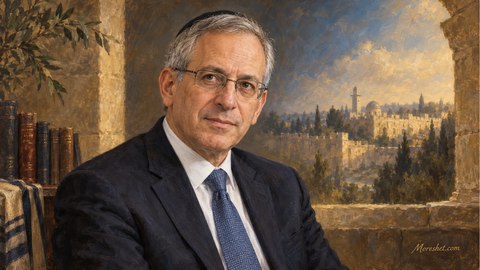
Yoel Zussman
Israel’s fourth Supreme Court president and the jurist who made civil procedure a foundation of practical justice
Yoel Zussman (24 October 1910–2 March 1982) was one of the jurists who helped shape Israel’s legal system during its formative decades. He served on the Supreme Court for more than a quarter-century, led it as its fourth president from 1976 to 1980, taught generations of lawyers, and wrote foundational texts used by judges, advocates, and students. Israel awarded him the Israel Prize in jurisprudence in 1975.
Zussman’s most enduring professional influence lies in civil procedure. He treated procedural rules not as a collection of technical obstacles but as the structure that allows courts to identify the real dispute, protect the parties, and reach a fair and workable result. Through his judgments, books, and teaching, he joined doctrinal precision with close attention to the practical consequences of law.
From Kraków to Mandatory Palestine
Born Yoel HaCohen-Zussman in Kraków, then part of the Austro-Hungarian Empire and later Poland, he studied law in Frankfurt, Heidelberg, and Berlin. He received a doctorate in law from Heidelberg University in 1933. This education gave him a firm grounding in continental European legal traditions at a time when Europe’s institutions and assumptions were undergoing profound change.
Zussman immigrated to Mandatory Palestine in 1934. The British Mandate authorities admitted him to legal practice in 1937, and he began working as a lawyer. He later pursued further study at the University of Cambridge and received an LLB from the University of London. His education therefore brought together continental legal thought and the English legal tradition that strongly influenced the courts of Mandatory Palestine and, later, Israeli law.
Legal service during Israel’s founding
Zussman joined the Haganah in 1941. With the outbreak of the War of Independence, he served as a military prosecutor in the newly established Israel Defense Forces and as deputy chief military prosecutor. His work placed him among the lawyers responsible for developing a functioning legal framework for a new national army under the pressure of war.
In 1949 he was appointed to the Tel Aviv District Court. This was more than a personal career transition: Israel’s young judiciary was then adapting inherited legal traditions to the needs of a sovereign state. Judges of Zussman’s generation had to administer existing law while helping to establish the practices, authority, and professional culture of new Israeli institutions.
More than twenty-five years on the Supreme Court
Zussman began serving on the Supreme Court in temporary appointments in 1951 and became a permanent justice on 11 December 1953. On 7 October 1970, he was appointed permanent acting president of the Court. After Shimon Agranat retired, Zussman became Israel’s fourth Supreme Court president on 8 September 1976. He held the presidency until retiring for health reasons on 29 February 1980 and was succeeded by Moshe Landau.
His long tenure spanned crucial stages in Israel’s institutional development. Courts were addressing the growth of public administration, mass immigration, electoral law, and constitutional questions for which legislation did not always provide explicit answers. Zussman helped develop an independent body of Israeli law grounded in careful legal analysis, institutional responsibility, and an understanding of how judicial rulings operate in practice.
Public responsibilities beyond the courtroom
Zussman was entrusted with public duties of exceptional sensitivity. In 1959 he chaired the Central Elections Committee for the Fourth Knesset, placing him in a role directly connected to the orderly administration of democratic elections. In 1969 he led the commission that investigated the circumstances of the fire at the Al-Aqsa Mosque. His appointment to examine an event with religious, domestic, and international consequences reflected confidence in his judgment and his ability to conduct a disciplined legal inquiry amid intense public concern.
The idea of a self-defending democracy
One of the decisions most closely associated with Zussman is the Supreme Court’s 1965 ruling in Yardor v. Central Elections Committee for the Sixth Knesset. The case concerned the exclusion of the Socialist List, associated with the Al-Ard movement, from an election. Zussman joined the majority in upholding the exclusion even though the election statute then in force did not expressly set out such a power.
His opinion articulated the concept of a self-defending democracy: a democratic state is not required to use its own institutions to facilitate the destruction of its existence. Drawing on fundamental principles, natural law, and the experience of postwar German constitutional law, he gave Israeli legal language to a problem that democracies continue to face—the tension between open political participation and protection of the democratic order itself. The phrase and the reasoning behind it became an enduring point of reference in Israeli constitutional and public debate.
Civil procedure as an instrument of justice
Zussman’s deepest technical contribution was to civil procedure. He understood that procedural safeguards protect substantive rights: a person’s legal entitlement has limited value if the court process does not provide a fair opportunity to present it. At the same time, he believed litigation should focus on the genuine issues in dispute, avoid fruitless proceedings, and move toward resolution as efficiently as fairness permits.
His approach was practical rather than merely formal. Zussman emphasized that judges should consider whether the result they were about to announce could actually work. An unworkable solution might signal a defect in the reasoning that produced it. This insistence on testing doctrine against consequences became a defining feature of his judicial outlook, joining legal consistency with procedural fairness and common sense.
Books that organized a developing legal system
Zussman wrote important works on bills and negotiable instruments and on arbitration. His central achievement as an author, however, was Seder Ha-Din Ha-Ezrahi, his comprehensive work on civil procedure. It assembled and analyzed legislation and case law in a systematic framework, giving Israel’s legal community a practical guide to both procedural rules and their underlying purposes.
The work appeared in seven editions. Its final three editions were published after Zussman’s death under the editorship of Justice Shlomo Levin and with the involvement of Zussman’s sons. That continued revision is evidence of the book’s status as a living professional tool rather than merely a historical treatise. It helped generations of practitioners navigate scattered rules while keeping sight of the larger objective: a fair, focused, and efficient judicial process.
Teaching the next legal generation
Alongside his judicial work, Zussman served as an adjunct professor at the Hebrew University of Jerusalem’s Faculty of Law. His students included jurists who later assumed major roles in Israeli law and public life. Among them were Yitzhak Zamir, who became attorney general and a Supreme Court justice, and Gabriela Shalev, who became a leading legal scholar and an Israel Prize recipient.
Teaching extended Zussman’s influence beyond the judgments issued in his name. Through his lectures, books, and professional example, he passed on a disciplined method of legal analysis and a view of procedure, institutional responsibility, and practical results as mutually reinforcing parts of justice.
Recognition, final years, and commemoration
In 1975 Zussman received the Israel Prize in jurisprudence, recognizing his contributions to legal scholarship, teaching, and the judiciary. He retired as Supreme Court president eight months before reaching the age of seventy because of ill health. He died on 2 March 1982 at the age of 71 and was buried at Kiryat Shaul Cemetery.
His sons, Amnon and Amir, also became lawyers and completed legal clerkships at the Supreme Court. An institute for advanced judicial studies was established in his memory in 1984—an especially fitting form of commemoration for a jurist whose career united judging, professional education, and the continuing development of legal institutions.
Why this legacy belongs in Moreshet
Yoel Zussman belongs in Moreshet because his work reached into the institutional foundations of Israeli life. He contributed to military justice at the state’s founding, served on the Supreme Court for decades, led the Court as its fourth president, accepted sensitive public assignments, and helped frame Israel’s lasting discussion of how a democracy may defend its own existence.
His legacy is equally visible in the everyday administration of justice. His civil-procedure scholarship gave generations of Israeli lawyers a systematic means of pursuing fair and efficient litigation, while his students went on to influence the courts, legal education, and public service. For Moreshet.com, his life demonstrates how rigorous scholarship, teaching, and sustained institutional service can strengthen the rule of law and the resilience of Israeli society. His importance rests not on office alone, but on the ideas, practices, institutions, and legal professionals he helped shape.