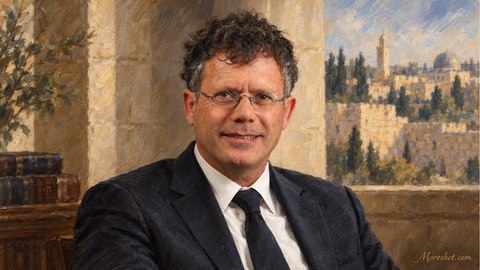
Moshe Lador
Former State Attorney of Israel whose public career helped shape the enforcement of law in cases of national importance
Moshe Lador (born November 4, 1944) is an Israeli lawyer who served as Israel’s tenth State Attorney from 2007 to 2013. Over several decades in the State Attorney’s Office, he worked as a criminal prosecutor, handled major economic and public-corruption proceedings, led the Jerusalem District Attorney’s Office, and ultimately headed Israel’s national prosecution service.
Lador’s significance reaches beyond the prominent defendants and cases associated with his career. His work illuminates the demanding role of public prosecution in a Jewish and democratic state: representing the public interest in court, enforcing the law in matters involving powerful institutions and officeholders, assessing whether evidence justifies prosecution, and operating within a judicial system that protects defendants’ rights and subjects prosecutorial decisions to scrutiny.
From Kibbutz Matzuva to law and public administration
Lador was born and raised at Kibbutz Matzuva in the Western Galilee. During his childhood, he accompanied his parents on assignments in Australia and the United States. He later earned a bachelor’s degree in law from the Hebrew University of Jerusalem and a master’s degree in public administration from Harvard University. He was also a member of the inaugural class of the Wexner Foundation’s leadership development program.
He completed his legal internship in 1972–1973 and worked in private practice in 1974, representing hotelier Haim Schiff. That early experience preceded a long career in government service, where criminal law and the protection of the public interest became the central concerns of his professional life.
A career in the State Attorney’s Office
Criminal prosecution and the bank shares trial
Lador joined the State Attorney’s Office in 1978. As a criminal prosecutor, he handled matters involving taxation, fraud, and violence. Among the proceedings in which he appeared were the trial of right-wing activist Yoel Lerner and the prosecution of members of the Lifta Gang. This work exposed him to varied forms of criminal conduct and to the practical responsibility involved whenever the state exercises its prosecutorial power.
A defining assignment came in 1991–1993, when Lador served as a prosecutor in the trial of bankers arising from the manipulation of Israeli bank shares. The underlying conduct had contributed to the 1983 bank stock crisis, which affected the capital market, the stability of major financial institutions, and the savings of ordinary Israelis. The resulting proceeding demonstrated how behavior with economy-wide consequences could also raise questions of individual criminal responsibility.
Lador later examined the case in an essay whose translated title is “The Bank Shares Manipulation Affair—When a Macroeconomic Phenomenon Finds Itself in the Defendant’s Dock.” Published in the Hebrew legal collection Roots in Law, the essay preserved professional knowledge from one of Israel’s most consequential financial prosecutions and explored the difficult intersection of economics, regulation, and criminal enforcement.
Jerusalem District Attorney
In 1994, Lador was appointed Jerusalem District Attorney. The position carries responsibility for significant criminal and civil litigation as well as the management of a major district office. During his tenure, he led the case against industrialist Eli Hurvitz. Hurvitz was convicted in the District Court and later acquitted by the Supreme Court—a result that underscores the distinction between a prosecutor’s decision to bring a case and the judiciary’s authority to determine guilt on appeal.
Lador was also among the officials involved in decisions concerning the Trade Bank embezzlement affair, one of the gravest cases of its kind uncovered in Israel. In other matters, he supported closing the Amedi and gifts investigations concerning Benjamin Netanyahu; Attorney General Elyakim Rubinstein ultimately closed the cases. These differing decisions illustrate an essential part of senior prosecutorial responsibility: public service requires not only bringing charges when the legal and evidentiary standards are met, but also declining prosecution when they are not.
Lador completed his term as Jerusalem District Attorney in 2004 and practiced law privately for a period afterward.
State Attorney of Israel
In November 2007, a search committee chaired by the attorney general selected Lador to become State Attorney. He served from December 17, 2007, through December 16, 2013. During those six years, he directed Israel’s national prosecution system at a time marked by unusually sensitive proceedings involving senior political and professional figures.
Enforcing the law in cases involving public power
During Lador’s tenure, prosecutors brought cases against senior officeholders, including former finance minister Abraham Hirchson and former prime minister Ehud Olmert. Hirchson’s prosecution resulted in conviction and imprisonment. Proceedings involving Olmert extended across several matters and years and produced differing outcomes at various stages. The pursuit of such cases gave practical meaning to a central principle of the rule of law: high office does not place a person beyond investigation or judicial process, while every defendant, however prominent, remains entitled to the law’s protections.
Lador also led the prosecution of attorney Jacob Weinroth, who was acquitted by the Tel Aviv District Court. That outcome is an important part of the factual record. It reflects the structure of criminal justice in which prosecutors present evidence and argument, but courts independently decide whether guilt has been proved.
Institutional independence and the structure of law enforcement
Lador regarded the professional independence of the prosecution service as an important part of his office. In November 2009, he publicly opposed Justice Minister Yaakov Neeman’s proposal to divide the attorney general’s responsibilities. Lador argued that institutionally separating government legal advice from national prosecution could weaken law enforcement and that a structural change of such magnitude required thorough professional and public consideration.
His intervention formed part of Israel’s continuing debate over how best to combine prosecutorial independence, accountability, external review, and democratic oversight. He also represented the prosecution’s position in discussions about the proposed powers of the commission established to review prosecutors and state representatives in court. His positions were not universally accepted, but they placed consequential institutional questions before the public: who supervises prosecutors, how their professional independence is protected, and how confidence in their decisions can be sustained.
Teaching, writing, and public engagement
After completing his term as State Attorney, Lador shared his accumulated experience with law students and professional audiences. He taught and lectured on the theoretical and practical dimensions of conducting enforcement proceedings, including at the Interdisciplinary Center Herzliya, now Reichman University, and through other lecture programs. Teaching this subject helps future lawyers understand not only statutes and judicial decisions but also the judgment, restraint, preparation, and ethical responsibility required when exercising enforcement powers.
Lador continued to write and speak publicly about the prosecution service, the legal system, and the rule of law. In May 2019, he joined former senior figures from the State Attorney’s Office and the attorney general’s legal apparatus in signing a public statement opposing an override clause and an expansion of parliamentary immunity. His later public interventions reflected his strong commitment to the independence of legal institutions, while also becoming part of Israel’s broader and often sharply contested debate over law and government.
In 2014, the Movement for Quality Government in Israel named Lador a Knight of Quality Government. The recognition followed a public career in which he had carried responsibility for complex prosecutions and for the management of one of Israel’s central law-enforcement institutions.
Public prosecution as a test of responsibility
A public prosecutor’s career cannot be measured only by convictions. It must also be assessed through decisions not to prosecute, the willingness to bring difficult cases before an independent court, respect for acquittals, and the capacity to defend institutional principles under public pressure. Lador’s record encompasses all of these: cases that ended in convictions, cases that ended in acquittals, investigations that were closed, and debates over the organization and oversight of the justice system.
That accumulated experience has particular historical value in Israel, where legal institutions must contend simultaneously with ordinary crime, complex financial misconduct, alleged abuses of public office, and intense political scrutiny. Lador’s career sits at the intersection of law, public administration, and democracy in practice—the point at which abstract commitments to equality and accountability become concrete decisions affecting institutions and citizens.
Why Moshe Lador’s legacy belongs in Moreshet
Moshe Lador merits inclusion in Moreshet because his work records an important chapter in the development of Israel’s public legal service and the enforcement of the rule of law. His participation in the bank shares trial, leadership of the Jerusalem District Attorney’s Office, and six years as State Attorney placed him at the center of proceedings that tested the relationship between economic power, public authority, and legal accountability.
For Israeli society and the wider Jewish story of state-building, establishing public institutions is only the beginning. Those institutions must cultivate a durable civic culture in which senior officials remain subject to law, prosecutors’ decisions can be tested by independent courts, and defendants’ rights coexist with protection of the public. Lador’s professional record forms part of that continuing effort.
By preserving his story, Moreshet.com helps readers understand the demanding work behind the principle of equality before the law and the influence of career public lawyers on Israel’s institutional life. Moreshet presents not merely a sequence of appointments and famous cases, but a career showing how public service, legal expertise, and the education of future practitioners can create a lasting institutional legacy.