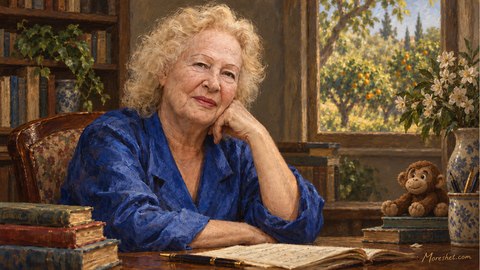
Shulamit Lapid
A novelist and playwright bringing women’s voices into Israeli history and contemporary fiction
Shulamit Lapid, born in 1934, is an Israeli novelist and playwright whose work spans historical fiction, detective novels, short stories and theatre. Gei Oni and the Lizzie Badihi mysteries occupy very different settings, yet both make room for people whose place in society cannot be taken for granted. Her contribution includes an expansion of the perspectives, genres and experiences available to a broad Hebrew readership.
A life among languages and stories
Lapid was born in Tel Aviv, the daughter of journalist, writer and translator David Giladi. Her early environment was closely connected with journalism and cultural life. She later studied Middle Eastern subjects and English literature at the Hebrew University, while periods abroad brought further contact with different languages and societies.
Her first book, the story collection Mazal Dagim, appeared in 1969. Alongside prose, she developed a substantial interest in drama, including plays such as The Inheritance and Abandoned Property. Theatre offered a form in which relationships and the force of memory could be examined through speech and direct encounters between characters.
Women within the story of settlement
Gei Oni returns to the First Aliyah and the beginnings of Rosh Pinna. Through a female protagonist’s experience, the historical setting becomes a world of family, livelihood, decisions and personal vulnerability. This approach expands the story of settlement beyond institutions and public milestones to include the practical and emotional conditions of daily life.
Its sequel, Havat Ha’alamot, continues the engagement with early Hebrew society in the land and with women’s roles within it. These are historical novels, combining research with invention. Their literary form allows readers to enter a period through the texture of living and to consider the private consequences of a much larger public transformation.
Lizzie Badihi and a local detective tradition
In Local Paper, published in 1989, Lapid introduced the journalist Lizzie Badihi. Her work for a Beersheba newspaper and her determination to investigate give the mysteries a strongly local perspective. The series helped establish Hebrew detective fiction as a form capable of exploring Israeli society from within.
Lapid has also written about family memory and the Tel Aviv of her childhood, including in Ve’ulai Lo Hayu. Her service as chair of the Hebrew Writers Association during the 1980s added a public dimension to her literary activity. Across these different settings and forms, the work reflects sustained curiosity about how people understand their circumstances and claim room to act.
Why Shulamit Lapid belongs in Moreshet
Lapid belongs in Moreshet at Moreshet.com because she enriched the ways Israeli readers encounter both their history and their contemporary society. She gave women a central presence in historical fiction, created an enduring local detective figure and brought personal memory into literary form. Her contribution joins narrative pleasure with the discovery of a different angle of vision, allowing people and experiences outside the expected centre to become essential parts of the story.