Shaul Tchernichovsky
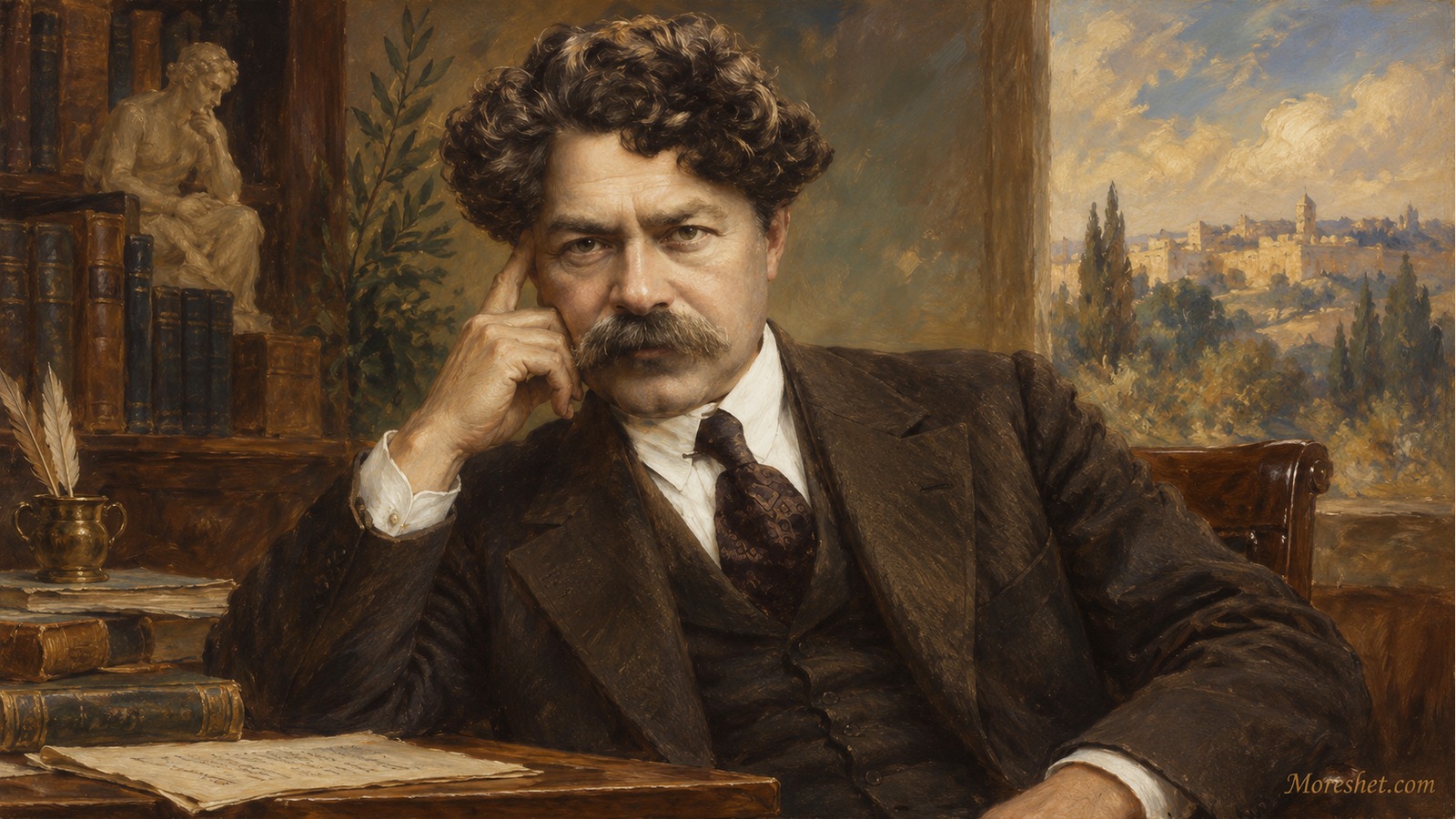
Shaul Tchernichovsky — AI-generated artistic portrait · Moreshet.com
A poet, physician and translator who widened the horizons of Hebrew culture
Shaul Tchernichovsky (1875–1943) was a central poet of the Hebrew literary revival, a physician and a translator of wide cultural range. His work brought landscape, physical life, Jewish memory and world literature into a richly varied poetic language. He helped expand Hebrew’s expressive resources at a time when it was developing a renewed public life, demonstrating that it could sustain both intimate experience and ambitious literary form.
Poetry beside a working medical life
Tchernichovsky was born in Mikhailovka in the southern Russian Empire, in present-day Ukraine. His early world included Hebrew learning, Russian reading and village life. Further education in Odesa introduced additional languages and intellectual possibilities. His collection Hezyonot U-Manginot established a distinctive young poetic voice.
He also studied medicine in Heidelberg and Lausanne and continued working as a physician throughout his life. After settling in Mandatory Palestine in 1931, he served as a school doctor in Tel Aviv. Medicine and poetry belong together in this portrait: both involved close attention to human beings, bodily existence and the conditions in which people live.
Bringing different inheritances into Hebrew
His poetry includes ballads, idylls, sonnets and ambitious sonnet sequences. Several idylls draw on childhood and Jewish communal life, including relationships with non-Jewish neighbours. Carefully observed detail is joined to strong musical and formal organization, allowing an ordinary scene to acquire considerable emotional depth.
Tchernichovsky’s attraction to Greek culture, evident in Before a Statue of Apollo, coexists with a sustained engagement with biblical figures and Jewish history. In At En-Dor, he returned to King Saul at a moment of isolation and impending catastrophe. These cultural encounters broaden the resources of Hebrew poetry rather than requiring it to surrender one inheritance for another.
Translation and a language of hope
His translations of Homer brought foundational Greek literature to Hebrew readers. This was also an act of cultural construction, enlarging the library available within a language undergoing renewal. His involvement with the Hebrew Language Committee and with professional terminology formed another part of his contribution to a language capable of serving many areas of life.
Ani Ma’amin, also known as Sahaki Sahaki, became a lasting expression of faith in human possibility. Yet hope in his work is accompanied by an awareness of suffering. Poems addressing persecution, loss and the Jewish historical experience, including Re’i Adama, place that confidence beside the knowledge of what people can endure. The result is an affirmative voice with emotional and historical weight.
Why Shaul Tchernichovsky belongs in Moreshet
Tchernichovsky belongs in Moreshet at Moreshet.com because he helped build a Hebrew culture rooted in Jewish experience and open to the achievements of humanity. His poems and translations enriched the literary language, while his wider linguistic work supported its practical renewal. His heritage remains present in the possibility of joining historical memory with curiosity, beauty and a generous belief in the human capacity to create.