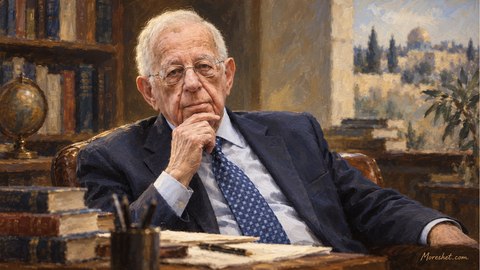
Joseph Klausner
A scholar and editor who helped build the institutions of Hebrew intellectual life
Joseph Klausner (1874–1958) was a historian, literary scholar and editor who helped connect the Hebrew cultural revival with the institutions needed to sustain it. His work ranged from modern Hebrew literature to the Second Temple period, and from critical essays to a major encyclopedia. He treated Hebrew as a language in which a society could conduct research, debate ideas and organize knowledge as well as produce imaginative writing.
From Odesa to Jerusalem
Born in Olkeniki, in the region of present-day Lithuania, Klausner studied at Heidelberg University and became active in education and literary life in Odesa. He immigrated to Mandatory Palestine aboard the Ruslan in 1919, joining a movement of writers and intellectuals who would help shape the emerging Hebrew cultural centre.
When the Hebrew University opened in 1925, he was among its first teaching faculty and led its work in Hebrew literature. He later occupied the chair devoted to the history of the Second Temple period. The combination reflects a broad intellectual undertaking: modern writing and ancient history could both contribute to a community’s informed understanding of itself.
Understanding the development of a literature
In his History of Modern Hebrew Literature, Klausner examined writers and changes that shaped the transition into modernity. Such a project involves more than arranging books in chronological order. It asks how styles, subjects and reading communities develop, and how an inherited language becomes the medium of new experience.
His long editorship of Ha-Shiloah also made him a participant in the literary world he studied. As editor and critic, he helped determine which new writing reached readers and contributed to arguments about its value. His influence therefore operated both through scholarship and through the daily work of cultural publication.
Historical research and public knowledge
Klausner’s research included the Second Temple period and the development of messianic ideas. His study of Jesus placed the subject within Jewish historical circumstances and reached readers outside Hebrew. It brought historical inquiry to an area long shaped by religious controversy and established another dimension of his international scholarly presence.
He was also active in the Hebrew Language Committee and in the founding of the Academy of the Hebrew Language. As the first editor-in-chief of the Encyclopaedia Hebraica, he helped construct an extensive public resource. Terminology, university teaching and encyclopedia editing belong to the same practical effort: enabling a modern society to learn and reason in Hebrew. In 1958, he received the Israel Prize in Jewish studies.
Why Joseph Klausner belongs in Moreshet
Klausner belongs in Moreshet at Moreshet.com because he helped build the intellectual tools and institutions through which Jewish culture could be studied in Hebrew. His scholarship, editing and linguistic activity gave cultural renewal a durable infrastructure. His contribution remains visible wherever readers approach their literature and history as subjects for serious inquiry, carrying inherited knowledge into an informed conversation about collective identity.