Sami Michael
Baghdad-born novelist whose writing enriched Hebrew literature with Iraqi Jewish memory, Haifa's shared life and a commitment to human dignity
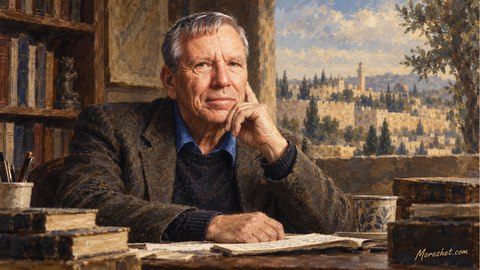
Sami Michael (1926–2024) was an Israeli novelist born in Baghdad whose work brought Iraqi Jewish memory and the complexity of shared life in Israel to Hebrew readers. His characters seek love, livelihood, belonging and dignity within social and national boundaries that can constrain their choices. Haifa, where he lived and worked for many years, was both a home and a literary setting. Alongside his fiction, he was a prominent public advocate for human rights and equal opportunity.
Two languages and a life of migration
Born Kamal Salah, Michael was educated in Baghdad's Jewish school system. As a young man he was active in Iraq's underground communist movement. Political persecution led him to escape to Iran in 1948, and he reached Israel in 1949. In Haifa he wrote for the Arabic-language press before developing his literary career in Hebrew. Arabic remained an important part of his cultural knowledge and imaginative world.
For decades he worked for Israel's hydrological service. Employment and encounters with people across the country continued alongside his writing, keeping his work connected to ordinary life. His first Hebrew novel, All Men Are Equal—But Some Are More, appeared in 1974 and addressed immigrants in transit camps and the distance between promised equality and actual opportunity.
Giving an individual life its full scope
Victoria follows a Jewish woman from Baghdad to Israel. Family, class and social restrictions are considered through her desires and resources, allowing the history of a community to become the story of a particular person. She is not absorbed into a general description of an ethnic group or a historical period.
A Trumpet in the Wadi, published in 1987, centres on a relationship between an Arab woman and a Jewish immigrant in Haifa. Neighbourhood spaces, apartments and conversations reveal a city inhabited by different memories and languages. A Storm Among the Palms introduced younger readers to the world of Baghdad's Jews, while Water Kissing Water returned to questions of identity and human encounter.
These books enlarged the range of experience represented in Hebrew. Michael's characters belong to communities, but they also exceed the categories through which others may attempt to understand them.
A wider cultural and public presence
Translations and adaptations for stage and screen extended the reach of his fiction. Readers could encounter Iraqi Jewish history and Israeli society through personal relationships rather than exclusively through political narratives. The books make room for emotional knowledge: how a street feels familiar, how a family remembers and what a person risks in seeking another kind of life.
Michael served as president of the Association for Civil Rights in Israel for twenty-two years, until September 2023, and then as honorary president. This public work continued his concern for human dignity. His literary achievement, however, remains available to readers who may differ over particular political positions. He died in Haifa in April 2024.
Why Sami Michael belongs in Moreshet
Sami Michael belongs in Moreshet at Moreshet.com because he gave rich literary form to Iraqi Jewish heritage and to encounters between cultures in Israel. His work shows how a shared language can grow through attention to another person's story. It preserves memory, broadens identification and adds faces and voices to the Israeli record that had not always received adequate attention.