Meir Shamgar
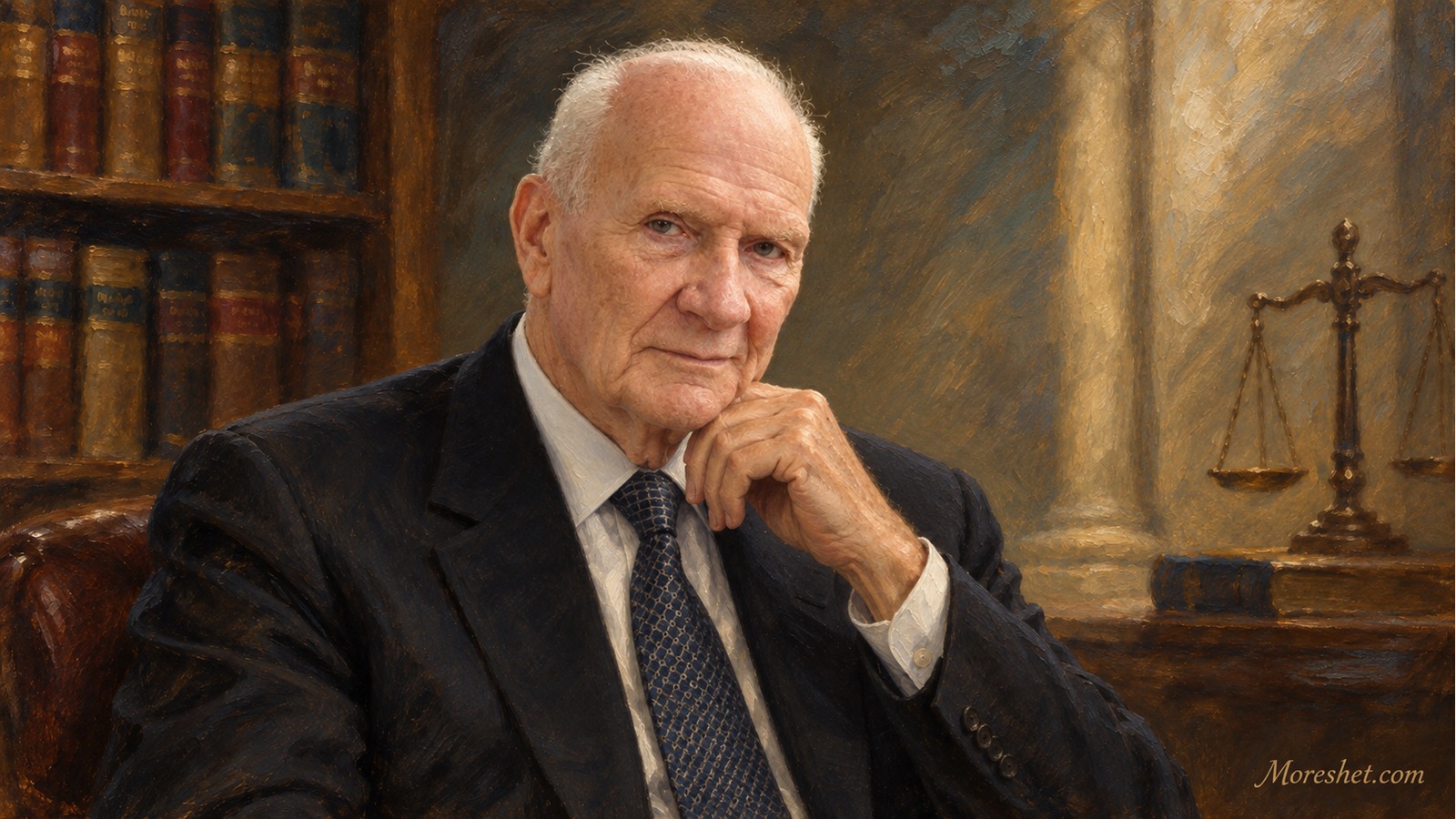
Meir Shamgar — AI-generated artistic portrait · Moreshet.com
The Supreme Court president who helped build Israel’s legal institutions and placed the rule of law at the center of public service
Meir Shamgar (August 13, 1925–October 18, 2019) was one of the principal architects of Israel’s legal system. Over more than four decades of public service, he worked at the highest levels of the Military Advocate General’s Corps, the Attorney General’s Office, and the Supreme Court of Israel. In each arena, he did more than administer an existing institution: he helped define its authority, professional standards, and responsibility to uphold the rule of law.
Shamgar served as Military Advocate General from 1961 to 1968, Attorney General from 1968 to 1975, a Supreme Court justice from 1975, and president of the Court from 1983 until his retirement in 1995. His judicial work addressed freedom of expression, protection of journalists’ sources, consent in sexual-offense law, state responsibility, military law, and access to judicial review. After leaving the bench, he continued to serve the country by leading inquiries into some of the most painful security and institutional failures in Israel’s history.
From Danzig to Mandatory Palestine
Shamgar was born Meir Sternberg in the Free City of Danzig, now Gdańsk, Poland. His parents, Dina and Eliezer Sternberg, were Revisionist Zionists who supported Ze’ev Jabotinsky. He immigrated to Mandatory Palestine in 1939, on the eve of the Second World War, and attended the Balfour Gymnasium in Tel Aviv.
In 1943 he joined the Palmach and served in Company D. The following year he joined the Irgun and was arrested by the British authorities. He was among the Irgun and Lehi detainees deported to camps in Africa, spending time in Eritrea with prisoners who included future prime minister Yitzhak Shamir and attorney and politician Shmuel Tamir. While interned, Shamgar continued studying law by correspondence through the University of London and participated in an escape attempt. His early life thus joined the struggle for Jewish independence with sustained study of the rules governing state power.
Following Israel’s establishment in 1948, he returned home, enlisted in the Israel Defense Forces, and served in Jerusalem during the War of Independence. He later studied history and philosophy at the Hebrew University of Jerusalem and completed his legal education. In 1950 he returned to the IDF as a military prosecutor.
Building a professional system of military law
Shamgar became Deputy Military Advocate General in 1956 and Military Advocate General in 1961, eventually attaining the rank of brigadier general. When he received the senior appointment, Prime Minister and Defense Minister David Ben-Gurion asked him to adopt a Hebrew surname; Sternberg became Shamgar.
During his tenure, the Military Advocate General’s Corps developed as a professional legal institution whose purpose was not simply to represent the armed forces, but also to advise commanders and place military action within a framework of law. After the Six-Day War, Shamgar designed the legal infrastructure for Israel’s military administration in the West Bank and Gaza Strip.
He formulated the position that Israel did not accept the full legal applicability of the Fourth Geneva Convention in those territories, while voluntarily undertaking to observe its humanitarian provisions. At the same time, he supported allowing residents of the territories to petition Israel’s High Court of Justice against the authorities. Opening the Court to such petitions had lasting institutional significance: military commanders and government agencies became subject to direct judicial scrutiny, while residents received a legal route through which to challenge state action. The framework Shamgar helped create influenced Israeli public law, IDF practice, and the continuing relationship among security, governmental authority, and individual rights.
Attorney General of Israel
In 1968 Shamgar left the military and became Israel’s Attorney General. He held the office for seven years, serving under prime ministers Levi Eshkol, Golda Meir, and Yitzhak Rabin. His tenure contributed to the standing of the Attorney General as an independent professional authority responsible for advising the government and testing official action against the law.
Among the policies associated with his term was a reduction in the use of administrative stays of criminal proceedings. The approach favored allowing cases to be determined through ordinary legal process rather than halted by executive decision. Although it increased pressure on the courts’ caseload, it reflected a broader commitment to equality before the law and restraint in administrative intervention in criminal justice.
Two decades on the Supreme Court
Shamgar was appointed to the Supreme Court on July 1, 1975. He became permanent acting president under Chief Justice Yitzhak Kahan in 1982 and the Court’s seventh president in November 1983. He retired upon reaching the mandatory retirement age of 70 on August 13, 1995. His nearly twelve years as president constituted the longest presidency in the Court’s history.
As both justice and president, Shamgar viewed the judiciary as responsible not only for resolving individual disputes but also for ensuring that public authorities acted lawfully. His opinions were marked by institutional care and by an effort to formulate principles capable of guiding future judges, officials, and public bodies.
Freedom of expression and journalistic work
Shamgar consistently gave substantial weight to freedom of expression, especially the freedom to criticize public institutions and officeholders. In defamation cases, he argued for meaningful protection of statements made in good faith even when they later proved inaccurate. If every minor factual error exposed speakers and journalists to legal proceedings, he reasoned, citizens could be deterred from voicing criticism. His position did not prevail in every case, and he sometimes wrote in dissent, but it helped shape Israeli debate over the balance between reputation and an open public sphere.
He also gave practical protection to journalism by recognizing a qualified privilege for confidential sources. Under his approach, a journalist could in appropriate circumstances decline to identify a source in court. The privilege was not absolute and could be overridden when weighty interests required disclosure, but its formal recognition strengthened the ability of sources to provide information of public importance without automatic exposure.
Consent, dignity, and legal responsibility
One of the best-known decisions from Shamgar’s presidency arose from the rape case at Kibbutz Shomrat. He made clear that the law should not require a woman to fight physically or demonstrate active resistance before an act could be recognized as rape; the decisive issue was the absence of consent. The ruling helped shift legal attention from how the victim responded to whether the participants had ensured that consent was present.
In the influential tort case ATA v. Schwartz, Shamgar examined the conflict between economic activity and the rights of people harmed by a nuisance. He rejected the idea that calculations of economic efficiency should by themselves determine legal rights and obligations. Yet his detailed engagement with economic analysis helped introduce that mode of reasoning into Israeli legal discussion, making the decision an enduring reference point in the study of tort law.
In 1993 Shamgar headed the five-justice panel that heard John Ivan Demjanjuk’s appeal. The Court found reasonable doubt concerning his identification as “Ivan the Terrible” of Treblinka and acquitted him of the charges dependent on that identification. The ruling demonstrated the criminal law’s demand for proof beyond reasonable doubt even in an emotionally charged case involving crimes of the Holocaust.
National inquiries and public accountability
Shamgar’s reputation for rigor and institutional judgment led governments to entrust him with highly sensitive public inquiries. In 1994, while still president of the Supreme Court, he chaired the state commission established after Baruch Goldstein murdered Muslim worshippers at the Cave of the Patriarchs. The commission also examined law enforcement concerning Israelis in the West Bank and the conduct of the military, police, and Civil Administration. Its recommendations contributed to the establishment of the Israel Police’s Judea and Samaria District and to clearer procedures governing cooperation among the police, IDF, and other security bodies.
After the assassination of Prime Minister Yitzhak Rabin in November 1995, Shamgar was appointed to lead the state commission investigating the murder and Israel’s protective-security system. The commission identified grave failures by the Shin Bet, including serious intelligence shortcomings. Its work led to substantial changes in the methods of the agency’s VIP Protection Unit and to much stricter security arrangements for Israeli leaders.
In 1997 he chaired a public committee established after the Bar-On–Hebron affair to examine the selection and tenure of the Attorney General. In 2000 he led a military commission investigating whether diving in the polluted Kishon River and nearby waters had contributed to illnesses among IDF personnel. Although a definitive scientific causal link had not been established, Shamgar wrote a minority opinion arguing that, as a matter of legal and public responsibility, the state and the IDF should accept responsibility for the harm suffered by soldiers ordered to dive there.
Jewish responsibility, writing, and public recognition
Shamgar understood Israel as bearing responsibility toward Jewish communities beyond its borders. As honorary president of the public committee for the remaining Jews of Ethiopia, he urged the government to complete their immigration and absorption. He framed the matter not merely as a budgetary question but as a Jewish and Zionist obligation. In 2000 he also headed the public council for the Jabotinsky commemorative year, which organized events devoted to the Zionist leader whose ideas had influenced Shamgar’s family and early environment.
His writings addressed judicial precedent, legal certainty, human dignity, and violence in Israeli society. In 2015 he published his autobiography, Not Finished: Chapters of a Life, recounting a journey that began in Danzig, continued through British detention camps in Africa, and reached the leadership of Israel’s judiciary.
In 1996 Shamgar received the Israel Prize for special contribution to society and the State of Israel. His other distinctions included the Zeltner Prize for Legal Research, the Ben-Gurion Prize, the Israel Bar Association Prize, the Israel Democracy Institute’s Democracy Award, and recognition from the Menachem Begin Heritage Center for his Irgun service and dedication to the rule of law.
Shamgar had three children with his first wife, Geula Neve, who died in 1983. He later married retired judge Michal Rubinstein Shamgar, a former vice president of the Tel Aviv District Court. Meir Shamgar died on October 18, 2019, at the age of 94, and was buried at Har HaMenuchot in Jerusalem.
A legacy carried by institutions
The ways in which Shamgar has been commemorated reflect the breadth of his influence. The road leading to the Supreme Court in Jerusalem bears his name, as do a square and avenue near the Magistrates’ Court in Eilat. An elementary school named for him opened in Holon. Tel Aviv University established the President Meir Shamgar Center for Digital Law and Innovation to study the meeting point of law, technology, and society. Linking his name to education and emerging legal challenges presents his legacy not merely as a record of institutions already built, but as a foundation for questions the legal system must still confront.
Why Meir Shamgar belongs in Moreshet
Meir Shamgar merits a central place in Moreshet because his influence can be found in institutions that shape daily life in Israel: the IDF, the government, the courts, the police, and the security services. He helped build the system of military law, strengthened the professional standing of the Attorney General, led the Supreme Court for the longest presidential term in its history, and developed practical protections for expression, journalism, consent, and access to judicial review.
His story also connects major chapters of modern Jewish and Israeli history: immigration on the eve of the Holocaust, the underground struggle, the War of Independence, and the construction of the state’s governing institutions. In times of national crisis, commissions under his leadership turned tragedy and institutional failure into changes in law enforcement and protective security. Preserving his life and work on Moreshet.com is therefore more than recording the career of a distinguished judge. It documents how a Jewish and democratic state sought to restrain power, determine responsibility, and require those who exercise public authority to remain accountable to law.