Jessica Sarah Tisch
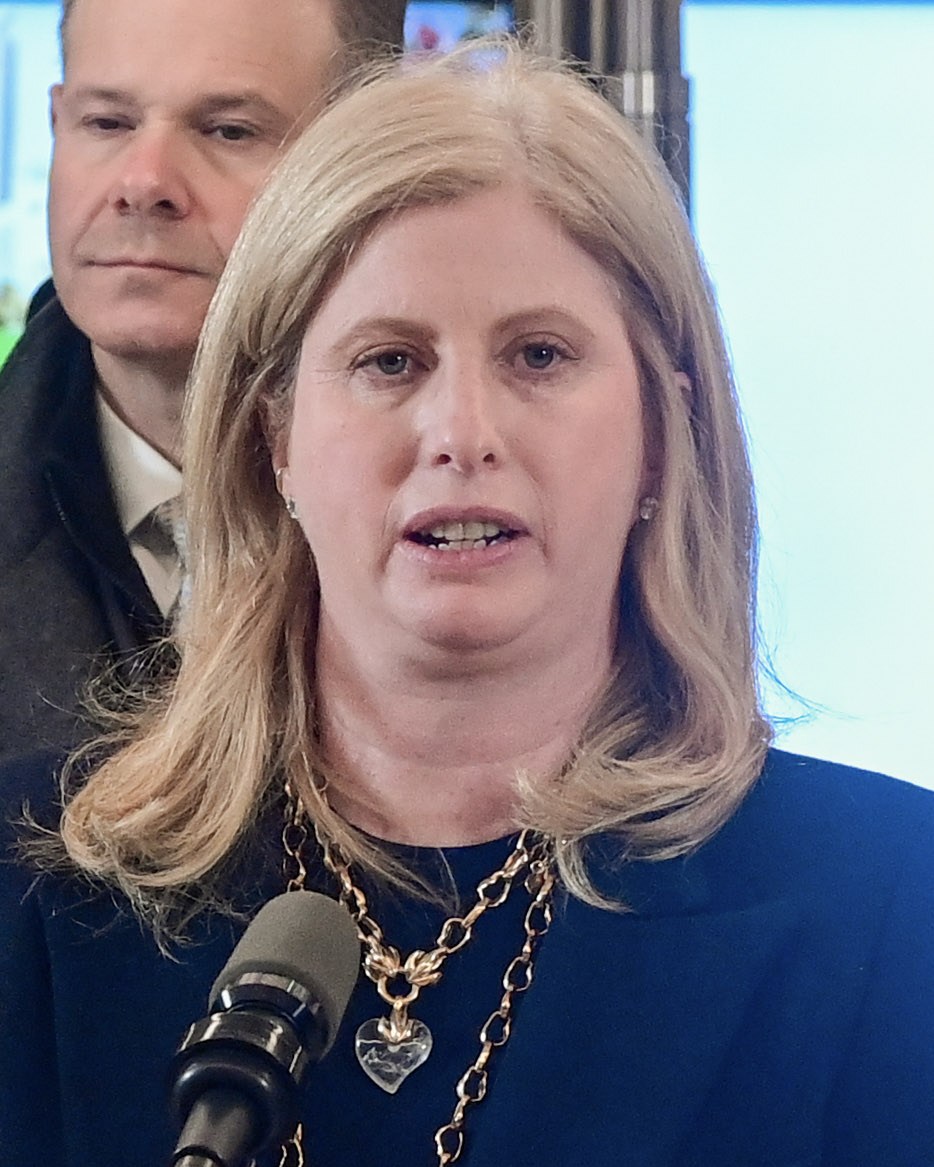
Jessica Tisch. Photograph by Metropolitan Transportation Authority, via Wikimedia Commons (CC BY 4.0).
The Jewish public administrator who brought technology, operational discipline and civic reform to New York City government
Jessica Sarah Tisch (born 1981) is a Jewish American public administrator whose career connects technology, essential city services and public safety. Since November 2024, she has served as the 48th commissioner of the New York City Police Department and the second woman to lead the NYPD. Her earlier responsibilities included directing the police department's information technology, serving as New York City's chief technology officer and managing one of the world's largest municipal sanitation systems.
The importance of her work lies not merely in the senior titles she has held, but in the infrastructure placed under her care. Emergency calls, operational information for police officers, body-worn cameras, citywide digital services, technology supporting the response to COVID-19, refuse collection and cleaner sidewalks all affect how safely and reliably a city functions. Tisch built her career inside public service by applying data, technology and operational management to large institutions whose performance is felt in daily life.
Education and entry into public service
Tisch is the daughter of James Tisch, a businessman who served as chief executive of Loews Corporation, and Merryl Tisch, a prominent figure in education and Jewish communal life. She graduated from Harvard University with a bachelor's degree in 2003. In 2008, she completed a joint course of study at Harvard Law School and Harvard Business School, earning both a JD and an MBA.
That same year, Tisch joined the NYPD as an analyst in its Counterterrorism Bureau. It was the beginning of a civilian career within a police institution: she did not rise through the ranks as a sworn officer, but developed expertise in analysis, operational systems, planning and administration. Her combination of legal and business training with direct knowledge of police needs shaped the leadership assignments that followed.
Modernizing technology inside the NYPD
In February 2014, Tisch was appointed the NYPD's deputy commissioner for information technology, a position she held until December 2019. She became responsible for systems essential to policing a city of millions, including elements of the 911 emergency communications infrastructure and the information tools used by officers and investigators.
Operational information, body cameras and emergency response
During her tenure, the department expanded its Domain Awareness System, which brings together multiple streams of information to support investigations and provide operational awareness. Tisch also oversaw the implementation of the NYPD's body-worn camera program. Equipping a police force of such scale required more than purchasing cameras: it involved data storage, technical support, training and integration into daily procedure. The resulting records became tools for documenting encounters, reviewing police work and strengthening institutional accountability.
Her work on 911 systems concerned one of the most consequential points of contact between residents and government: the moment a person seeks urgent help. Managing such infrastructure demands coordination among communications networks, databases, dispatch procedures and trained personnel. The experience established Tisch as an administrator able to connect a technical system with its practical purpose in the field.
Leading city technology during a public emergency
Mayor Bill de Blasio appointed Tisch commissioner of the New York City Department of Information Technology and Telecommunications, known as DoITT, in December 2019. She also served as the city's chief technology officer. Holding the role until January 2022, she moved from responsibility for one agency's systems to a broader mandate over the digital infrastructure of municipal government.
Under her leadership, New York introduced the ability to contact 911 by text message. That option is especially important for people who are deaf or hard of hearing, for callers who cannot safely speak during a dangerous incident and for circumstances in which a voice call is impractical. During the COVID-19 pandemic, her department also helped operate technological systems supporting the city's vaccination program. At a time of intense public need, the capacity to share information, arrange access and coordinate agencies became part of the city's health response.
Reshaping New York's sanitation system
In April 2022, Mayor Eric Adams appointed Tisch commissioner of the New York City Department of Sanitation. The move from technology to sanitation highlighted the central feature of her expertise: improving a vast public system through schedules, measurements, logistics and phased implementation.
During her tenure, the department changed refuse set-out and collection schedules to reduce the amount of time bags remained piled on sidewalks. It expanded the shift from loose bags on the curb toward closed containers and broader use of bins. These measures addressed one of New York's most familiar street-level problems, with the practical goals of improving public space and limiting rodents' access to discarded food and other waste.
Tisch also led the expansion of curbside organic-waste collection to households across the city. The significance extended beyond routine collection. Separating food scraps and other organic material can reduce the waste sent to landfills and make residents participants in environmental change on a citywide scale. Introducing such a program in a dense city of apartment buildings required new routes, equipment, staffing and sustained public communication.
Leading the New York City Police Department
On November 20, 2024, Tisch was named New York City police commissioner; she was sworn in on November 25. She became the department's 48th commissioner and the second woman in NYPD history to hold the office, following Keechant Sewell.
Her appointment placed a civilian administrator with years of internal NYPD experience at the head of the organization. She returned after managing its technology and then leading two major city departments. That background gave her a detailed understanding of how field operations depend on budgets, information, equipment, communications and organizational processes. At the head of one of the world's largest and most influential police departments, she bears responsibility for the safety of millions of residents and many distinct communities, including New York's large Jewish population and its institutions.
Jewish identity and service to a diverse city
Tisch grew up in a Jewish family with a substantial presence in American business, education, philanthropy and communal affairs. In 2006, she married Daniel Zachary Levine at Central Synagogue in Manhattan. Her maternal grandfather, Rabbi Philip Hiat, officiated at the ceremony. The couple have two sons.
Her contribution to Jewish heritage does not rest on religious scholarship or work in Israel. It arises from the place she has earned as a Jewish woman leading central institutions in a city that is home to one of the world's largest Jewish communities. The public systems she has managed directly serve Jewish neighborhoods, synagogues, schools, charities, businesses and families, alongside every other part of New York. Her career also belongs to the larger history of Jewish participation in American civic life: advancement into positions of authority accompanied by responsibility for the city as a whole.
Why Jessica Sarah Tisch belongs in Moreshet
Jessica Sarah Tisch merits inclusion in Moreshet because her career demonstrates how modern public service can improve lives through systems that often remain behind the scenes. She helped turn police information into an operational resource, oversaw the adoption of body-worn cameras, broadened access to emergency communications, helped maintain digital infrastructure during a pandemic and changed how New York handles refuse in its streets.
Her story also deserves a place in the record of contemporary Jewish life. It presents a Jewish woman reaching an exceptional level of responsibility in a city of profound importance to Jewish history and dedicating her abilities to institutions serving the entire public. Moreshet.com preserves this profile not for representation alone, but because Tisch's work has had practical consequences for safety, accessibility, cleanliness and urban function—the everyday conditions shaping the lives of Jewish New Yorkers and millions of their neighbors.