Yaakov Shabtai
Novelist, playwright and lyricist whose flowing prose transformed the Hebrew novel and the literary memory of Tel Aviv
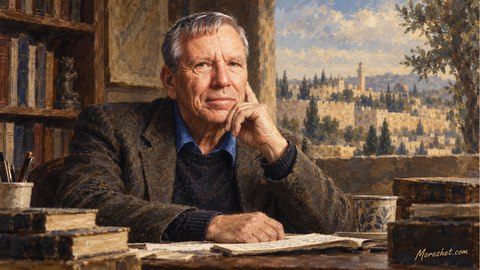
Yaakov Shabtai (1934–1981) was a novelist, playwright, lyricist and translator whose work profoundly influenced the form of the Hebrew novel. Past Continuous and Past Perfect gave Tel Aviv, family memory and the passage of time a new literary expression. He also wrote short stories, plays and songs that reached wider audiences. His distinctive power lay in connecting small details of life into an extensive human network, where past and present remain active within one another.
Tel Aviv and the kibbutz
Shabtai was born and raised in Tel Aviv in a working-class family of Polish origin. After military service in the Nahal, he lived on Kibbutz Merhavia, worked in agriculture and wrote. He returned to Tel Aviv in the 1960s and increasingly devoted himself to literary and theatrical work. Both settings formed part of his knowledge of Israeli social life and the ideals that had shaped it.
The stories collected in Uncle Peretz Takes Off return to family memories, neighbourhood figures and moments whose significance emerges through narration. Affection and irony coexist. A character's limitations do not remove the writer's interest in that person or the value of their place in the world.
A sentence that contains a world
Past Continuous, published in Hebrew as Zikhron Devarim in 1977, follows three central figures and the people around them in Tel Aviv. Long sentences and movement between stories, memories and generations create the sense of a life that cannot be divided into tidy compartments. A small event can open onto an entire past.
The formal invention serves the novel's subject. Families, friendships and earlier promises continue to affect the present even as the city changes. Shabtai found a way to write that accumulation without repeatedly stopping to explain it. The novel became a landmark in Hebrew literature and influenced later thinking about syntax, narrative perspective and memory.
The stage, song and the unfinished life
Past Perfect, published posthumously in Hebrew as Sof Davar in 1984, centres on Meir and an acute awareness of time and mortality. Private experience opens into family, city and imagination. The novel investigates how a person holds on to life through remembered relationships, desire and the fear of loss.
For the theatre, Shabtai wrote Crowned Head, about King David's last years, and The Spotted Tiger, about a dream of establishing a circus in Tel Aviv. His lyric writing includes The Song of Sarah Aaronsohn and Lifnot Erev, and he translated songs from other languages. Work across these forms reveals an ear for rhythm and speech, as well as an ability to embody an idea in a scene.
His early death left a relatively concentrated body of work, but its influence cannot be measured by the number of titles. The precision of its observation and the originality of its form continue to reward close reading and reinterpretation.
Why Yaakov Shabtai belongs in Moreshet
Yaakov Shabtai belongs in Moreshet at Moreshet.com because he renewed the means through which Hebrew literature can remember lives and portray a society. He left a searching account of Tel Aviv and its families, alongside writing that remains part of theatre and song. His books make Israeli heritage available as a movement of relationships, memories and voices rather than merely a sequence of public events.