Isaac Herzog
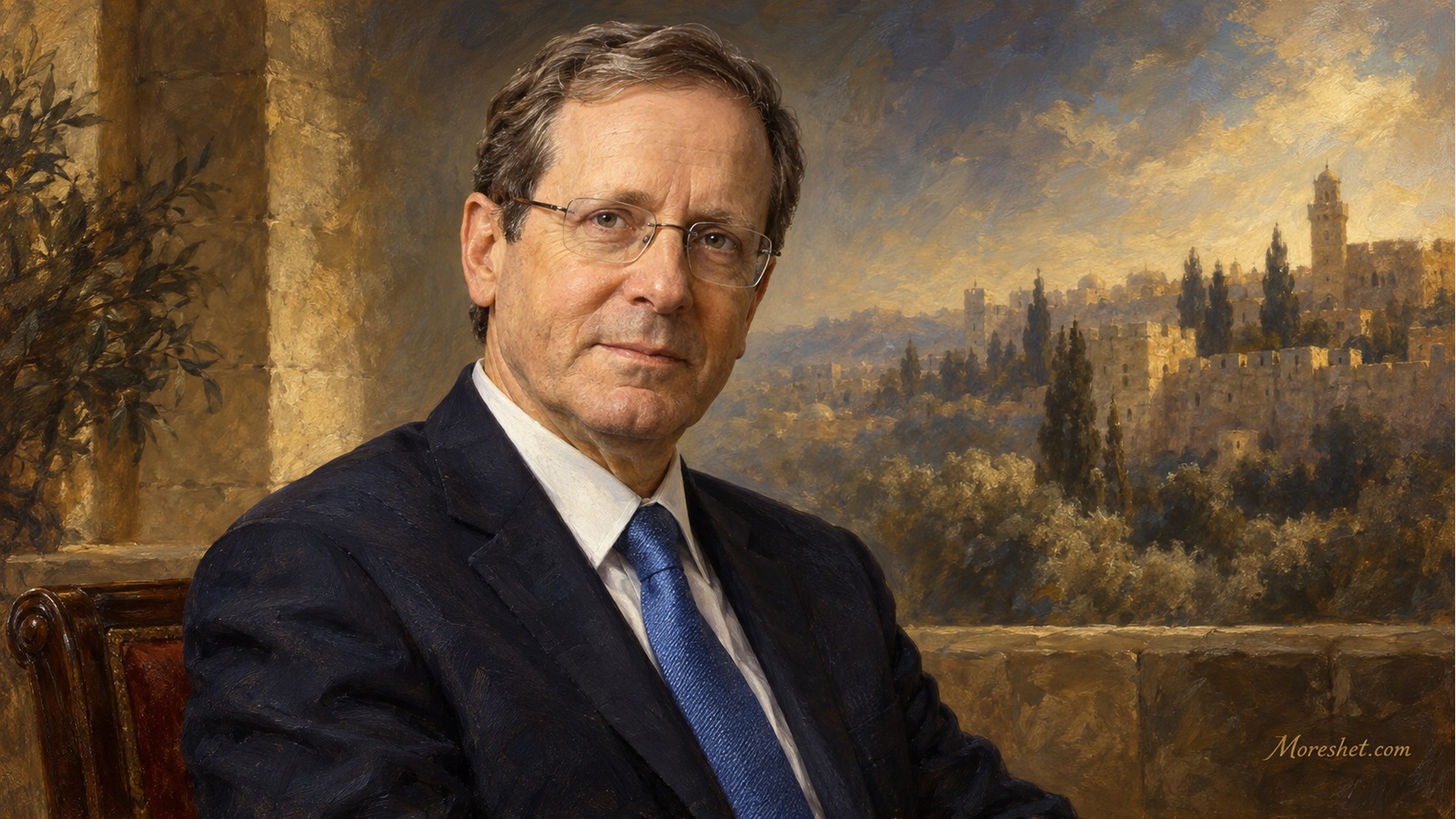
Isaac Herzog — AI-generated artistic portrait · Moreshet.com
Eleventh President of the State of Israel, attorney and statesman, former opposition leader and Jewish Agency chairman, whose career links Zionist continuity, diplomacy, welfare policy and world Jewry
Isaac Herzog, often known in Israel as Bougie Herzog, is the eleventh President of the State of Israel, an attorney, statesman and Israeli public figure. He has served as a member of Knesset, cabinet minister, Leader of the Opposition, chairman of the Labor Party and the Zionist Union, chairman of the Jewish Agency for Israel, and since July 7, 2021, President of Israel. His public life connects several central paths of Israeli leadership: law and government, party politics, welfare and society, Israel-diaspora relations, the fight against antisemitism, presidential diplomacy and the continuing effort to hold together a divided society.
Herzog’s importance in Israeli and Jewish heritage does not arise from the presidency alone. He belongs to a family deeply involved in the making of the state and the Jewish people across generations. His grandfather, Rabbi Yitzhak Isaac HaLevi Herzog, was Chief Rabbi of Ireland and later Ashkenazi Chief Rabbi of Mandatory Palestine and the State of Israel; his father, Chaim Herzog, was an IDF major general, Israel’s ambassador to the United Nations and Israel’s sixth president; his mother, Aura Herzog, founded the Council for a Beautiful Israel and worked in social, environmental and civic fields. Within this inheritance, Isaac Herzog built his own path of public service, centered on the relationship between the institutions of the State of Israel and the Jewish people as a whole.
Family roots, childhood and education
Isaac Herzog was born in Tel Aviv on September 22, 1960. He grew up in a family that viewed public service as a way of life. His father, Chaim Herzog, was already a major security and diplomatic figure and later served for a decade as Israel’s president. His mother, Aura, was one of the founders of Israeli civic environmental awareness. His brother Michael Herzog also became a senior diplomat and Israel’s ambassador to the United States.
As a child, Herzog grew up in the Tzahala neighborhood of Tel Aviv. He attended school in Israel, and later moved with his family to New York when his father served as Israel’s ambassador to the United Nations. During that period he studied at the Ramaz School in Manhattan, gaining close exposure to Israeli diplomacy, American Jewish life and the language through which Israel presents itself to the world.
This education was unusual: on one hand, an Israeli childhood shaped by statehood, security and public responsibility; on the other, daily contact with diaspora Jewry, American Jewish institutions and the delicate relationship between Israel and the wider Jewish world. Throughout his public life, Herzog would return to this question: how to preserve a living, respectful and deep relationship between the State of Israel and Jewish communities that differ greatly from one another.
Military service, law and early public work
After returning to Israel, Herzog served in the Israel Defense Forces in Unit 8200 of the Intelligence Corps. He later reached the rank of major in the reserves. Service in a central intelligence unit connected him to the worlds of security, information and national responsibility, although military life did not become the center of his career.
Herzog studied law at Tel Aviv University, along with additional academic studies in the United States. He later worked as an attorney and became a senior partner at Herzog, Fox & Ne'eman, one of Israel’s leading law firms. There he dealt, among other fields, with communications, telecommunications and international companies, gaining close familiarity with the development of Israel’s economy, high-tech sector and regulation in infrastructure and communications.
Before entering the Knesset, he was already active in public and party life. He worked with leaders of the Labor Party, served as an adviser and organizer, and from 1999 to 2001 served as cabinet secretary in the government of Ehud Barak. That role taught him the workings of cabinet government, interministerial coordination, governmental procedure, the relationship between the Knesset and the executive branch, and the inner mechanics of the state.
Knesset member and minister: welfare, housing, tourism and diaspora affairs
In 2003 Herzog was elected to the Knesset for the Labor Party. He served in the 16th through 20th Knessets, and over the years held several ministerial roles. In 2005 he became Minister of Housing and Construction, and later served as Minister of Tourism, Minister of Welfare and Social Services, and Minister for Diaspora, Society and the Fight Against Antisemitism.
His ministerial work reflected a strong concern with society, welfare and vulnerable populations. As welfare minister, he advanced the national program for children and youth at risk, strengthened elder-care systems, increased assistance for Holocaust survivors, promoted food security and reinforced social services. He was also associated with efforts to integrate people with disabilities into the workforce, including the principle that entering employment should not automatically cause the loss of disability benefits.
As minister responsible for diaspora affairs and the fight against antisemitism, Herzog worked on Israel’s relationship with Jewish communities around the world and on the rise of antisemitism. This field fit his family and personal background especially well: a person raised both in Israel and within an American Jewish environment, who understood that the future of the Jewish people is shaped not only in Jerusalem and Tel Aviv, but also in New York, Paris, London, Buenos Aires, Melbourne and many other communities.
Labor Party chairman and Leader of the Opposition
In 2013 Herzog was elected chairman of the Labor Party, defeating Shelly Yachimovich. He consequently became Leader of the Opposition. He tried to reshape Labor as a social-democratic and diplomatic party able to offer a governing alternative to Benjamin Netanyahu, combining security responsibility, social policy, pursuit of a diplomatic settlement and preservation of Israel’s Jewish and democratic character.
Ahead of the 2015 Knesset election, Herzog formed the Zionist Union list together with Tzipi Livni. The list won 24 seats and became the largest opposition faction in the Knesset. Although it did not form a government, it marked a moment in which Herzog stood as a serious candidate for prime minister and attempted to unite a broad center-left camp around a civic and diplomatic alternative.
As Leader of the Opposition, Herzog led parliamentary and public battles, dealt with security and foreign-policy issues, and sought to advance regional diplomatic initiatives. He supported the two-state framework in principle, while emphasizing security arrangements, a regional approach and recognition of changing diplomatic realities. Even when his positions drew criticism from both left and right, he tried to articulate a pragmatic, security-conscious and moderate Zionist line.
Chairman of the Jewish Agency: a bridge between Israel and the diaspora
In 2018 Herzog was unanimously elected chairman of the Jewish Agency for Israel. Upon taking office, he left the Knesset and the position of Leader of the Opposition. The move from party politics to the Jewish Agency was significant: he moved from an internal Israeli arena of political struggle into a historic institution whose role is to connect the State of Israel, aliyah, Jewish communities, Jewish education, communal security and Jewish identity around the world.
As Jewish Agency chairman, Herzog emphasized the danger of a rupture between Israel and diaspora Jewry, the need to fight antisemitism and the importance of living Jewish identity among younger generations. After the Pittsburgh synagogue shooting in 2018 and further antisemitic incidents in Europe and the United States, he placed the security of Jewish communities and the struggle against antisemitism at the center of his agenda.
During his tenure, the Jewish Agency advanced measures intended to strengthen the relationship between Israel and the Jewish people, including a strategic plan for the next decade, reaffirmation of commitment to the principles of Israel’s Declaration of Independence, support for Jewish communities and a broader approach to pluralism, Jewish continuity and belonging. Herzog viewed this role as a historic mission: not merely managing an old institution, but protecting the fabric of relations among the parts of the Jewish people.
Election as President of Israel
In 2021 Herzog ran for the presidency of the State of Israel. On June 2, 2021, the Knesset elected him as Israel’s eleventh president by 87 votes to 26 against Miriam Peretz — the largest majority ever received by a presidential candidate in Israel. He took office on July 7, 2021. He became the first Israeli president born after the establishment of the state and the first son of an Israeli president to become president himself.
His presidency began during the coronavirus pandemic, deep political tensions and a fractured society after repeated elections. From the beginning of his term, Herzog sought to present the President’s Residence as a place of connection, dialogue and civic responsibility. He emphasized healing social rifts, respectful public language, relations with world Jewry and strengthening the sense of partnership among Israel’s citizens.
The Israeli presidency is not an executive office like the premiership, but precisely for that reason it requires symbolic, moral and public skill. Herzog tried to use the role to convene, calm, warn, represent and mediate — between Jews and Arabs, right and left, religious and secular Israelis, Israel and the diaspora, and the state and the world.
Presidential initiatives: dialogue, climate and a shared Jewish people
One initiative associated with Herzog’s presidency is Time to Talk, a program intended to address polarization in Israeli society and create spaces for conversation, consensus-building and the management of disagreements. Activities around this initiative were developed at the President’s Residence and beyond it, based on the belief that a democratic society need not agree on everything, but must know how to argue without destroying the shared framework.
In the climate field, Herzog established the Israeli Climate Forum under the auspices of the President’s Residence, recognizing that the climate crisis is a civic, economic and international challenge as well as an opportunity for regional cooperation. In doing so, he also continued a family line: his mother Aura Herzog was one of the founders of Israel’s civic environmental movement.
Another important initiative is Voice of the People, a council designed to connect Jews in Israel, North America and the rest of the world around the future challenges of the Jewish people. The initiative reflects Herzog’s consistent view that the Jewish people are not merely a historical community or a shared memory, but a living network of mutual responsibility that must speak, consult and build a future together.
The judicial reform crisis and the attempt to mediate
In 2023, against the background of the fierce dispute over the government’s judicial reform, Herzog became a central figure in the attempt to mediate among the government, opposition and different parts of the public. He delivered national addresses, called for a halt to legislation and a broad compromise, and presented the People’s Outline as an alternative designed to prevent constitutional and social rupture.
His role in the crisis illustrated both the limits and the importance of the presidency. The president cannot impose a political agreement, but he can warn, convene, propose language and serve as a public address for those seeking a way out of polarization. Herzog tried to occupy exactly that space: not as a party actor, but as a state institution seeking to preserve the shared framework.
Even those who disagreed with his proposals recognized that the crisis placed the president at the center of one of the largest debates in the history of Israeli democracy. From the perspective of public heritage, this is an important chapter: an attempt to use the presidency as a force of restraint, compromise and warning inside a turbulent political system.
October 7, the Swords of Iron War and the struggle for the hostages
After the Hamas attack of October 7, 2023 and the Swords of Iron War, Herzog and First Lady Michal Herzog focused on strengthening national morale, visiting wounded Israelis and bereaved families, accompanying the families of hostages, delivering state addresses and presenting Israel’s position to the world. During this period, the president became a symbolic voice of grief, endurance, memory and the demand to bring the hostages home.
Herzog appeared frequently in international media, defended Israel’s right to protect itself, warned against rising antisemitism and emphasized the scale of the disaster that struck Israel. He also called for an independent, nonpolitical state commission or inquiry to examine the intelligence and security failures that led to the catastrophe.
In a reality of prolonged war, displaced communities, hostages, wounded families and sharp political disagreement, Herzog’s presidency was tested not only by ceremonies and speeches, but by the ability to offer a state language to a grieving society. This became one of the major tests of his presidency.
Presidential diplomacy and Israel’s relations with the world
Herzog’s term has included extensive diplomatic activity. He became the first Israeli president to visit the United Arab Emirates, and he also visited many other countries, including Greece, Cyprus, Turkey, Jordan, the United States, Italy, Hungary, Ethiopia, Australia, Kazakhstan, Panama and Costa Rica. In many visits he emphasized ties with local Jewish communities and the importance of fighting antisemitism.
In March 2022 he visited Turkey and met President Recep Tayyip Erdogan as part of an effort to renew Israel-Turkey relations after years of tension. In July 2023 he addressed a joint session of the United States Congress marking Israel’s 75th anniversary, stressing the U.S.-Israel alliance, the Iranian threat, the Abraham Accords and Israel’s identity as a Jewish and democratic state.
After October 7, presidential diplomacy acquired an additional dimension: representing Israel amid international criticism, maintaining relationships with leaders, supporting Jewish communities experiencing antisemitism, and presenting the pain of hostages and victims to the world. Herzog acted in a space where the president does not formally conduct foreign policy, but his voice can influence how Israel is seen and understood.
Family, writing and public character
Herzog is married to Michal Herzog, an attorney, and the couple has three sons. During his presidency, Michal Herzog has held a visible public role alongside him, especially in connection with hostage families, bereaved families, Jewish communities and state events.
Alongside his political and presidential activity, Herzog published writing on society and economics, including the book Work Plan: A Recipe for Economic Welfare, written during his period as welfare minister. That writing reflects his view that the state has responsibility in welfare, education, health, employment and the protection of vulnerable populations.
Herzog’s public style is not based on explosive charisma or inflammatory rhetoric, but on moderate, legal, state-oriented and bridge-building language. Some see that as a strength; others see it as a limitation. Yet precisely this style fits the presidency as he understands it: not a place of command, but a place of convening, persuasion, softening conflict and representing historical continuity.
Why this legacy belongs in Moreshet
Isaac Herzog merits inclusion in Moreshet because his story connects generations of Jewish and Zionist leadership with contemporary Israeli public service. He carries a family name linked to the Chief Rabbinate, diplomacy, the IDF, the presidency and relations with world Jewry, but his own contribution stands independently: Knesset member, welfare minister, opposition leader, Jewish Agency chairman and president who tried to turn the President’s Residence into a house of dialogue, memory, Jewish responsibility and civic unity.
Moreshet.com documents Herzog because Jewish and Israeli heritage is not only a story of military victories or diplomatic achievements, but also of institutions, bridges, difficult conversations, mutual responsibility and the relationship among parts of the Jewish people. Isaac Herzog’s place in Moreshet rests on the way he worked to connect the State of Israel with diaspora Jewry, politics with welfare, the presidency with solidarity, and deep family memory with the 21st-century challenges of polarization, antisemitism, war, crisis of trust and the shared future of the Jewish people and the State of Israel.