Howard William Lutnick
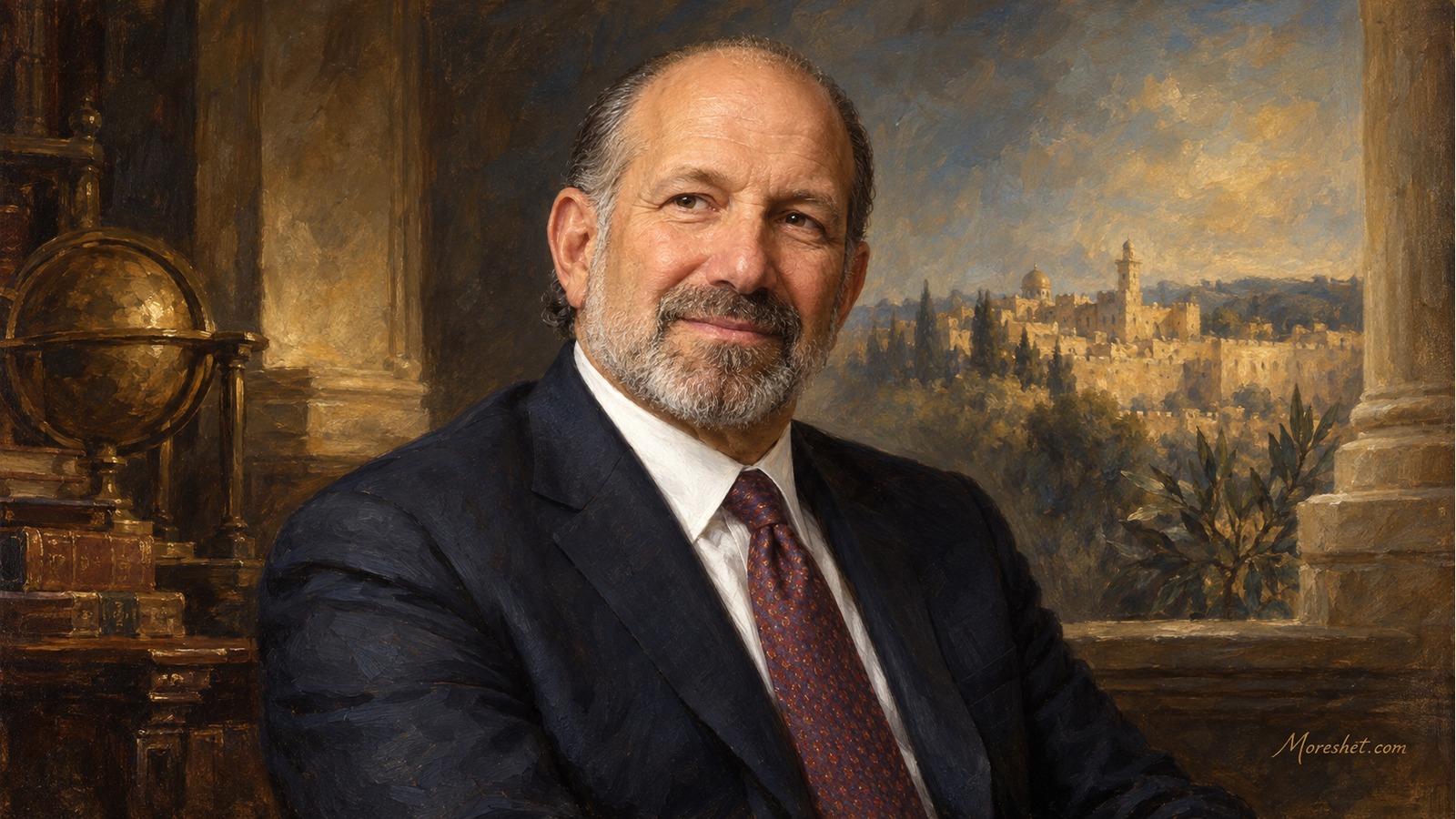
Howard Lutnick — AI-generated artistic portrait · Moreshet.com
From rebuilding Cantor Fitzgerald after September 11 to serving as U.S. secretary of commerce
Howard William Lutnick is a Jewish American businessman, philanthropist and public official whose career spans more than four decades in financial markets, trading technology, institutional recovery and charitable work. He is most closely associated with Cantor Fitzgerald, which he led through the loss of 658 employees in the September 11, 2001 attacks, and with his subsequent appointment as the 41st United States secretary of commerce in February 2025.
Lutnick's public story is not simply one of commercial advancement. It is also about how an institution continues after catastrophic loss, how technological infrastructure can become a source of resilience, and how resources accumulated in business can be directed toward bereaved families, disaster victims and education. His later move into government placed him at the center of decisions affecting American industry and international trade.
Early loss and an education at Haverford
Lutnick was born on July 14, 1961, and raised in Jericho on Long Island, New York, in a Jewish family. His father, Solomon Lutnick, was a history professor at Queens College. His mother, Jane Lutnick, was a painter, sculptor and art teacher. She died of lymphoma when Howard was 16. Shortly after he began studying at Haverford College in Pennsylvania, his father died following an overdose of chemotherapy medication administered during cancer treatment.
Haverford president Robert Stevens offered to waive Lutnick's college fees. Lutnick remained at the school, captained its tennis team and graduated with a bachelor's degree in economics in 1983. His relationship with Haverford would last for decades; he eventually became the largest donor in the college's history.
Building Cantor Fitzgerald through markets and technology
After graduation, Lutnick briefly worked as a broker in the U.S. dollar–Japanese yen market. He joined Cantor Fitzgerald in 1983 under the mentorship of its founder, B. Gerald Cantor. Lutnick advanced rapidly, managing a division that handled investments for Cantor and his associates and attracting additional clients. He became the firm's president and chief executive in 1991 and its chairman after Cantor's death in 1996.
One of Lutnick's most consequential business decisions was to push Cantor from a market built heavily around telephone brokers toward electronic trading. The firm invested approximately $250 million in developing eSpeed, an electronic platform for trading government securities and other financial instruments, and launched it in 1999. By 2001, the technology supported dozens of marketplaces. It strengthened Cantor's position in U.S. Treasury trading and later proved essential to the firm's ability to keep operating.
Lutnick continued reshaping the group after September 11. In 2004, BGC Partners was formed to house parts of its broker-assisted business while Cantor retained other financial-market activities. In 2008, he oversaw the combination of BGC and eSpeed in a transaction reported at approximately $1.3 billion. These moves created a broader enterprise joining traditional brokerage, capital markets and electronic trading technology.
September 11: loss, survival and reconstruction
Cantor Fitzgerald's New York offices occupied high floors of the World Trade Center's North Tower, above the point where American Airlines Flight 11 struck. On September 11, 2001, all 658 Cantor employees who were in the office that morning were killed—roughly two-thirds of the firm's New York workforce. Among them was Lutnick's younger brother, Gary.
Lutnick survived because he was taking his son to his first day of kindergarten. The company lost a central part of its leadership, trading staff and accumulated professional knowledge in a single morning. Operations in London and New Jersey, together with eSpeed's electronic infrastructure, allowed Cantor to resume trading and begin rebuilding. By December 2002, the company again employed about 750 people in New York.
Alongside the effort to preserve the business, Cantor established the Cantor Fitzgerald Relief Fund. It began making direct payments to the families of those killed, while the firm committed a share of profits and extended health support to bereaved families. Published figures state that approximately $180 million had been distributed to families by September 2006. Lutnick personally contributed $1 million to the fund.
The destruction and rebuilding of the company were later examined in the 2013 documentary Out of the Clear Blue Sky. This chapter of Lutnick's career matters beyond one firm's balance sheet: it shows how technological preparation, operational continuity and sustained responsibility toward affected families can help an institution endure collective trauma.
Philanthropy after catastrophe
The Cantor Fitzgerald Relief Fund eventually extended its work beyond the families of Cantor employees. It provided assistance after hurricanes, tornadoes and other disasters. Following Hurricane Sandy, Lutnick and the fund distributed $1,000 debit cards directly to affected families; the same form of assistance was later offered to families struck by the 2013 tornado in Moore, Oklahoma.
Cantor Fitzgerald and BGC also developed an annual September 11 Charity Day. Public figures, athletes and entertainers joined the firms' trading activity to help raise money for nonprofit organizations. By September 2014, the initiative had raised a reported cumulative total of approximately $101 million for charitable causes, including organizations devoted to September 11 remembrance and education.
Haverford College occupies a distinctive place in Lutnick's giving. By 2014, his contributions to the college totaled approximately $65 million. That year he made a $25 million gift, then the largest single donation in Haverford's history. His support benefited the library, an integrated athletic center, an art gallery, and a tennis and track center named for his brother Gary. In doing so, Lutnick returned substantial resources to the institution that had supported him after he was orphaned and expanded academic, artistic and athletic facilities for later generations of students.
From business leadership to public service
After years of political fundraising, Lutnick was named a co-chair of Donald Trump's presidential transition team in August 2024. In November, Trump selected him as his nominee for commerce secretary. Lutnick appeared before the Senate Committee on Commerce, Science, and Transportation in January 2025. The full Senate confirmed him on February 18 by a vote of 51–45, and he was sworn in on February 21, 2025.
As commerce secretary, Lutnick has worked on issues with direct consequences for the American economy and its relationships abroad: tariffs and trade, investment in domestic manufacturing, controls on the export of advanced technologies, semiconductors, artificial intelligence and commercial space activity. He participated in discussions with foreign officials and promoted the administration's use of tariffs, export rules and investment policy to strengthen American production and protect national-security interests.
Moving from the leadership of a financial-services group to a major cabinet department gave Lutnick influence over rules extending far beyond any single company. Commerce Department decisions can affect supply chains, technology businesses, manufacturers, workers, consumers and trade relationships between the United States and countries including Israel. In 2025, Time included him on its list of the world's 100 most influential people. He has also received the U.S. Navy Distinguished Public Service Award.
Why Howard William Lutnick belongs in Moreshet
Lutnick merits inclusion in Moreshet because his record joins several fields of enduring historical importance: building an internationally significant financial and technological enterprise; leading an institution after an attack destroyed an entire workplace community; creating channels of aid for bereaved families and disaster victims; supporting higher education on an exceptional scale; and entering public office in a role that helps shape the global economy.
As a Jewish American figure, his life adds to the record of Jewish participation and influence in American business, philanthropy and government. The relevance to Jewish heritage rests not on identity or office alone, but on concrete acts that raise lasting questions of mutual responsibility, remembrance, reconstruction and a leader's obligations to a wounded community. Moreshet.com therefore documents Lutnick's story for its practical impact and for what it reveals about institutional and human resilience under extreme pressure.
Editorial note on inclusion
Howard Lutnick is included on the site even though this person and their public record are controversial among broad sections of the public. Inclusion does not determine whether the influence is positive or negative; it reflects the significant place this figure holds in shaping the lived experience, culture and way of life of the public. Naturally, some regard this activity as positive and even heroic, while others see it as contrary to their worldview. The very existence of opposing assessments is part of the historical record that justifies including this significant and influential figure in the heritage of the Jewish people.