Bill Ackman
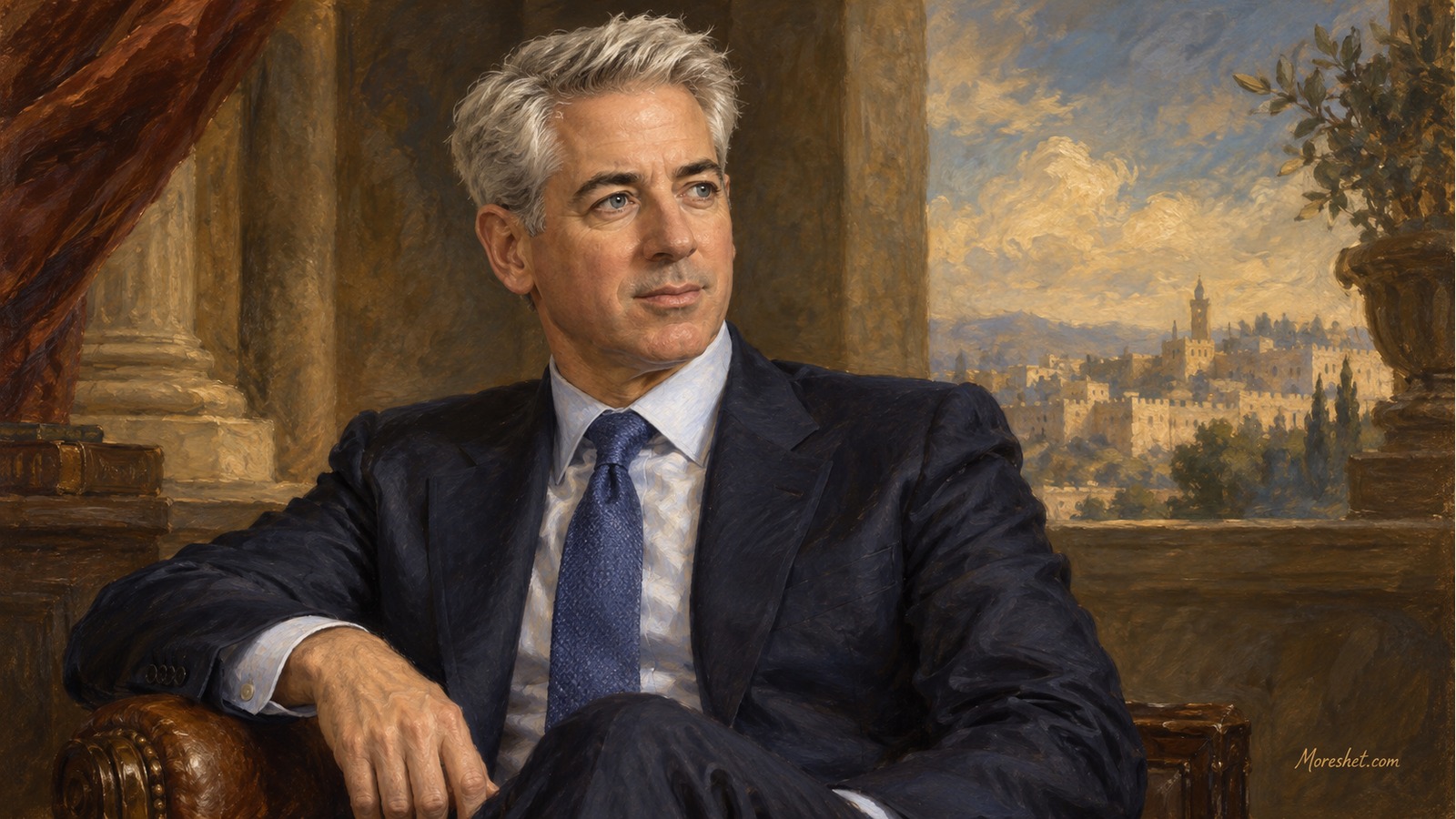
Bill Ackman — AI-generated artistic portrait · Moreshet.com
Jewish-American investor, Pershing Square founder, philanthropist and public voice in debates over Israel, antisemitism and elite institutions
Bill Ackman, born William Albert Ackman, is a Jewish-American investor, founder and chief executive officer of Pershing Square Capital Management, philanthropist and prominent public voice at the intersection of capital, corporate governance, social responsibility, Israel and Jewish communal life. He is known as one of the most visible activist investors of his generation: a manager of concentrated portfolios, a public campaigner for corporate change, a sharp participant in economic and institutional debates, and a philanthropist operating at large scale.
Ackman belongs to a generation of financial figures whose influence is not limited to managing money. He acts as an investor, active shareholder, funder of research and social initiatives, and public figure who uses his platform to affect institutional debate. Especially after the October 7, 2023 attack on Israel and the fierce argument that followed on American campuses, Ackman became one of the most visible voices in the public fight against antisemitism and in public support for Israel. For that reason, his story touches not only economics but contemporary Jewish heritage: the way a Jewish business figure uses capital, position and voice in a charged public arena.
Family background and education
Ackman was born on May 11, 1966, in Chappaqua, New York, into an Ashkenazi Jewish family. His father, Lawrence David Ackman, was a major figure in New York real-estate finance and led Ackman-Ziff Real Estate Group. From his family and early environment, Ackman gained familiarity with business, real estate, finance and risk, but he built his own path as an independent investment manager with a highly personal style.
He attended Horace Greeley High School and then Harvard University. In 1988 he graduated magna cum laude from Harvard College with a degree in social studies, and his senior thesis examined the Jewish and Asian-American experience in Harvard admissions. In 1992 he completed an MBA at Harvard Business School. Even in his early academic work, one can see an interest in the combination of elite institutions, identity, opportunity and social power — themes that would return later in his public activity.
Gotham Partners and the making of an investor
In 1992, shortly after completing business school, Ackman co-founded Gotham Partners with David Berkowitz. The firm invested in small and mid-sized public companies and grew quickly. Already in this period, Ackman’s style began to take shape: deep research, identification of a gap between the value of a company and the way it is managed or priced, and a willingness to act publicly with management teams, boards and markets.
One of the defining early episodes of his career was his research and position against MBIA, a bond insurer, before the 2008 financial crisis. Ackman argued that the credit market and complex financial instruments concealed risks greater than those reflected in ratings. For years he faced intense criticism, but during the financial crisis, important parts of his argument about credit risk proved significant. The episode strengthened his image as an investor willing to stand against consensus, even at the cost of a long, expensive and public battle.
Pershing Square: concentrated investing and corporate activism
In 2004 Ackman founded Pershing Square Capital Management. The firm was built around a concentrated investment approach: holding a relatively small number of companies in which it believes significant long-term value can be created. Unlike a passive investor who simply chooses securities, Ackman often acts as an activist investor, seeking to influence strategy, management, capital structure, board composition or corporate direction.
Investments and campaigns associated with Ackman include Canadian Pacific Railway, Chipotle Mexican Grill, Universal Music Group, Howard Hughes Holdings, Target, JC Penney, Valeant Pharmaceuticals and Herbalife. Some of these moves became major successes, while others ended in losses or sharp criticism. That combination is important to understanding him: Ackman is not best described as an investor without mistakes, but as a person who acts in markets with strong conviction about research, management, incentives and the possibility of changing organizations.
The Canadian Pacific Railway campaign became one of the leading examples of his success as an activist investor. Ackman and Pershing Square pushed for changes in leadership and strategy at the Canadian railway company, and the campaign led to changes in management and improved performance. By contrast, the Valeant investment and the Herbalife short position became examples of the complexity and risk of financial activism, especially when an investment campaign also becomes a public, regulatory and media battle.
Investment style and influence on corporate governance
Ackman operates from the view that shareholders should not merely watch from the sidelines. When he identifies a company that he believes is managed below its potential, he may try to change its direction through engagement with management, public letters, proxy contests, strategic proposals or board changes. In this respect he is part of a broader movement of corporate activism that changed the balance of power between corporate executives and shareholders.
This style has both supporters and critics. Supporters see it as a way to force large companies to become more efficient, transparent and accountable to the capital entrusted to them. Critics argue that activist investors may promote interests that are too short-term or use economic power in ways that sharply affect companies, employees and markets. In Ackman’s case, the dispute itself is part of the story: he helped turn investing from a quiet act of capital allocation into a public exercise in analysis, persuasion, contest and governance.
In recent years, Ackman has increasingly emphasized permanent capital and the building of Pershing Square as a stable, lean institution loyal to its employees and investors. Pershing Square’s own materials present the firm as a significant investment organization with a focused team and a close internal culture. Here too one can see his outlook: a good company is not only a portfolio of assets, but a system of people, trust, incentives and long-term capacity to act.
Investment in Israel and economic support during war
After the October 7, 2023 attack and the war that followed, Ackman stood out as one of the most prominent Jewish business figures publicly supporting Israel. In January 2024, Ackman and his wife, Neri Oxman, purchased approximately 4.9 percent of the Tel Aviv Stock Exchange as part of a secondary offering. The transaction was viewed not only as a financial investment, but also as a signal of confidence in the Israeli economy during a period of uncertainty, war and international pressure.
Symbolically, the purchase of a stake in the Tel Aviv Stock Exchange carried wider meaning. The exchange is a central infrastructure of Israel’s economy, and choosing to invest in it during a sensitive period presented Israel, in Ackman’s view, not only as a political or emotional subject but as an entrepreneurial, institutional and economic market of value. He later spoke of interest in additional Israeli investments and described Israel as one of the world’s important entrepreneurial economies.
Campus antisemitism and public debate
One of the most visible public chapters in Ackman’s life began after October 7, 2023, around the response of elite American universities to antisemitism, Israel and anti-Israel activism on campus. Ackman, a Harvard alumnus, strongly criticized the university’s leadership and what he saw as institutional failure to protect Jewish students and to draw lines around speech that supported or excused violence.
His activity in this field was public, forceful and often controversial. He called for transparency regarding organizations and students involved in letters or actions that placed full responsibility for the violence on Israel after the Hamas attack, and he became one of the voices applying public pressure on university leadership. He later engaged with allegations of plagiarism and the governance of elite institutions. Some saw his actions as a necessary fight against institutional antisemitism; others saw them as an overly aggressive use of the power of a private investor and donor. From the perspective of heritage documentation, however, this chapter matters because it shows how questions of Jewish security, free speech, economic power and institutional identity moved to the center of American public debate after October 7.
Ackman also participated in public discussions about the future of Jews at elite universities, including events at the Center for Jewish History in New York. His participation alongside scholars, public figures and Jewish leaders showed that the argument was not only about one campus or one president, but about the long relationship between American Jews and institutions of knowledge, prestige and influence.
Philanthropy: the Pershing Square Foundation and strategic giving
In 2006 Bill Ackman and his then wife Karen founded the Pershing Square Foundation. The foundation, and later the broader activity of Pershing Square Philanthropies, has supported initiatives in health, life sciences, education, economic development, human rights, the arts, innovation and criminal justice. Its grantees and fields of support have included medical research, academic scholarships, rights organizations, museums and cultural institutions, and organizations working against wrongful convictions and for broader opportunity.
Ackman is a signer of The Giving Pledge, committing to give away a substantial portion of his wealth to public purposes. His philanthropy often resembles his investment approach: it seeks points where capital, management, research and measurement can create wider influence. This is not only symbolic giving, but an attempt to build systems, accelerate institutions and fund ideas that can scale.
In 2021 Ackman announced a major donation of Coupang shares to philanthropic entities, including his own foundation. In the following years he continued to combine investing, research and philanthropy. This activity places him within a broad Jewish-American tradition of public giving, in which wealthy individuals seek to affect education, health, justice, culture and communal resilience.
The Ackman Oxman Institute and medical research
In August 2026, reports described the launch of the Ackman Oxman Institute, a major philanthropic initiative advanced by Ackman and his wife Neri Oxman after a severe medical event experienced by Ackman’s daughter Lucy. According to the supplied material and reviewed sources, the institute is intended to focus on brain research, rehabilitation, recovery, brain-computer interfaces, human optimization and longevity, with an emphasis on moving research from laboratory work into real treatment for patients.
The importance of the initiative lies not only in the initial reported commitment of approximately $400 million, but in the question it raises: how can a research and treatment institution be built so that its success is measured not only by academic publications, but also by its ability to accelerate therapies, devices, technologies and rehabilitation for patients? For Ackman, long accustomed to analyzing companies and incentives, the initiative represents a transfer of business and philanthropic thinking into medicine and science.
If the institute develops according to the vision described, it may become one of the most significant expressions of Ackman’s philanthropy: not a single donation, but the building of a new institution around family pain, advanced science and the belief that private capital can accelerate medical solutions.
Personal life and Israeli connection
Ackman was married to Karen Herskovitz, with whom he has three children. In 2019 he married Neri Oxman, an Israeli-American scientist, designer and researcher, and they have a daughter. His relationship with Oxman strengthened his public presence around Israel, academia and technology, although his Jewish and philanthropic activity preceded that marriage.
In 2025 Ackman received an honorary doctorate from the University of Haifa, together with Neri Oxman. The honor reflected Israeli recognition not only of his business achievements, but also of his support for Israel, his campaign against antisemitism and his philanthropic activity. At a time when the relationship between diaspora Jewry and Israel faces complex tests, Ackman’s public role illustrates a contemporary form of Jewish engagement: financial, public, institutional and polemical at once.
Controversy as part of the influence
Ackman is a controversial figure. His activist investments, campaigns against specific companies, political positions, criticism of universities, activity around Israel and use of social media have generated extensive criticism. Some see him as a courageous person willing to say publicly what others fear to say; others see him as an example of the excessive power of private wealth in markets, academia and public discourse.
Yet controversy is not a reason to avoid documentation. On the contrary, it is part of the reason to document him carefully. Ackman embodies a major phenomenon of the present: a financial figure who uses capital, media, institutions and philanthropy to influence not only companies, but also public argument, Jewish identity and the way institutions respond to antisemitism and Israel.
Editorial note on inclusion
Bill Ackman is included on the site even though this person and their public record are controversial among broad sections of the public. Inclusion does not determine whether the influence is positive or negative; it reflects the significant place this figure holds in shaping the lived experience, culture and way of life of the public. Naturally, some regard this activity as positive and even heroic, while others see it as contrary to their worldview. The very existence of opposing assessments is part of the historical record that justifies including this significant and influential figure in the heritage of the Jewish people.
Why this legacy belongs in Moreshet
Bill Ackman merits inclusion in Moreshet because he represents a contemporary form of Jewish-American influence: influence moving among capital markets, academic institutions, philanthropy, the fight against antisemitism and support for Israel. Through Pershing Square, the Pershing Square Foundation, his activity around elite universities and his investments in Israel, he became a figure whose actions touch both business and questions of security, identity and Jewish standing in public life.
Moreshet.com documents Ackman not because every action or position of his is universally accepted, but because his influence is real, wide and characteristic of the era. Heritage is not only the story of political leaders or thinkers of the past; it also includes figures who operate with the tools of the present — capital, media, global institutions and philanthropy — and affect the way Jews, Israelis and their supporters respond to the challenges of our time. Bill Ackman’s place in Moreshet therefore rests on the distinctive connection between financial achievement, public responsibility, Jewish commitment and visible involvement in debates that shape Jewish and Israeli life in our generation.