Laurence Douglas Fink
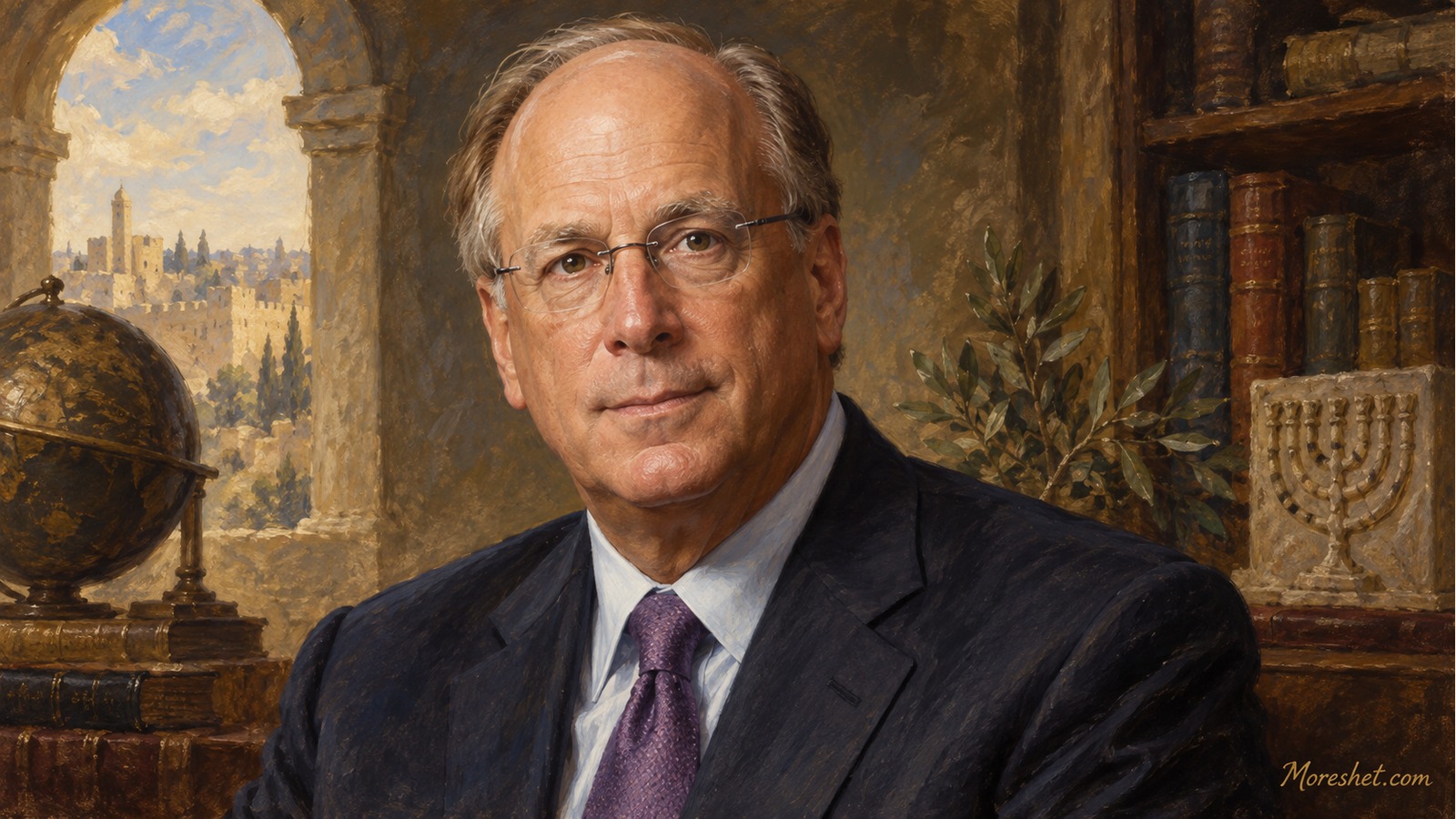
Larry Fink — AI-generated artistic portrait · Moreshet.com 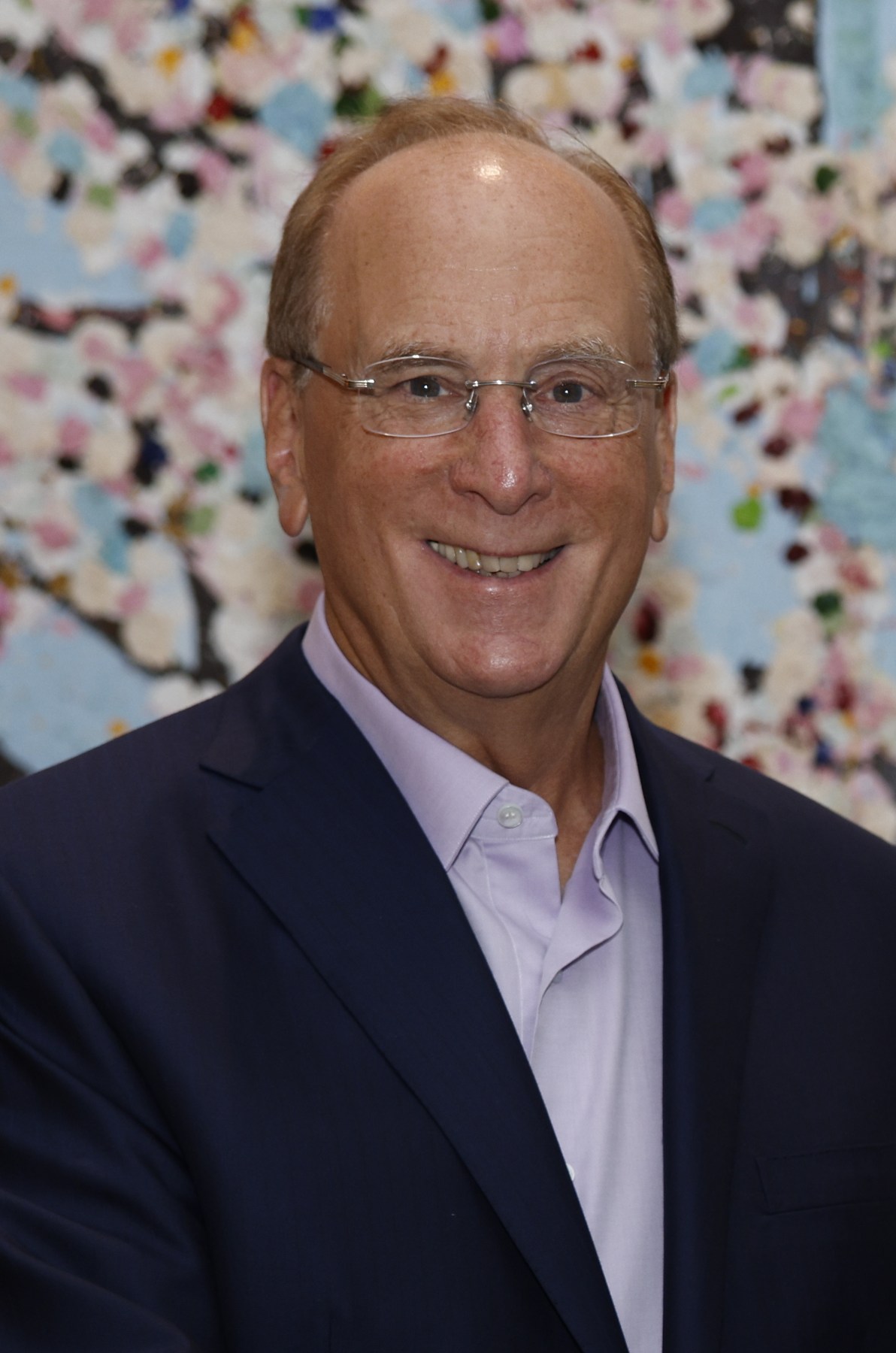
Larry Fink. Photograph by Kena Betancur/European Commission, via Wikimedia Commons (CC BY 4.0).
Jewish-American financier, BlackRock co-founder, chairman and CEO, and one of the capital managers who profoundly shaped global markets, retirement, risk management and corporate governance
Laurence Douglas Fink, known as Larry Fink, is a Jewish-American financier, co-founder of BlackRock, chairman and chief executive officer of the company, and one of the most influential figures in global capital markets. Under his leadership, BlackRock grew from a relatively small fixed-income investment firm in the late 1980s into a global asset-management company overseeing trillions of dollars for pensions, funds, institutions, governments, private investors and organizations around the world.
Fink’s importance is not limited to the scale of assets managed. He helped make systematic risk management a central language of modern investing, led BlackRock’s expansion into exchange-traded funds and passive products through iShares, turned his annual CEO letters into a global platform for questions of corporate governance, business responsibility, climate, retirement and the future of capitalism, and placed the asset manager in a position of influence not only over returns, but over the way companies and governments think about risk, long-term time horizons, public trust and economic infrastructure.
Jewish childhood in Los Angeles and education at UCLA
Fink was born in Los Angeles on November 2, 1952, and grew up in Van Nuys, California, in a Jewish-American family. His mother, Lila, was an English professor, and his father, Frederick, ran a shoe store. His background was not one of inherited financial power, but of education, work, local commerce, responsibility and discipline. From that environment emerged a figure who combined business intuition with broad institutional thinking.
Fink studied at the University of California, Los Angeles, completing a bachelor’s degree in political science in 1974. In 1976 he earned an MBA in real estate from UCLA Anderson School of Management. The combination of political science and real estate is important for understanding his career: he did not see finance only as a mathematical exercise, but as a field connected to institutions, governments, households, credit, housing, assets and broad social processes.
First Boston and the formative lesson of risk management
In 1976 Fink began his professional career at the investment bank First Boston. He became one of the early specialists in trading and managing mortgage-backed securities, a field that was developing rapidly in the United States and changing the relationship between capital markets and housing. He later managed the bank’s bond department, served on the management committee and held senior leadership roles in taxable fixed income, mortgages and financial products.
His early success was considerable, but in 1986 his department suffered a loss of about 100 million dollars after an incorrect forecast of interest-rate movements. The episode was a professional blow, but it became one of the defining moments of his career. Fink understood that scale, talent and instinct were not enough without a deep system for measuring risk, testing assumptions, tracking exposure and understanding scenarios.
That lesson became foundational to BlackRock. Instead of viewing risk as the enemy of investment, Fink saw it as a language to be learned, measured and managed. This concept would accompany the company he built and distinguish it from much of the industry: not only selecting assets, but building a system for understanding the risk behind every portfolio.
The founding of BlackRock and the building of a new financial institution
In 1988 Fink was one of eight co-founders of BlackRock, which began under the corporate umbrella of Blackstone. The firm was designed to specialize in investment management with a focus on fixed income, mortgages and risk management. Fink was its chief executive from the beginning and the central figure in shaping its culture: analytic discipline, service to institutional clients, understanding of risk and the ambition to build a long-term company.
In 1994 BlackRock separated from Blackstone, and in 1999 it became a public company. In the decades that followed, it grew rapidly through organic expansion, strategic acquisitions, technology systems and management of assets for an enormous range of clients. Fink has repeatedly emphasized that BlackRock is a fiduciary for its clients, and that the money it manages belongs not to BlackRock but to savers, retirees, institutions and funds.
The culture built around BlackRock rested on an attempt to turn trust into an institutional product. Large clients do not seek returns alone; they seek someone who can manage risk, explain volatility, build portfolios, provide data and help navigate periods of crisis. Fink built a company that specialized precisely at that intersection.
Aladdin and risk management as technological infrastructure
One of BlackRock’s most important assets is Aladdin, the company’s technology and risk-management platform. Aladdin emerged from the need to understand thousands of assets, scenarios, exposures, interest rates, currencies, credit risks and volatility inside complex investment portfolios. Over time it became a platform used not only by BlackRock itself, but also by outside financial institutions.
Aladdin matters because it turned risk management from a scattered process into a systemic tool. In a world where assets, countries, currencies and markets are connected in real time, an investment manager cannot rely on instinct alone. A continuous picture of exposure and risk is necessary. Fink understood early that financial technology was not an add-on to capital markets, but an essential part of how capital is managed.
In this sense, Fink’s contribution also lies in the connection among banking, asset management and technology. BlackRock does not merely hold assets; it built a system of understanding, control and reporting that shapes how many institutional bodies think about their portfolios.
The BGI acquisition, iShares and the rise of passive investing
One of the most important moves in BlackRock’s history was the 2009 acquisition of Barclays Global Investors. The transaction included iShares, one of the world’s largest exchange-traded-fund platforms, and made BlackRock the largest money-management firm in the world. The acquisition took place after the global financial crisis, at a time when trust in the financial system was especially low and the need for transparency, liquidity and lower costs had become more visible.
iShares strengthened BlackRock’s position in passive investing. Exchange-traded funds and index funds allowed many investors to gain broad market exposure at relatively low cost, and they changed how pensions, institutions and households invest. In doing so, Fink contributed to a structural change: a large shift from expensive active management to transparent, tradable index-based products.
This change was not merely technical. It affected competition in the financial industry, management fees, the voting power of large asset managers and the question of who truly influences public companies when dispersed investors hold them through passive products. Fink stood at the center of that transformation.
BlackRock in financial crises and its relationship with governments
During the 2008 financial crisis, and later during other periods of stress, BlackRock was called on to help governments and institutions understand complex assets, manage risks and support intervention programs. In 2020, during the COVID-19 pandemic, the Federal Reserve again turned to BlackRock for assistance with securities-purchase programs. These roles showed the unusual position the company had reached: a private institution with expertise that governments seek in moments of pressure.
This relationship between BlackRock and governments highlights Fink’s historical importance. He built a financial institution capable of operating alongside states, central banks, pension funds and giant corporations. At the same time, the very closeness between a huge private entity and public decision-makers raised questions about concentration of power, transparency, competition and conflicts of interest. Here too, Fink’s place in heritage comes not only from success, but from the need to understand how asset management became part of the architecture of modern economic governance.
CEO letters, corporate governance and business responsibility
For years Fink has published annual letters to CEOs and investors. The letters have addressed issues beyond quarterly returns: long-termism, corporate purpose, organizational culture, employee pay, climate, retirement, infrastructure, economic democracy, public trust and the need for companies to recognize their impact on society. The letters became a regular event in the business world because they came from the head of one of the largest investment firms on earth.
The letters had influence because BlackRock owns shares across an enormous range of public companies. When Fink speaks about corporate governance or climate risk, he is not merely a commentator; he leads an institution that votes in shareholder meetings, engages with boards and represents the savings of many institutional clients. His words were therefore seen by some as a call to responsibility and by others as an attempt to extend the power of asset managers beyond their traditional role.
Whether one accepts or rejects his positions, Fink influenced the way corporations speak about their purpose. He contributed to a shift from a narrow language of profit alone toward a broader language of stakeholders, long-term risks and social impact. Later, in response to political criticism from different sides in the United States, BlackRock adjusted some of its language, but the debate itself showed how central Fink had become to the question of the role of private capital in society.
Climate, ESG and the debate over the role of capital
Fink became one of the leading voices in finance arguing that climate risks could become material investment risks. In his letters, he wrote that the transition to a lower-carbon economy would transform companies and industries, and that investors needed to understand how climate change, regulation, technology and consumer preferences would affect asset values. In doing so, he helped make ESG and climate risk central topics in capital markets.
At the same time, these positions placed him at the center of a sharp public debate. On one side, climate activists argued that BlackRock was not acting quickly enough and was not divesting sufficiently from polluting investments. On the other, conservative politicians and investors in the United States accused the company of using client money to promote a political agenda. Fink himself has emphasized BlackRock’s fiduciary duty to clients and the need to understand long-term economic risks.
The debate around him matters because it exposes a broader question: should giant asset managers remain quiet investors, or are they required to address social and environmental risks that affect company value? Fink made that question one of the central issues in 21st-century finance.
Retirement, democratizing investment and the economic future
In recent years Fink has increasingly emphasized the retirement crisis and the need to allow more citizens to participate in the growth of capital markets. He has argued that longer life expectancy, insufficient savings, the shift from guaranteed pensions to individual savings and changes in the labor market create a major social and economic challenge. For him, retirement is not a marginal issue; it is one of the central questions of modern capitalism.
This emphasis also connects to BlackRock’s strategy. The company does not manage only the money of the wealthy; much of its assets are linked to pensions, retirement plans, savings funds and institutions meant to serve millions of people. Fink has tried to present capital management as a field connecting markets with the economic security of ordinary families.
From a heritage perspective, this is one of the important connections in his life: finance is not only the world of bankers and traders, but a mechanism that affects retirement, education, housing, health, infrastructure and intergenerational futures. Fink helped make that discussion more visible.
The World Economic Forum and international institutional influence
Fink has long been involved in international forums of business, government and civil society. In 2025 he and André Hoffmann were selected to serve as co-chairs of the Board of Trustees of the World Economic Forum, initially on an interim basis during an institutional transition. The role reflects his status as one of the people connecting capital markets, corporations, governments and global economic discourse.
The World Economic Forum itself is often the subject of public debate, but Fink’s selection to a leadership role there indicates the trust that international institutions place in his experience. He is not only the chief executive of a large American company; he is a figure invited into conversations about the future of the economy, technology, risk, markets, infrastructure and trust in institutions.
Philanthropy, education and health
Alongside his business activity, Fink has been involved in philanthropy and educational and health institutions. He serves in leadership roles at NYU and NYU Langone Medical Center, and has also been involved with institutions such as Robin Hood, MoMA and the Council on Foreign Relations. Together with his wife Lori, he supported the creation of the Laurence D. and Lori W. Fink Center for Finance and Investments at UCLA Anderson, a center intended to advance research, teaching and professional dialogue in finance.
This activity matters because it returns part of his financial influence to institutions of knowledge, health and community. UCLA was where he received his education, and the center bearing the couple’s name connects his professional legacy to the preparation of new generations of finance professionals, researchers and managers.
In Jewish and Israel-related contexts, Fink has also been associated with philanthropic and communal involvement connected with Israel and Jewish life in the United States. This work is not the center of his business activity, but it adds a layer to his place in Jewish-American heritage: a Jewish financier whose influence is institutional, global and communal at once.
Personal life and public identity
Fink has been married to Lori since 1974, and the couple has three children. He is known as a long-time supporter of the Democratic Party in the United States, but throughout his career he has worked with different administrations and with business and political leaders from many camps. That reflects the nature of his role: BlackRock is not merely a partisan actor, but a financial institution operating inside many economic, regulatory and political systems.
Publicly, Fink is unusual because he is very well known within the financial elite but less widely known to the general public than the scale of his influence might suggest. Many people encounter the system he built through pension funds, ETFs, retirement plans, shareholder votes and financial markets, even if they do not know his name. This is a distinctive form of modern power: influence through institutions, infrastructure and the movement of capital.
Editorial note on inclusion
Larry Fink is included on the site even though this person and their public record are controversial among broad sections of the public. Inclusion does not determine whether the influence is positive or negative; it reflects the significant place this figure holds in shaping the lived experience, culture and way of life of the public. Naturally, some regard this activity as positive and even heroic, while others see it as contrary to their worldview. The very existence of opposing assessments is part of the historical record that justifies including this significant and influential figure in the heritage of the Jewish people.
Why this legacy belongs in Moreshet
Laurence Douglas Fink merits inclusion in Moreshet because he is one of the most influential Jews in modern finance. His path connects a Jewish-American family in California, public higher education, investment banking, a formative lesson about risk, the founding of BlackRock, the passive-investing revolution, the management of trillions of dollars, retirement, corporate governance and institutional philanthropy.
Moreshet.com documents Fink because Jewish and Israeli heritage also includes Jewish figures who acted on the world stage and shaped foundational systems of modern life. Larry Fink’s place in Moreshet rests on the way he turned asset management, risk and capital into a mechanism influencing companies, governments, savers, retirees, community institutions and major public questions. His story helps explain how, in the global era, history is shaped not only by statesmen and inventors, but also by the leaders of financial institutions whose decisions touch the lives of millions.