Joshua Kushner
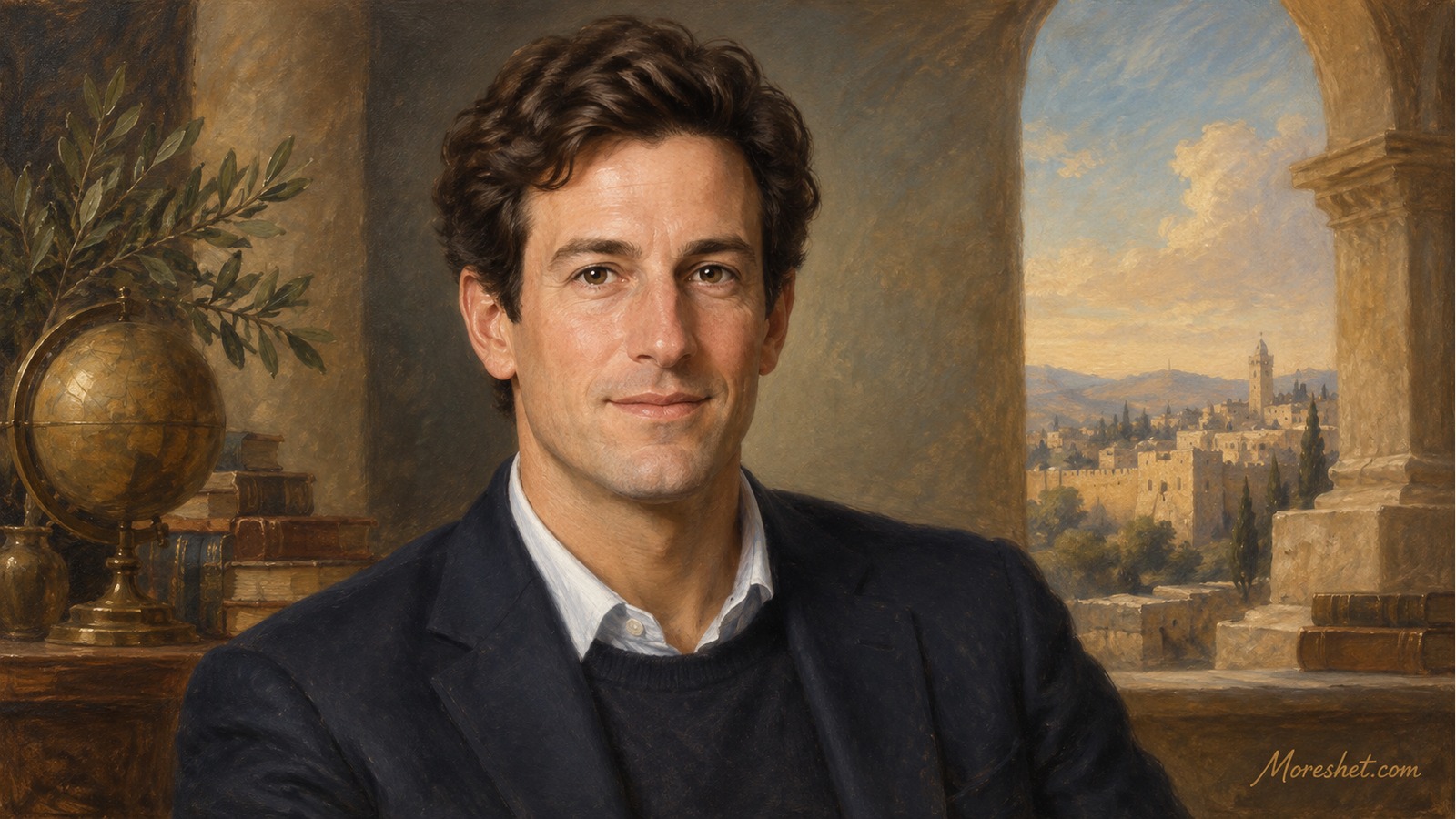
Josh Kushner — AI-generated artistic portrait · Moreshet.com 
Josh Kushner. Photograph by SWinxy, via Wikimedia Commons (CC BY 4.0).
Jewish-American investor and entrepreneur, founder of Thrive Capital, co-founder of Oscar Health, and a major investor in technology, health care, media and sports
Joshua Kushner, widely known as Josh Kushner, is a Jewish-American investor, entrepreneur and businessman. He is the founder and chief executive officer of Thrive Capital, co-founder and vice chairman of Oscar Health, co-founder of Vostu and Cadre, and one of the prominent figures in the newer generation of American venture capital. Unlike investors who only finance companies from a distance, Kushner built an investment institution that seeks to accompany companies over time — from early idea to major growth — helping determine which technologies, platforms and services receive the capital, trust and patience needed to reach global scale.
His importance does not rest only on a famous family name or proximity to political figures. Kushner has built an independent business path around technology, health care, software, consumer products, media, artificial intelligence and sports. Thrive Capital has invested in companies that shaped how people communicate, pay, consume digital services, use artificial intelligence and operate businesses. Oscar Health tried to renew one of America’s most conservative and complicated systems — health insurance — through technology, user experience and data-driven operations. In recent years, Kushner has also expanded into media and sports ownership, fields where capital, brand, community and culture meet.
Jewish family, Holocaust roots and education in New Jersey
Kushner was born on June 12, 1985, in Livingston, New Jersey, to a Jewish family. His parents are Charles and Seryl Kushner, and he was raised in a Modern Orthodox Jewish environment. The Kushner family carries a heavy Jewish memory: his grandparents were Holocaust survivors who came to the United States after the war from Novogrudok, in present-day Belarus. In such a family story, American business success is not only a tale of capital and entrepreneurship, but part of a wider path of survival, migration, rebuilding and Jewish integration into a new world.
He grew up in New Jersey with his siblings, including Jared Kushner, who later became a businessman and senior White House adviser. The family environment combined real estate, business, Jewish education, institutional ambition and broad social networks. Yet Joshua Kushner chose to build his main career not in the family’s real-estate world but in venture capital, technology and health care — fields where value is created less through ownership of physical property and more through early identification of an idea, team, market and timing.
His Jewish-American education matters for his heritage profile. He belongs to a generation of American Jews raised after the Holocaust, inside a United States of economic and technological opportunity, who entered positions where they do not merely participate in markets but help shape their new infrastructures: software, digital health, AI, media and professional sports.
Harvard, early ventures and the practical school of entrepreneurship
Kushner studied at Harvard College and graduated in 2008. He later completed an MBA at Harvard Business School in 2011. Already as a student, he was drawn to building new ventures. He was involved in Scene, a student publication focused on pop culture, and later co-founded Vostu, a company aimed at social games and the internet market in Latin America. Although Vostu did not become a lasting success at the scale initially imagined, it gave him early experience in emerging markets, rapid growth, competition, digital consumer products and the difficulties of building a global company.
After college he was also involved in Unithrive, a venture that tried to help students finance education by connecting alumni lenders with students who needed support. The idea was smaller than the companies he would later back, but it already expressed an interest in large and difficult systems: education, capital, debt, access to opportunity and the ability to use technology to connect people whom the traditional system does not easily connect.
Early in his career, he worked briefly at Goldman Sachs in private equity and distressed debt. That experience gave him a professional view of markets, balance sheets, risk, crises and valuation. But Kushner did not remain in traditional finance. He moved toward a world in which money is not only a tool for buying an existing asset, but a means of building new companies.
The founding of Thrive Capital
In 2009 Kushner founded Thrive Capital, a venture-capital firm initially focused on media, internet and young technology companies. Thrive was built in New York rather than Silicon Valley, and over time became one of the investment firms most closely associated with the meeting point of technology, consumer products, enterprise software, health care, finance and artificial intelligence. That choice mattered: it showed that a major technology investment firm could be built outside the classic California center, with deeper connections to New York’s ecosystem of media, finance, commerce and consumer life.
Thrive invested in early-stage and growth-stage companies, often building long-term relationships with founders. Companies associated with the firm’s investments include Instagram, Spotify, Stripe, Slack, Instacart, OpenAI, SpaceX, Skims and others. Not every investment had the same scale or significance, but together they point to an ability to identify companies that become platforms: not merely products, but broad systems of use that change behavior among consumers, developers, businesses or institutions.
One of Thrive’s best-known early investments was participation in Instagram’s funding before its acquisition by Facebook. That success became a symbol of the firm’s ability to recognize a visual consumer platform before it became a global cultural center. Later, investments in companies such as Stripe and OpenAI expanded Thrive’s standing from consumer internet into payments infrastructure, software and artificial intelligence.
An investor of the artificial-intelligence era
In the 2020s, Thrive Capital became especially associated with the artificial-intelligence wave. Its investments in OpenAI and other AI-related companies placed Kushner at the center of one of the period’s most important economic and technological shifts: the movement of AI from research or internal tooling into systems that millions of people use for writing, coding, search, design, customer service, data analysis, creation and knowledge management.
In 2024 Thrive raised very large new funds, and in 2026 it was reported to have raised more than 10 billion dollars for a new fund, the largest in its history. Such fundraising is not only a financial data point. It reflects institutional confidence that Kushner and the team he built can deploy capital in a period when AI, robotics, space, life sciences and computing infrastructure require large sums, patience, founder access and sometimes the courage to invest while the future remains unclear.
Thrive’s strategy often emphasizes deep relationships with founders, relatively concentrated investments and belief in companies that can define entire categories. From a business-heritage perspective, this places Kushner within a broad Jewish-American tradition of financiers, merchants and technology investors who played major roles in directing resources toward new ideas.
Oscar Health and the attempt to renew health insurance
In 2012 Kushner co-founded Oscar Health, an American health-insurance company intended to build a more modern, digital and understandable insurance experience. Oscar sought to address one of the most difficult systems in the United States: a health-care system that is expensive, fragmented and full of friction among patients, doctors, insurers, employers and regulators.
Kushner has served on Oscar’s board since its founding and later became vice chairman. The company went public in 2021 and continued to operate as a health-technology company focused on insurance plans, user experience, data infrastructure and digital tools. Oscar did not solve all the problems of American health care, and its business path included challenges, but its founding expressed an important attempt: to use the principles of software, product design and customer service to touch a system that had long been opaque and cumbersome for consumers.
In this sense, Oscar illustrates one of the central lines in Kushner’s career: attraction to large and complex systems in which technology can change interface, access and operations. As in venture capital, in health care he worked at a point where financial decisions ultimately affect people, families and the ability to receive basic services.
Cadre, real estate and financial technology
In 2015 Kushner co-founded Cadre with his brother Jared Kushner and Ryan Williams. Cadre was designed as a technology platform for real-estate investment by institutional investors, family offices and other capital holders. The venture sought to bring transparency, digitization and a new form of access to private real-estate markets, where deals had long been based on closed networks, personal relationships and processes not always accessible to outsiders.
Cadre connects two worlds in the Kushner family story: real estate and technology. On one hand, it touches the traditional field in which the family had long operated; on the other, it tries to turn that field into a financial-technology product that can be analyzed, distributed and managed more modernly. Here too the pattern returns: take an old, complicated and not always transparent system, and ask whether software, data and platform design can change how it works.
Media, LIFE, i-D and visual culture
In recent years Kushner expanded into media. Together with his wife, Karlie Kloss, he is connected to Bedford Media, a company that has worked to revive media and cultural brands with history. In 2023 Bedford Media acquired the fashion and culture magazine i-D, and in 2024 it announced an agreement to bring LIFE back into print and digital publication in partnership with Dotdash Meredith.
The choice of LIFE was not accidental. LIFE was one of the great brands in the history of photography, visual journalism and American storytelling. Its revival points to an interest not only in new technology but also in older institutions of memory: magazines, archives, photography, visual culture and stories that hold a place in public imagination. For Kushner, this expands investment thinking into fields where value is measured not only in software, but also in trust, legacy, brand and cultural depth.
His media involvement adds an important dimension to his profile. It shows that a contemporary technology investor does not operate only behind the scenes of SaaS or AI companies, but also in spaces where culture, image, story and public identity take form. In a world where traditional media struggles to find a new economic model, private capital can help decide which brands survive and which voices continue to be heard.
Professional sports as investment in communal brands
Kushner also entered the world of professional sports ownership. In 2019 he acquired a small stake in the Memphis Grizzlies, and later was connected with acquiring a stake in the Miami Heat. In 2026 it was reported that Thrive Capital, through an initiative called Thrive Eternal, was preparing to invest in the San Francisco Giants as part of a strategy focused on long-term sports and cultural assets that cannot be easily replicated by artificial intelligence.
In August 2026 it was reported that Kushner and Bob Iger reached an agreement to buy the Los Angeles Lakers at a valuation of 12.5 billion dollars, a transaction described as a record price for a professional sports team. Because major sports deals depend on approvals, ownership structure and closing processes, at the time of this profile it is more accurate to describe the matter as an acquisition agreement or reported agreed transaction, not simply as a final operational fact.
His move into sports reveals a wider direction in Kushner’s career: investment in assets whose value comes from community, loyalty, story, belonging and history. A major sports team is not only a business; it is a cultural institution. For an investor who cultivated technology companies, the move into sports and media reflects an understanding that in the age of AI, human brands, fan communities, memory and live experience may become especially rare assets.
Personal life and public identity
In 2018 Kushner married Karlie Kloss, a model, entrepreneur and advocate for technology education, after she converted to Judaism. The couple has three children. Their private life receives public attention at times, but both have generally maintained a measured family profile relative to their public standing.
Politically, Kushner has often been described as a Democrat, even though he belongs to a family strongly associated with the Trump administration through his brother Jared and Ivanka Trump. This point appears frequently in coverage of him, but it should not define his achievements. The separation between his business path and his family’s political identification underscores the effort to build an independent public figure: a technology investor, fund founder, digital-health entrepreneur and participant in media and sports.
His Jewish identity is present mainly through family, education, Holocaust roots, marriage, community and Jewish-American social circles. He is not a Jewish public figure in the sense of a rabbi, Jewish politician or communal leader, but his life and work belong to a broader story of American Jews who have influenced major institutions in the contemporary economy, technology and culture.
Capital, responsibility and institutional influence
Kushner represents a newer form of business power: not only an entrepreneur who builds one company, but an investor who helps decide which founders and ideas receive the opportunity to grow. Venture capital is a system of selection. It determines who receives time, team, infrastructure, patience and market access. When a firm such as Thrive invests in leading companies in payments, AI, health care, media or consumer technology, it participates in shaping the future of entire sectors.
Such power creates responsibility. Large technology investments are not neutral: they affect work, privacy, health, information, access, capital markets, culture and relations between human beings and machines. Kushner’s documentary importance arises in part from the fact that he operates at the point where private capital, technological innovation and public-social systems meet.
His profile also illustrates the changing figure of the Jewish-American business leader in the 21st century. Instead of only a merchant, banker or industrialist, the central figure here is a platform investor: someone who builds a fund, connects founders with resources, participates in financing AI infrastructure, enters health care, revives media brands and invests in professional sports. This is a new chapter in the economic and technological heritage of American Jewry.
Why this legacy belongs in Moreshet
Joshua Kushner merits inclusion in Moreshet because his story connects family Holocaust memory, Jewish-American education, technology entrepreneurship, venture capital, digital health, media, AI and professional sports. He is important not merely because he is a member of the Kushner family, but because he built Thrive Capital as an investment institution that influences which companies and technologies are given the chance to become infrastructures of modern life.
Moreshet.com documents Kushner because Jewish and Israeli heritage also includes Jewish figures working in the global economic and technological arena who shape systems people use every day: payments, health care, artificial intelligence, media, consumer products and sports communities. Josh Kushner’s place in Moreshet rests on the way capital, identity, technology and cultural institutions meet in his work — and on the understanding that in the present age, those who finance and build new infrastructure also influence the lives of Jewish, Israeli and wider human communities.