Frank Owen Gehry
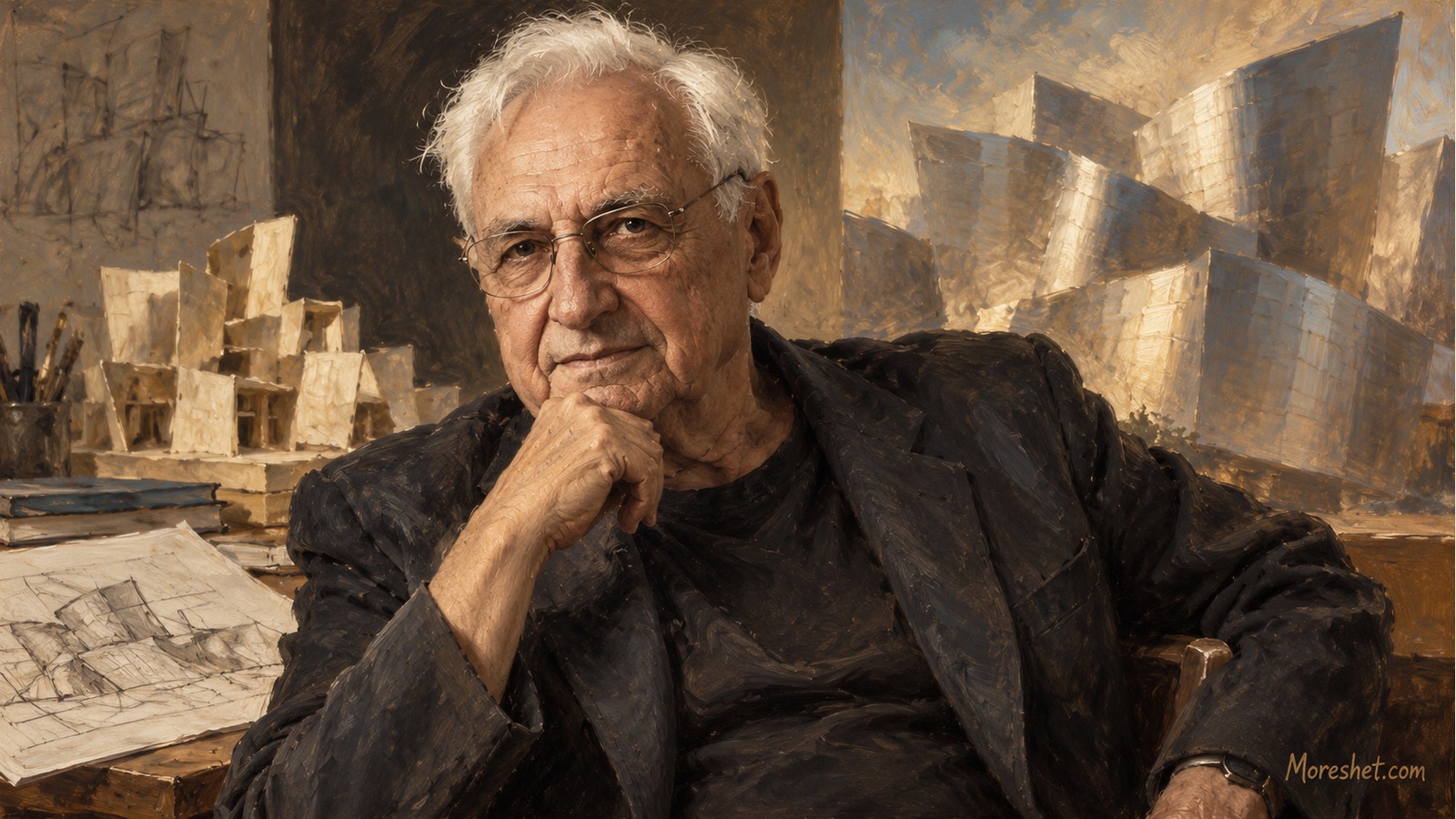
Frank Garry — AI-generated artistic portrait · Moreshet.com
The Jewish Canadian-American architect who transformed buildings through sculptural form, unexpected materials, and digital innovation
Frank Owen Gehry (February 28, 1929–December 5, 2025), born Frank Ephraim Owen Goldberg, was one of the most influential and recognizable architects of his era. From the Guggenheim Museum Bilbao to Walt Disney Concert Hall in Los Angeles, his buildings blurred the line between architecture and sculpture. They also demonstrated that an audacious building could reshape more than a skyline: it could change how people experienced art, music, public space, and even an entire city.
A Jewish architect born in Canada and based for most of his career in the United States, Gehry worked across architecture, design, education, and technology. He combined ordinary materials—plywood, chain-link fencing, corrugated metal, and cardboard—with titanium, glass, and stainless steel. He joined intuitive hand drawing to advanced three-dimensional modeling, making forms buildable that once would have been prohibitively difficult to calculate and fabricate. Although his work was frequently described as postmodern or deconstructivist, Gehry resisted rigid labels. He understood architecture as an inherently sculptural art that still had to answer to engineering, purpose, place, and human use.
Jewish roots, migration, and an education in materials
Gehry was born in Toronto to a Jewish family. His father, Irving Goldberg, was born in New York to an Eastern European Jewish family, while his mother, Sadie Thelma Caplan, was born in Łódź, Poland. His grandfather gave him the Hebrew name Ephraim, which he used at his bar mitzvah. Antisemitism was not an abstract part of the family's history: the Goldbergs returned to Toronto after encountering it in Timmins, Ontario, and in 1954 he changed his surname from Goldberg to Gehry after his then-wife expressed concern about antisemitic discrimination.
Some of the essential ingredients of his architecture appeared in childhood. With his grandmother Leah Caplan, he built imaginary cities from scraps of wood obtained from his grandfather's hardware store. Saturday visits to that store introduced him to utilitarian materials that architects conventionally concealed or dismissed. His mother encouraged his interest in museums, art, and music. Decades later, those experiences remained visible in his work: exposed structure became expressive, inexpensive materials acquired dignity, and a building's outer skin became an active composition of volume, movement, and light.
The family moved to California in 1947. Gehry drove a delivery truck and attended Los Angeles City College before enrolling in architecture at the University of Southern California. He graduated in 1954 and belonged to Alpha Epsilon Pi, the Jewish college fraternity. After serving in the United States Army, he studied city planning at Harvard's Graduate School of Design but left without completing the program. That encounter with planning helped widen his field of vision from the individual object to the city, its institutions, and architecture's social responsibilities.
From Los Angeles experimentation to an international practice
Early work and the Gehry Residence
Gehry worked for Victor Gruen Associates, a practice known for commercial development and urban thinking, and spent 1961 in Paris working for architect André Remondet. In 1962 he established his own Los Angeles practice. It later became Frank Gehry and Associates and, in 2001, Gehry Partners, the organization through which he produced projects around the world.
The David Cabin in Idyllwild, designed in 1957 with his former classmate Greg Walsh, already displayed exposed beams, unfinished wood, and an interest in making structure visible. The project that firmly established Gehry's experimental reputation, however, was the continuing transformation of his own Santa Monica residence, purchased in 1977. He wrapped the conventional 1920 house in chain-link fencing, plywood, glass, and corrugated metal without erasing the original building. The collision between old house and new enclosure became a manifesto: architecture could reveal its seams, layers, and construction rather than presenting itself as a polished, sealed object.
During the 1980s he expanded this language in such works as the Cabrillo Marine Aquarium, the California Aerospace Museum, and the eccentric Norton House in Venice. Their apparent informality was supported by close attention to spatial sequence, structure, art, and use. Collectively, these buildings helped make Los Angeles an important center of architectural experimentation, less bound by inherited European conventions.
Museums that became part of their cities' identities
Gehry's decisive international breakthrough was the Guggenheim Museum Bilbao, which opened beside the Nervión River in Spain in 1997. Its curving titanium surfaces change with the weather and light, making the enormous building appear to be in motion. The museum attracted an international public and contributed to Bilbao's cultural and economic renewal. Its impact gave rise to the planning term the “Bilbao effect”: the proposition that an exceptional cultural building can help transform a city's image and economy. The idea has often been qualified and cannot be reproduced by architecture alone, but the creation of the term itself reflects the extraordinary reach of Gehry's work.
He went on to design cultural institutions that developed different relationships among art, city, and audience. The Weisman Art Museum in Minneapolis presents a sharply folded steel face; Seattle's Museum of Pop Culture has a fluid, colorful envelope; Panama's Biomuseo uses vividly colored roofs to express biodiversity; and the Fondation Louis Vuitton in Paris resembles an assembly of glass sails set in the Bois de Boulogne. At LUMA Arles in France, he formed a tower from fractured, reflective volumes.
His transformation of the Art Gallery of Ontario in his native Toronto revealed a more restrained aspect of his practice. Rather than turning every commission into an extravagant gesture, Gehry used timber, glass, and internal circulation to reconnect the museum with its street and existing buildings. The project showed that his architecture was not a fixed visual formula. It was a method of reconsidering how visitors move, gather, look, and understand a place.
Buildings for music, learning, and civic life
Gehry's concert halls offered some of the clearest evidence that sculptural architecture could serve a demanding public purpose. Walt Disney Concert Hall, opened in Los Angeles in 2003, became the home of the Los Angeles Philharmonic and a cultural emblem of the city's downtown. Its stainless-steel exterior creates a powerful urban presence, while the auditorium brings listeners into a comparatively intimate relationship with the musicians. The building strengthened the cultural district along Grand Avenue and gave Los Angeles a concert venue with a distinctive civic identity.
He also designed the Jay Pritzker Pavilion in Chicago's Millennium Park, the New World Center in Miami Beach, and the Richard B. Fisher Center for the Performing Arts at Bard College. In each case, architecture made music and performance visible in civic life. The arts were not hidden behind an anonymous facade; they became an invitation, a public gathering point, and part of the character of the surrounding place.
At academic institutions, Gehry explored how buildings could encourage movement, encounter, and the exchange of ideas. His projects included the Stata Center at the Massachusetts Institute of Technology, the Peter B. Lewis Library at Princeton University, and the Dr Chau Chak Wing Building at the University of Technology Sydney. The undulating Sydney facade, assembled from hundreds of thousands of hand-laid bricks, joined traditional craft to digitally calculated geometry.
Other projects extended his influence across the urban landscape. The Dancing House became an emblem of post-Communist Prague; 8 Spruce Street brought a rippling facade to a New York residential tower; and the Dwight D. Eisenhower Memorial in Washington created a public setting for remembering the general who commanded Allied forces in Europe during the Second World War and later served as president.
The technology behind the seemingly impossible
Gehry's importance cannot be measured solely by the appearance of his buildings. The curving shapes that emerged from his hand-drawn sketches demanded new methods of calculation, fabrication, and coordination. His practice adapted three-dimensional tools associated with aerospace and manufacturing, using them to translate sculptural models into precise information for architects, engineers, fabricators, and contractors.
In 2002 the practice spun off Gehry Technologies. Working with Dassault Systèmes, the company developed tools including Digital Project for modeling complex buildings and coordinating the many participants in construction. These methods advanced the use of integrated digital design across architecture, engineering, and construction. Gehry therefore influenced the profession in two connected ways: through the buildings that architects studied and through the working processes that enabled a generation of designers and engineers to realize previously impractical geometries.
Design, teaching, and access to the arts
Gehry's experiments also operated at the scale of furniture and objects. His Easy Edges series turned corrugated cardboard, an inexpensive packing material, into strong sculptural furniture. He later produced bentwood chairs, jewelry, tableware, sculpture, fish lamps, a sports trophy, and a yacht. The fish became a recurring motif, appearing in his Barcelona fish sculpture and in lamps built from wire armatures and fragments of plastic laminate. These works carried his curiosity about structure, movement, and material beyond the boundaries of the building.
He maintained a long involvement with exhibition design, particularly at the Los Angeles County Museum of Art. One of the most historically significant projects was the installation for an exhibition about the fate of modern art persecuted as “degenerate” by Nazi Germany. He also created stage settings for dance and opera, including Lucinda Childs's Available Light and musical productions presented in spaces he had designed.
Gehry taught at institutions including the University of Southern California, Harvard, Yale, Columbia, UCLA, and the University of Toronto. His educational influence was not simply a matter of passing on a recognizable style. Students encountered a design process built on drawing, physical models, experimentation, revision, digital tools, and collaboration across disciplines.
His commitment to arts education also took institutional form. In 2014 he co-founded Turnaround Arts: California, a nonprofit expanding access to the arts in under-resourced public elementary and middle schools. He donated professional time to socially focused projects, including a Children's Institute facility in the Watts neighborhood and a home for Youth Orchestra Los Angeles. Completed in 2021, the YOLA center supports young people from underserved communities with free instruments, music instruction, performance space, and academic assistance. It is a direct example of architecture serving education, opportunity, and community life.
Recognition and lasting influence
Gehry received the Pritzker Architecture Prize in 1989, the profession's most prominent international honor. His other distinctions included the Wolf Prize in Arts, the Praemium Imperiale, the American Institute of Architects Gold Medal, the National Medal of Arts, the Prince of Asturias Award for the Arts, and the Presidential Medal of Freedom. He was a Fellow of the American Institute of Architects and a Companion of the Order of Canada, reflecting the esteem in which he was held in both countries central to his life.
His deepest legacy remains embedded in buildings and methods. He expanded architecture's vocabulary: industrial materials could carry beauty and cultural importance; a wall could seem to move; a museum could participate in urban renewal; and computers could do more than make conventional drafting efficient—they could enable fundamentally new forms. Architects around the world adopted, developed, and sometimes argued with these ideas. That continuing debate is evidence of substantial influence rather than a passing fashion.
Why Frank Owen Gehry's legacy belongs in Moreshet
Frank Owen Gehry merits a central place in Moreshet because his life connects a modern Jewish experience of migration and antisemitism with creative achievement of global consequence. The Jewish child who made imaginary cities from wood scraps in his grandmother's home became an architect who altered real cities. He did not claim to create a narrowly defined “Jewish architecture,” yet his story preserves an important strand of modern Jewish heritage: carrying family memory and identity into universal professional work, even after changing a Jewish surname because of the fear of discrimination.
The reasons for his inclusion are concrete. The Guggenheim helped renew Bilbao; Walt Disney Concert Hall gave Los Angeles a major civic and musical landmark; the digital tools his practice advanced changed how complex structures could be designed and built; and his educational and pro bono work widened young people's access to art and music. By documenting this record, Moreshet.com presents readers in Israel and around the world with a consequential example of Jewish contribution to architecture, technology, education, urban culture, and the shared human environment.