Dan Eitan
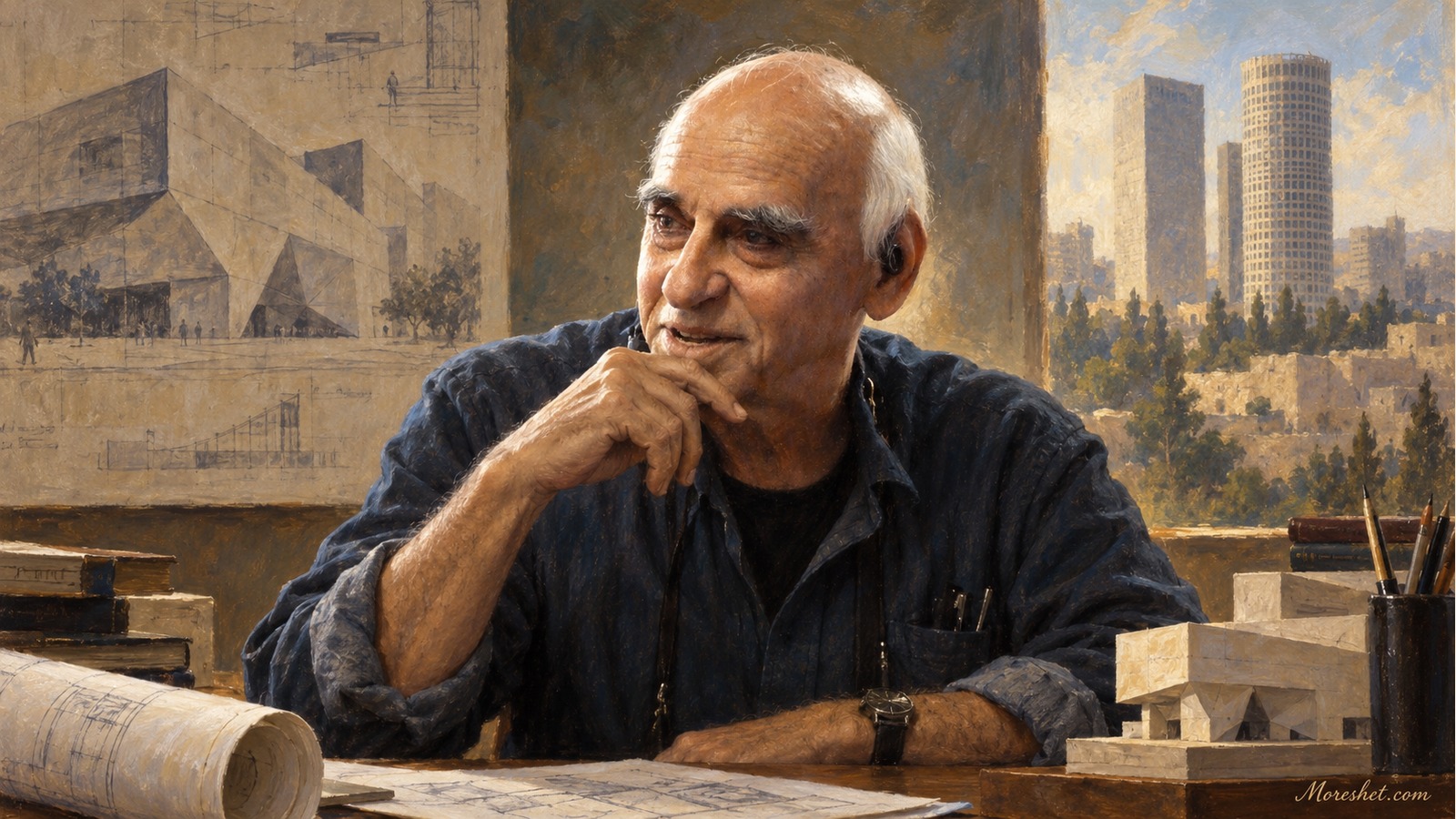
Dan Etan — AI-generated artistic portrait · Moreshet.com
The Israel Prize-winning architect who helped shape the country’s cultural, civic, academic, and residential landscape
Dan Eitan (Ettingen) (June 28, 1931–January 11, 2023) was a leading Israeli architect whose long career coincided with the creation and expansion of many of Israel’s civic and cultural institutions. Over nearly seven decades, he worked on museums, university facilities, government buildings, commercial centers, housing, and urban plans in Israel and abroad. His best-known projects include the main building of the Tel Aviv Museum of Art, the Mexico Building at Tel Aviv University, Clal Center in Jerusalem, and Israel Police National Headquarters.
Eitan’s importance rests not on a single architectural type but on the breadth of public life his work accommodated. His buildings became places where Israelis encountered art, studied, worked, received public services, shopped, and lived. Together, they form part of the physical record of Israel’s transformation from a young state urgently constructing its institutions into a complex urban society.
From sculpture to architecture
Eitan was born at Kibbutz Ein Shemer, associated with the Hashomer Hatzair movement. His family left the kibbutz for central Israel when he was four. Before turning to architecture, he studied sculpture at the Avni Institute, gaining an early grounding in form, volume, and material.
His route into architecture followed his participation in a competition to design a memorial incorporating a remembrance room. The project brought artistic expression together with built space and public memory, leading him to study architecture at the Technion–Israel Institute of Technology. He graduated in 1955.
While still a student, Eitan worked in the office of Zeev Rechter, a formative figure in Israeli modern architecture. After graduation he spent about six months with an architectural practice in Finland. On returning to Israel, he worked for a period in Dov Karmi’s office. These early positions placed him in direct contact with influential architects and professional environments during a decisive period in the country’s development.
Partnerships and an independent practice
Approximately two years after graduating, Eitan established an independent office. In 1958 he entered into partnership with architect Yitzhak Yashar. Their collaboration, which continued until 1965, produced several of the projects for which both architects became best known. Eitan resumed independent practice in 1966 and was later a partner of architect Ari Goshen from 1978 until 2010. He subsequently established a practice with his partner, architect Ruth Lahav.
These long collaborations enabled Eitan to work at markedly different scales. In addition to individual buildings, he participated in planning neighborhoods and cities in Israel and Iran. His portfolio encompassed cultural institutions, public facilities, commercial complexes, and housing, including an early 14-story residential tower in Jaffa built with concrete, precast elements, and large pebbles.
Architecture embedded in Israeli public life
Tel Aviv Museum of Art
A defining achievement of the Eitan–Yashar partnership was the design of the main building of the Tel Aviv Museum of Art. The project, documented from 1964, provided one of Israel’s central cultural institutions with a setting for exhibitions, education, and public engagement. Eitan and Yashar received the Rechter Prize for the design.
The building’s significance extends beyond its architectural distinction. For decades it served artists, curators, students, and visitors, helping to shape the way Israeli audiences encountered both Israeli and international art. It gave durable physical form to an institution central to the country’s visual culture.
Tel Aviv University and the connection between art and education
Eitan and Yashar also designed the Mexico Building at Tel Aviv University, a project dated to 1967. As part of the university’s developing campus, the building supported teaching and creative work within a rapidly expanding national institution. The architects received the Rokach Prize for its design.
Eitan’s contribution to the relationship between higher education and visual culture also included the Genia Schreiber University Art Gallery. Such projects placed art not at the margins of academic life but within the everyday spaces of learning, research, and public exchange.
Jerusalem’s civic and commercial landscape
In Jerusalem, Eitan designed a series of major projects that became part of the city’s changing urban fabric. They included Clal Center, dated to 1972; Israel Police National Headquarters, dated to 1973; City Tower from the mid-1970s; and the Hashoshanim residential tower at the edge of the Talbiya neighborhood.
These buildings served different aspects of urban life—public administration, policing, offices, commerce, and housing. Collectively, they demonstrate Eitan’s participation in the reshaping of Jerusalem during a period of intensive construction and institutional growth.
Projects across Israel and overseas
Other works attributed to Eitan and his practices include the community cultural hall at Givat Haim Ihud, the Hanitzahon neighborhood in Dimona, Hadera’s central bus station, and the “Subaru” building on HaMasger Street in Tel Aviv. With Yitzhak Yashar, he participated in planning civil services and public buildings at the Nuclear Research Center in the Negev, as well as work on a central structure at the site. The partners also designed a residential neighborhood in Côte d’Ivoire, documented in 1964.
The variety of this portfolio reveals the practical reach of Eitan’s profession. Architecture, in his career, provided a framework not only for prominent national institutions but also for transportation, commerce, housing, and community life. Although some of the buildings have changed over time, they continue to document the materials, construction methods, and public ambitions of Israel in the second half of the twentieth century.
Teaching and professional leadership
Alongside his architectural practice, Eitan taught at the Technion and attained the rank of professor. Teaching allowed him to connect extensive experience in buildings and urban planning with the education of architects.
He also assumed leadership roles within the profession. From 1986 to 1988, he chaired the national committee of the architects’ association and the United Architects Association. In 1993, he served on the steering committee established to develop what became the Azrieli School of Architecture at Tel Aviv University. In 1997, he was a member of an international review committee for the Technion’s Faculty of Architecture and Town Planning.
These positions broadened his contribution beyond his own commissions. He took part in shaping the professional organizations and academic structures through which Israeli architecture was taught, evaluated, and advanced.
Awards and public recognition
Eitan’s work received several of Israeli architecture’s major distinctions. He and Yitzhak Yashar were awarded the Rechter Prize for the Tel Aviv Museum of Art and the Rokach Prize for the Mexico Building at Tel Aviv University. In 2013, Eitan was named an Esteemed Citizen of Tel Aviv-Jaffa, recognizing his connection to a city that contains several of his most important works.
In 2019, he received the Israel Prize for Architecture, the country’s highest state honor in the field. The award recognized a career that extended from Israel’s early decades into the twenty-first century and combined architectural practice, teaching, and professional service.
Final years and architectural legacy
Eitan lived in Herzliya with Ruth Lahav, his partner in life and architecture. He died there on January 11, 2023, at the age of 91, and was buried at Nahalat Yitzhak Cemetery. He was survived by four children and an extended family.
His most tangible legacy remains the buildings themselves. They tell part of the story of how Israel constructed museums, universities, government institutions, commercial centers, transportation facilities, and homes. Eitan’s work is therefore more than a catalog of individual designs: it is a built record of the country’s civic development and of the cultural and public life that grew within it.
Why Dan Eitan belongs in Moreshet
Dan Eitan merits inclusion in Moreshet because his influence is present in places where Israeli culture and society operate in everyday life. He helped give architectural form to a major art museum, university spaces, public institutions, urban centers, and residential environments. Generations of Israelis have used these buildings to experience art, pursue education, receive public services, work, and participate in city life.
This profile on Moreshet.com preserves more than a list of commissions. It records Eitan’s role in building the physical infrastructure of sovereign Israeli life and in creating settings for culture, knowledge, community, and public institutions. His combined record as a designer, professor, and professional leader—recognized by the Israel Prize, the Rechter Prize, and the Rokach Prize—secures his place in the history of Israeli architecture and in Israel’s material and civic heritage.