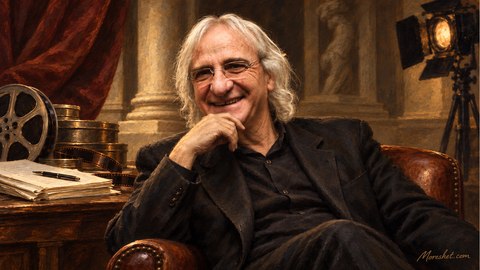
Etgar Keret
Short-story writer and filmmaker whose surprising, compassionate fiction brought a distinctive Israeli voice to readers around the world
Etgar Keret, born in Ramat Gan in 1967, is an Israeli short-story writer, screenwriter and filmmaker with an international readership. In a few pages he can establish a character, introduce an unexpected reality and reach a deep emotional consequence. His conversational language and humour can turn suddenly toward pain or compassion. Collections such as Missing Kissinger and Suddenly, a Knock on the Door expanded both the audience for short fiction and the possibilities of contemporary Israeli storytelling.
A local voice with an international reach
Keret grew up in a family of Holocaust survivors from Poland. Family experience and inherited memory appear alongside ordinary Israeli life, without requiring a ceremonial or solemn style. His first collection, Pipelines, appeared in 1992. The success of Missing Kissinger helped establish him among younger readers and a broader literary public.
A story may begin with a familiar situation—a child, an object, a conversation or a chance meeting—before following an unexpected rule. Characters sometimes accept the impossible as an everyday fact, encouraging readers to reconsider what is strange about ordinary reality. Brevity is therefore more than a matter of length. It concentrates an experience while leaving imaginative work for the reader.
Humour that opens into feeling
Stories such as Breaking the Pig and The Siren expose the distance between accepted social rules and an individual's response. A small figure, an awkward moment or a gesture can carry an ethical question without turning the narrative into instruction. A conclusion may surprise, but the story's effect continues beyond its final turn.
Later collections developed this approach, including Anihu, Suddenly, a Knock on the Door and the Hebrew collection published in English as Fly Already. The latter received the Sapir Prize. Translations and publication in international literary magazines demonstrated that a voice grounded in very particular Israeli details could also be immediately engaging to readers elsewhere.
Stories across different media
Keret wrote for television, including The Cameri Quintet, and collaborated with comics artists and filmmakers. Jellyfish, which he co-directed with Shira Geffen, won the Caméra d'Or at Cannes in 2007. The award for a first feature acknowledged a collaborative achievement that carried a literary sensitivity into image, performance and cinematic structure.
Children's books, essays and personal accounts have added other dimensions to his work. Teaching and writing workshops have also made him part of the conversation through which new writers develop their craft. Across these activities, a recognisable concern remains: the individual seeking connection in a world that does not always behave reasonably.
His international reception is particularly valuable as an encounter with Israeli culture beyond the news. Readers meet humour, family attachment, anxiety and imaginative freedom, all expressed through specific voices rather than a general statement about a country.
Why Etgar Keret belongs in Moreshet
Etgar Keret belongs in Moreshet at Moreshet.com because he gave Israeli literature an original and recognisable route into the wider world. He expanded the short story's range by joining humour with compassion, local life with imaginative invention and family memory with the present. His writing adds voices to Jewish and Israeli heritage that feel intimately human even when they describe impossible events.