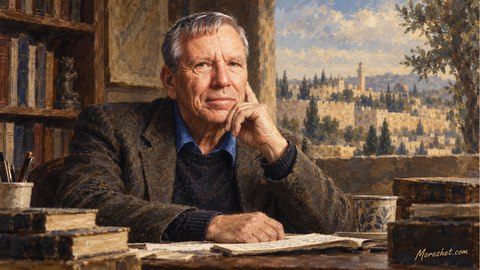
Elhanan Leib Lewinsky
The writer and publisher who imagined a Hebrew future and helped build its cultural foundations
Elhanan Leib Lewinsky (1857–1910) understood national renewal as both an imaginative undertaking and a daily cultural task. A writer, essayist, publisher and activist in Hovevei Zion, he considered how Hebrew could sustain a living world of education, literature and public conversation. His best-known work described a future Land of Israel. His practical activities helped develop the readers, books and institutions that a modern Hebrew culture would require.
Education, commerce and the Odessa literary world
Lewinsky was born near Vilna, in what is now Lithuania. His traditional Jewish education was accompanied by an interest in the literature of the Haskalah, the Jewish Enlightenment. He worked as a teacher and a merchant, becoming involved in Hovevei Zion during the early 1880s. A visit to the Land of Israel in that period strengthened his commitment to the development of a Jewish cultural centre there.
Odessa became the principal setting of his mature activity. Its Jewish literary circles brought him into close contact with Ahad Ha'am, Hayim Nahman Bialik and Yehoshua Hana Ravnitzky. His emphasis on education and the substance of public life reflected the cultural questions discussed in that environment. Alongside literary work, he managed the local Carmel enterprise, promoting wine produced by Jewish settlements in Palestine. Cultural aspiration and practical economic connections were parts of the same undertaking.
Imagining a Hebrew future
In 1892 Lewinsky published Journey to the Land of Israel in the Year 5800, a utopian story set in 2040. A travelling couple encounters a future society in which Hebrew, education and intellectual life occupy a central place. The book is an early landmark of Hebrew utopian fiction and is frequently discussed in histories of Hebrew science fiction. It appeared a decade before Theodor Herzl's Altneuland, while developing a distinctively culture-centred vision.
Its importance does not depend on whether particular predictions proved accurate. Lewinsky invited readers to think in Hebrew about institutions, technology, ethical conduct and everyday arrangements that did not yet exist. A language associated with inherited texts and historical memory became a means of imagining a modern future. The journey format also made ambitious social ideas accessible through the experience of ordinary travellers.
A conversational voice in the Hebrew press
Lewinsky's literary achievement extended beyond the utopian story. In his Thoughts and Deeds series in Ha-Shiloah, he developed the Hebrew feuilleton: a short, observant form combining humour, reflection and commentary on public affairs. He addressed readers through familiar situations and recognisable human weaknesses, allowing large cultural questions to emerge from smaller incidents.
His articles, stories and travel writing appeared in several Hebrew publications, sometimes under pen names, including Rabbi Karov. This work helped make the periodical press a place of sustained conversation. The reader was invited to consider the relationship between ideals and conduct, rather than simply receive a programme of national aspirations.
Publishing for the next generation
In 1901 Lewinsky joined Bialik, Ravnitzky, S. Ben-Zion and Meir Dizengoff in founding the Moriah publishing house in Odessa. Its educational and literary books contributed to the developing modern Hebrew school. The enterprise helped make biblical texts, rabbinic stories and Hebrew reading material available in forms suited to younger audiences.
Publishing gave practical expression to Lewinsky's cultural outlook. A Hebrew-speaking future required more than enthusiasm for a language: teachers needed books, children needed accessible reading and institutions needed a dependable body of material. His contribution therefore included the less conspicuous work that allows literary and educational life to continue beyond a single celebrated author.
Why Elhanan Leib Lewinsky belongs in Moreshet
Lewinsky belongs in Moreshet at Moreshet.com because he connected cultural imagination with cultural infrastructure. He helped readers picture a Hebrew future, developed an engaging public voice and participated in building the educational resources that could support that future. His name survives in streets, Tel Aviv's Lewinsky Market and the tradition of teacher education associated with it. His deeper legacy lies in showing how writing, publishing and practical organisation can reinforce one another in the renewal of Jewish life.