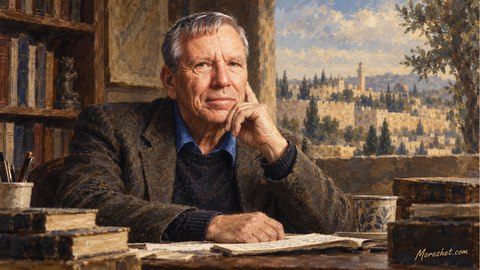
Hanoch Bartov
Israel Prize-winning novelist whose work connected the Jewish Brigade, encounters with Holocaust survivors and the making of Israeli society
Hanoch Bartov (1926–2016) was an Israeli novelist, journalist, translator and cultural representative who received the Israel Prize for literature in 2010. Although he belonged to a generation born in Palestine, his writing repeatedly emphasised the relationship between Israeli life and the wider Jewish story. War, migration, family and memory emerge through people trying to understand both their experiences and their place within a continuing history.
A young soldier encountering postwar Europe
Born Hanoch Helfgott in Petah Tikva to parents who had immigrated from Poland, Bartov enlisted in the British Army at seventeen and later served in the Jewish Brigade in Europe. Encounters with Holocaust survivors and the remnants of European Jewish life became formative experiences. He began publishing stories while still a soldier.
After returning, he studied general and Jewish history at the Hebrew University. During the War of Independence he served in Jerusalem with the Etzioni Brigade and was wounded. He subsequently lived on Kibbutz Ein HaHoresh, teaching and working in agriculture while continuing to write. Life in the developing Israeli society remained connected to the events he had witnessed abroad.
Fiction about identity and encounter
Pitzei Bagrut, published in 1965 and translated into English as The Brigade, follows Jewish soldiers meeting Europe at the war's end. It asks how young people raised in Palestine understand the fate of the wider people to which they belong. Instead of leaving the native-born Israeli and the European Jew as fixed opposites, the novel examines connections, misunderstandings and developing responsibilities.
Everyone Had Six Wings portrays an immigrant neighbourhood and the effort to build a common life. Whose Little Boy Are You? returns to childhood in Petah Tikva and the family world behind a newly formed Israeli identity. Across these books, belonging is something lived and negotiated. Becoming Israeli does not eliminate the memories and relationships that precede it.
Documentary writing and cultural service
Bartov also wrote Dado: 48 Years and 20 Days, a substantial biography of Chief of Staff David Elazar with particular attention to the Yom Kippur War. The project added a documentary dimension to his work, combining collected material with an effort to understand a person carrying great historical responsibility. It received the Yitzhak Sadeh Prize for military literature.
His journalism appeared in LaMerhav and Maariv. From 1966 to 1968 he served as cultural attaché at Israel's embassy in London, and he was also active in the Israeli branch of PEN. The Bialik Prize and other honours, alongside the Israel Prize, recognised a career that connected literary creation with the wider public life of culture.
Throughout that career, he returned to the individual account: the family remembered, the unfamiliar neighbour, the soldier learning what had happened elsewhere. Such attention gave large historical changes a human scale without making them simple.
Why Hanoch Bartov belongs in Moreshet
Hanoch Bartov belongs in Moreshet at Moreshet.com because he deepened the literary connection between Israel and Jewish historical memory. He gave form to encounters between native-born Israelis and Holocaust survivors, to immigrant lives and to the identity of a society taking shape. His books show an Israeli heritage built through human continuity as well as new beginnings.