Aharon Megged
Israel Prize-winning novelist and editor whose work explored individual lives within Israeli society and the claims of cultural memory
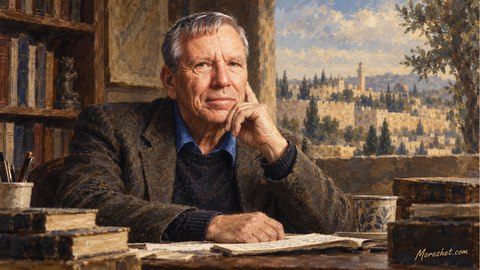
Aharon Megged (1920–2016) was an Israeli novelist, playwright, editor and essayist whose work became an important part of post-independence Hebrew literature. His books explore the kibbutz and the city, public ideals and the individual who does not always fit comfortably within them. Alongside a substantial creative career, he helped sustain literary platforms and represent Israeli culture abroad. He received the Israel Prize for literature in 2003.
From collective life to literary work
Born Aharon Greenberg in Poland, Megged immigrated with his family in 1926. He grew up in Ra'anana, attended the Herzliya Hebrew Gymnasium and participated in the HaMahanot HaOlim youth movement. He was a member of Kibbutz Sdot Yam for many years. Collective life and pioneering ideals were lived experiences, supplying both affection for a social project and questions about what it demanded of individuals.
He began publishing stories in the 1940s, and his first book, Ruach Yamim, appeared in 1950. After moving to Tel Aviv, he expanded his literary and journalistic activity. The movement between kibbutz and city brought him into contact with different forms of ambition, success and belonging in a changing society.
People within the stories of a society
Hedva and I considers the move from a kibbutz to the city and the tension between a shared plan and the separate desires of a couple. It became the basis for Hedva and Shlomik, an early Israeli television drama, carrying his work to an audience beyond the printed book.
Books including The Living on the Dead, The Evyatar Notebooks and Foiglman continue to examine relationships between people and the narratives through which their lives are understood. In Foiglman, a Yiddish poet and an Israeli historian encounter each other within a relationship charged by memory and the need for recognition. The Jewish literature of Europe seeks an address within the Israeli present rather than remaining safely confined to the past.
Building a literary conversation
Megged was a founder and long-serving editor of Masa and worked as a literary editor for LaMerhav and Davar. Such editing is a form of cultural construction. Selecting work, developing discussion and placing different voices beside one another help writers and readers become part of a common literary world.
From 1968 to 1971 he served as cultural attaché at Israel's embassy in London. He participated in literary programmes abroad and held visiting writing appointments, while translations brought his books to readers in other languages. The Bialik, Brenner and Israel prizes acknowledged a sustained contribution across fiction, drama, essays and cultural service.
The breadth of his career reveals a writer concerned not only with what a book says but also with the environment in which books can be heard. Creation and editing reinforce one another, joining individual artistic work to the continuing life of a literature.
Why Aharon Megged belongs in Moreshet
Aharon Megged belongs in Moreshet at Moreshet.com for his contribution to the literary portrait of Israel and its relationship with a wider Jewish memory. He made room for the person behind a public ideal and for the story that has not yet found a listener. His work as an editor and cultural representative added lasting service to Hebrew literature and its readers.