Yoram Arbel
The Israeli broadcaster whose voice turned sporting moments into shared national memories
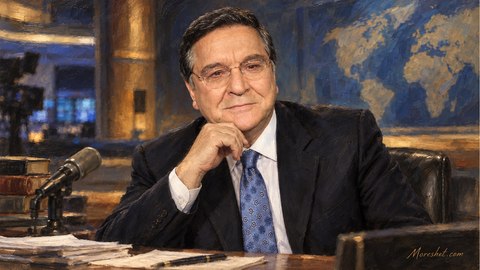
Yoram Arbel (born June 23, 1942) is an Israeli sports broadcaster, radio and television presenter, singer, and producer. For more than five decades, he has accompanied Israeli public life through the microphone and television screen. He reported the outbreak of the Six-Day War on radio, narrated major football and basketball events, hosted popular television programs, helped establish the sports website ONE, and created expressions that entered everyday Hebrew. His career shows how broadcasting can become part of a society's collective memory.
From Petah Tikva to broadcasting
Arbel was born in Petah Tikva as Yoram Arbeiter and grew up in a working family. His father, Mula, managed a health-fund warehouse, while his mother, Haya, was a homemaker. Sport was part of his life from an early age. He played handball and trained in athletics with Hapoel Petah Tikva, winning the 1960 Israeli senior javelin championship.
He served in the Nahal entertainment troupe alongside Aliza Rosen, Hanan Goldblatt, Yisrael Poliakov, Gavri Banai, and Yehoram Gaon, who was then the troupe's commander. The experience combined performance, timing, vocal presence, and the ability to engage a large audience — skills that later became central to his work in radio and television.
Radio beginnings and the move to television
Arbel began his media career in the 1960s as a newsreader and presenter on Kol Yisrael. On June 5, 1967, he presented the news bulletin announcing the outbreak of the Six-Day War. His voice helped bring an unfolding historic event directly into Israeli homes at a moment of national uncertainty.
In 1968 he traveled to New York to study television. After returning to Israel, he continued in radio while also establishing an advertising and jingle-production business. One of the campaigns associated with him was Elite coffee's “The people chose Elite coffee.” He also recorded music. His 1969 hit “I’ll Paint the Autumn Leaves Green” topped Israeli radio charts and was later included on his only album, Tov She’at Kan (“It Is Good That You Are Here”), released in 1972. That year he also recorded a successful Hebrew-market cover of Elvis Presley's That's When Your Heartaches Begin.
The voice of Israeli sport
In 1972, Arbel joined the sports department of Israeli Television under Dan Shilon. He first concentrated on football and, from the early 1980s, also broadcast basketball. He regularly presented the sports magazine Mabat Sport alongside Orly Yaniv and became one of the most recognizable voices on Israeli television.
His broadcasts accompanied events that carried significance well beyond the scoreboard, including Maccabi Tel Aviv's second European Cup basketball victory in 1981. For many Israelis, his commentary transformed games into shared national occasions, bringing families and communities together around the screen.
In 1986, together with Mordechai Spiegler, he broadcast the Mexico World Cup quarter-final between Argentina and England, remembered for Diego Maradona's first goal, later known as the “Hand of God.” On March 19, 1989, while broadcasting Israel's World Cup qualifying match against Australia, Arbel coined the phrase “You can't build a wall like that,” which became a Hebrew expression used far beyond football. His cry of “Hallelujah” after an especially beautiful goal became another enduring trademark.
Commercial television, production, and national news
After the 1990 World Cup, Arbel moved to the newly established Sports Channel and became its principal commentator. From 1994 to 1999, he broadcast the featured match of Israel's top football league on Channel 2 through an independent production company he founded. He also hosted The 91st Minute, the channel's weekly review program. The show helped make the weekend football roundup a regular part of Israeli popular culture.
On November 4, 1995, during the program, Arbel delivered a special bulletin reporting the assassination of Prime Minister Yitzhak Rabin. He was the first to report the event on air and later described that broadcast as the most important moment of his television career. The episode showed how a presenter associated with sport and entertainment could suddenly be called upon to communicate news of national trauma to the public.
At the end of the 1990s, Arbel was among the founders of ONE, a sports website initially also called The 91st Minute. His participation marked the transition of Israeli sports journalism from scheduled broadcasts and print coverage toward continuous online news, scores, and commentary.
A broadcaster across generations
Arbel's production company produced the Israeli version of Who Wants to Be a Millionaire? from 1999 to 2007, with Arbel as host. The program first aired on Channel 2 and later moved to Channel 10; it won a 2000 award in the quiz-show category. His ability to move between sport, news, entertainment, and production made him one of the most versatile and recognizable figures in Israeli television.
During the first decade of the twenty-first century, he continued to broadcast and produce Israeli Premier League basketball, UEFA Champions League matches, and games involving the Israel national football team. In 2012 he returned to Channel 1 after a 22-year absence and covered events including the London Olympics. He also broadcast the 2014 World Cup and later worked with ONE and Charlton, including broadcasts of Spanish league matches.
His work also reached audiences beyond conventional sports television. At the 2022 World Cup, he participated in studio broadcasts adapted for blind and visually impaired viewers. The initiative expanded access to a major shared sporting experience and reflected the continuing public role of broadcasting in connecting diverse audiences.
Music, food, and popular culture
Arbel's cultural activity extended beyond broadcasting. He appeared with the Apples at a groove festival in 2011 and in 2019 participated in the song “Hands in the Air,” alongside Shaanan Street and Noam Amit, on producer Ido Maimon's album Memories from the Future. In 2022 he appeared on the television program The Masked Singer.
In 2009 he opened a hummus restaurant in Ramat Gan called Hummus Hallelujah, selling it in 2014. He explained that he had imagined opening such a restaurant for two decades and described hummus as a “bridge over troubled waters” between Israel and its neighbors. The venture reflected his familiar combination of humor, Israeli popular culture, and an instinct for bringing people together.
Recognition and lasting influence
From 2002 through 2005, Arbel won the Golden Screen Award for Sports Presenter four years in succession. In December 2015, he received a Lifetime Achievement Award in Sport at the Israeli Sports Awards. These honors recognize more than longevity. Across decades, Arbel helped define how Israelis experienced matches, victories, disappointments, and national moments through radio and television.
Why Yoram Arbel belongs in Moreshet
Yoram Arbel merits inclusion in Moreshet because his work stands at the meeting point of Israeli media, sport, language, and shared public experience. He reported historic news, narrated defining sporting events, hosted major entertainment programs, and helped move sports journalism into the digital age. His phrases became part of spoken Hebrew, while his broadcasts gave generations of Israelis a common vocabulary for excitement, suspense, and celebration.
His place on Moreshet.com is therefore not based only on professional fame. It reflects a documented contribution to Israeli cultural life: the growth of sports broadcasting, the role of television in shaping collective memory, and the ability of a single distinctive voice to turn a live broadcast into an enduring part of national heritage.