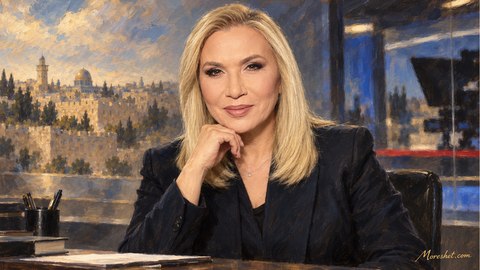
Chaim Yavin

Chaim Yavin — AI-generated artistic portrait · Moreshet.com
The journalist, editor, and documentary maker who helped build Israeli television and shape the country’s public memory
Chaim Yavin is one of the defining figures in the history of Israeli broadcasting. For decades he did more than present the news: he helped build Israeli television, shaped the language of public broadcasting, produced documentaries about the country’s identity and conflicts, and gave national events a recognizable frame and narrative. His long presence on screen, measured delivery, and professional authority made him known to generations of Israelis as “Mr. Television.”
From Radio to Israeli Television
Yavin was born on September 10, 1932, in Beuthen, Germany, now Bytom in Poland, as Heinz Kluger. He was a descendant of Rabbi Shlomo Kluger. In 1933 he immigrated with his family to Mandatory Palestine and grew up in Kiryat Binyamin, later incorporated into Kiryat Ata. He attended high school in Kiryat Motzkin, worked in the metal shop of the Phenicia factory in Haifa, and completed his matriculation examinations during his military service.
He later studied at the Hebrew University of Jerusalem, earning a bachelor’s degree in Hebrew and English literature and pursuing graduate studies in comparative literature. As a student he worked at several temporary jobs and played as a regular member of Hapoel Jerusalem’s football team. His literary education and practical experience helped develop the skill that became central to his career: presenting complex stories in language that was clear, precise, and accessible to a broad public.
In 1956 Yavin joined Kol Yisrael as a news presenter and host of music and entertainment programs. In 1962 he helped launch “The Light Wave,” which later became Reshet Bet. He subsequently moved to Kol Yisrael’s documentary department, where he worked as an editor, producer, and presenter. Even at this early stage, he demonstrated an ability to connect an individual story with a wider social reality. A broadcast in which the young Yaffa Levy of Beit She’an said, “I am hungry,” drawing attention to her family’s poverty, generated a broad public response and showed how radio could bring neglected social hardship into the center of national conversation.
Building the Language of Israeli News
Yavin was part of the founding team of Israeli television, later known as the First Channel. On July 23, 1968, he presented the first edition of “Mabat LaHadashot,” whose leading story concerned an El Al aircraft hijacked to Algeria. For approximately four decades, his voice was a familiar part of daily life in Israel through “Mabat,” “Yoman HaShavua,” “Mabat Sheni,” and special broadcasts covering wars, elections, crises, and historic events.
Yavin’s achievement was not simply the length of his career. He helped define the standards of Israeli television news: combining immediate reporting with explanation, placing political events in their social context, and bringing the experiences of ordinary citizens into the national picture. At a time when television was the principal source of information for most households, he became a trusted mediator between a rapidly changing reality and the public watching at home.
From 1970 to 1975 he served as the Israel Broadcasting Authority’s correspondent in the United States. He later became editor of “Mabat,” head of television news, editor and presenter of “Mabat Sheni,” and the editor and creator of numerous documentaries. From 1986 to 1990 he directed Israeli television. In that role he was responsible for the creation or advancement of programs including “Ro’im Olam,” “BaShidur Hoker,” “Siba LeMesiba,” and “Shavshavet.” His work as an administrator required more than a public presence: he made editorial decisions and helped broaden the range of programming offered by public television.
Moments That Entered Israel’s Collective Memory
One of the moments most closely associated with Yavin took place on election night, May 17, 1977, during the elections for the Ninth Knesset. The broadcast used an exit poll for the first time. When its results indicated the end of the long rule of Mapai and the Alignment, Yavin declared a “mahapach”—a “turnabout.” The word became part of the Hebrew political lexicon, and the broadcast remains a landmark in Israeli political and media history. Its importance lay not only in the election result, but also in the fact that television became the arena in which the public experienced a historic change together.
Yavin was also associated with interviews and broadcasts that presented leaders, parties, and social movements to the public. In this way he helped create a living archive of Israel: not merely a record of results, but a record of the language of each period, the distribution of power, and the ways in which leaders and citizens sought to describe themselves.
A Documentary Maker of Israeli Society
Alongside his work as a presenter, Yavin created documentaries and series dealing with memory, identity, and the disagreements that have shaped Israeli society. “HaNivcharim” from 1981, “HaMahapach HaSheni” from 1992, and “Bein HaMahpachot” from 1999 examined Knesset elections and the changes taking place in Israeli politics and society. These programs documented more than campaigns and results: they captured the transformations that made Israel an increasingly diverse and complex society.
In 1991 he edited and presented “Gachelet Locheshet,” a series about Soviet Jewry after the fall of communism. It directed Israeli attention toward a large Jewish community that had been isolated from the free Jewish world for decades, and toward the questions opened by the collapse of the Soviet regime: how Jewish identity survives under repression, what freedom means, and how immigrants from the Soviet Union become part of Israeli society.
In 1993 Yavin spent a short period in Germany as a radio and television correspondent, working on the documentary “Berlin–Jerusalem and Back.” The film connected his birthplace in Europe with his Israeli home and raised questions of memory, migration, and the relationship between the Jewish European past and the State of Israel.
In 2005 he directed the documentary series “The Land of the Settlers,” examining conditions in the West Bank on the eve of Israel’s disengagement from the Gaza Strip. The series received the 2006 Israeli Television Academy Award for Best Documentary Series. In 2008 he created “Te’uda Kchula,” about Arab citizens of Israel. In 2011 he directed “The People’s Army,” a three-part series examining Israel’s military ethos and asking whether political divisions were weakening the Israel Defense Forces. In late 2016 his documentary “Jerusalem: City of Broken Dreams” was screened, focusing on a city that is at once a center of faith, memory, longing, and dispute.
Teaching, Children’s Culture, and Work Beyond the News
Yavin also helped train a new generation of media professionals. He taught television-reporting courses at the Sam Spiegel Film and Television School in Jerusalem, at the Open University, and at other institutions. Through this work he passed on experience gained during a period of major technological change and changing relationships among journalists, broadcasters, and audiences. His teaching addressed the practical disciplines of working on camera, shaping a news story, and creating documentary television.
In 1997 he briefly moved to Channel 2, where he created, edited, and presented the investigative program “HaErev HaHamishi” for Keshet. In September 1998 he returned to presenting “Mabat” on the First Channel. After leaving the regular news desk, he hosted a personal radio program in 2008.
Yavin’s voice also became part of Israeli children’s culture. During the 1970s he recorded story albums including “Chitty Chitty Bang Bang,” “Babar the Elephant,” “Jack and the Beanstalk,” “Aladdin,” and “Mr. Happy and His Friends.” He did more than narrate: he played characters and performed songs. These recordings extended his cultural presence beyond the news and made his familiar voice part of childhood for many Israeli families.
Retirement and Public Recognition
On May 10, 2007, Yavin announced his intention to retire from presenting “Mabat” after approximately forty years. On February 5, 2008, he presented the program for the last time. The closing broadcast included a special tribute featuring news presenters from other channels as well as his successors on the First Channel. His retirement marked the end of an era in which a single presenter could be identified for decades with the main evening newscast and with public broadcasting itself.
In 1997 Yavin received the Israel Prize for Communications. In November 2009 Ben-Gurion University of the Negev awarded him an honorary doctorate. These honors recognized a contribution broader than personal celebrity. Yavin helped build a profession, an institution, and a public language in Israel, making television a central instrument of documentation, education, and civic discussion.
Why Chaim Yavin’s Legacy Belongs in Moreshet
Chaim Yavin merits inclusion in Moreshet because he worked at the point where modern Israel’s civic and media culture was being formed. He helped establish Israeli television, presented its main news program for decades, documented elections and the struggles that shaped Israeli society, and brought the stories of Jewish communities and diverse Israeli groups into the national conversation.
His documentary work is an essential part of that legacy. “Gachelet Locheshet” preserved public awareness of Soviet Jewry and the community’s future after communism; “HaNivcharim” and “Bein HaMahpachot” recorded political transformation; and his films about Jerusalem, the army, and Israeli society expanded the range of subjects television could examine. His teaching and his recordings for children added educational and cultural dimensions to his influence.
Moreshet.com preserves Yavin’s story not simply as the biography of a familiar broadcaster, but as a record of the institutions, voices, and defining moments through which Israelis—and Jews around the world—came to see the State of Israel, the society within it, and its relationship to Jewish history.