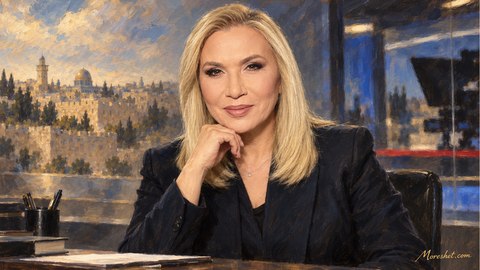
Asheret Cutler
Israeli journalist, news presenter, documentary creator and author
Asheret Cutler is an Israeli journalist, news presenter, editor, television creator and author. For more than two decades, she was one of the recognizable figures of Israeli television journalism, presenting news editions, leading current-affairs and interview programs, and producing documentary and investigative series on social, cultural and civic issues. Her work brought subjects that were not always central to public debate into the national conversation and helped shape the way Israelis encountered news, social criticism and personal stories.
From local news to the center of Israeli television
Cutler was born in Jaffa as Osharett Levy and grew up in Bat Yam and Ramat Hasharon. Her family originated in Bulgarian Jewry, and she has said that her family is also descended from Jews expelled from Spain. After graduating from Rothberg High School, she served in the Israel Defense Forces as a welfare and casualties officer in the Armored Corps. She later studied political science, worked as a flight attendant for Tower Air, and studied philosophy at Tel Aviv University.
She began her media career as a presenter and editor for the local cable-news service Gevanim. In 1993, when Channel 2 News was established, she joined its journalistic operation in a range of roles: archive researcher, report director, editor, news-bulletin presenter and culture correspondent. She also served as associate editor and presenter of “Mussaf HaShabbat,” filled in on Rafi Reshef’s “Five with Rafi Reshef,” and substituted for Ya’akov Eilon on the main evening news.
These roles reflected an unusual ability to move between meticulous newsroom work and direct on-screen communication. Cutler was not only a familiar face to viewers; she also gathered material, edited reports, shaped stories and made journalistic decisions. At a time when television was the principal news source for much of the Israeli public, her work played a real part in framing the national agenda and explaining major events to viewers.
A breakthrough for women in Israeli journalism
In 1996, Cutler began presenting and editing “Meet the Press.” She became the first woman in Israel to lead a personal political interview program of this kind. Her position expanded the roles available to women in Israeli journalism and placed a woman at the center of questioning public figures, setting the agenda and directing conversations with people in positions of power.
During her years at Channel 2 News, she also presented “Ulpan Shishi,” initially alongside Emmanuel Rosen, and edited the program in 1999. In 2001, she began presenting “Shesh Im.” She presented news during the period surrounding the assassination of Yitzhak Rabin, when Israeli journalism faced a national trauma, rapidly developing information and a public need for clear and responsible explanation.
One of the best-known interviews from this period was her 1997 conversation with Hamas leader Ahmed Yassin. Cutler conducted the interview wearing a traditional Islamic chador, a choice intended to create a distinctive cultural context for the encounter and to convey the complexity of interviewing a central figure in the Israeli-Palestinian arena.
Documentary and investigative journalism
Cutler’s work extended beyond news presentation. In 2005, she presented two documentary series for Keshet, one about Kabbalah and the other about education. These programs connected popular television with questions of faith, identity, learning and the ways individuals and societies create meaning.
In 2007, she presented a special program about sexual harassment and “The End of the World?”, which examined Israel’s ecological condition and air pollution around the world. That year, she also created “On Drugs” for Yes Docu, a series that strongly criticized Israel’s information and enforcement policies on drugs. The series placed drug policy within a broader public discussion involving law, health, education and governmental responsibility.
In 2008, she created additional documentary and investigative programs for Channel 10. “Lords of War” examined Israel’s weapons industries; “The Corrupt at the Top” addressed governmental corruption; “Reality Check” challenged the culture of reality television; “Forbidden Child, Permitted Child” explored parent-child relationships and the loss of parental authority; and “The Rich Live Longer” examined widening inequalities in Israel’s health services. The range of subjects reflected a form of journalism concerned not only with events, but also with the systems behind them and the cost they impose on citizens and communities.
In December 2007, she began presenting “Saturday News,” renamed “The Magazine” in 2010. The program combined news, interviews, in-depth reports and investigations. In 2014, she also presented the Channel 10 main evening news on an alternating basis. Until the end of her regular work at News 13 in 2019, she remained one of the prominent presenters of Israeli television journalism.
Writing, family memory and Sephardi Jewish identity
Alongside television, Cutler wrote two books. Her first, “A Story That Begins with Tears,” published in 2006, explored Spinoza, Zen Buddhism and psychoanalysis while connecting those ideas to her own life story. The book reflects her interest in the meeting point between philosophy, spirituality, psychology and personal experience.
In 2009, she published “Ija Mia,” Ladino for “My Daughter.” The book returned to her Bulgarian and Sephardi roots and to her Ladino-speaking family, set against the decisive years of the Land of Israel and the young State of Israel. In doing so, it contributed to preserving Sephardi Jewish memory—not simply through the story of one family, but through language, tradition, migration and the transition from an older Jewish world to an emerging Israeli society.
The connection between journalism, documentary work and personal writing gives Cutler’s career a wider significance. She documented Israeli society in real time, while also returning to deeper layers of identity: faith, family, memory, education and belonging. For readers and viewers of Balkan and Sephardi background, her writing about a Ladino-speaking home helped bring family heritage into the visible and accessible space of Israeli culture.
A new chapter in public engagement
In June 2019, the final edition of “The Magazine” under her presentation was broadcast. After leaving journalism, Cutler volunteered her media and spokesperson services to organizations involved in public protest against Benjamin Netanyahu. At this stage, too, she remained engaged in public life, working behind the scenes and drawing on years of experience in journalism, message development and mass communication.
Cutler’s career also included moments when her on-air statements prompted intense public debate. This is part of the record of a journalist who did not limit herself to technical reporting, but addressed the moral and social meaning of events. Whatever the debate surrounding particular statements, her documented contribution is evident in the scale of her work, the subjects she brought forward and the space she created on television for social questions and underrepresented concerns.
Why this legacy belongs in Moreshet
Asheret Cutler merits inclusion in Moreshet because she represents an important chapter in the development of Israeli journalism: the movement from conventional news presentation toward television that combines reporting, interviewing, investigation and social documentation. She was among the first women to lead a personal political program on Israeli television, presented news during decisive national moments, and created programs addressing education, health, pollution, violence, corruption, weapons industries, reality-TV culture and drug policy.
Her importance to Jewish and Israeli heritage is also visible in her writing about her Bulgarian and Sephardi family and the Ladino world. Through both television and books, she made questions of identity, memory and belonging part of public conversation. Moreshet.com preserves this story not merely as the biography of a media professional, but as a record of her influence on the ways Israelis encountered their society, their family heritage and the issues that shaped their shared lives.