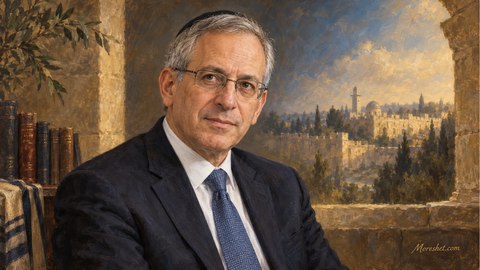
Yitzhak Amit
Yitzhak Amit — AI-generated artistic portrait · Moreshet.com
President of Israel’s Supreme Court and Israeli jurist whose broad jurisprudence spans civil, criminal, administrative and constitutional law in a defining institutional period
Yitzhak Amit, born Yitzhak Goldfreund, is an Israeli jurist and President of the Supreme Court of Israel. He has served as a justice of the Supreme Court since 2009 and, after a period as acting president, was appointed President of the Court in 2025. Over his judicial career he has worked across a wide range of legal fields: civil law, torts, contracts, insurance, taxation, criminal law, administrative law, constitutional law, security law, freedom of information and human rights.
Amit is one of the central judges for understanding Israel’s judiciary in the first decades of the 21st century. His jurisprudence does not belong to only one subject or one school. It is marked by practical judgment, deep familiarity with the work of courts, direct legal language, a preference for solutions that seek a just result, and engagement with questions at the heart of Israeli life: security and rights, governmental responsibility, freedom of information, tort law, the relations among branches of government, judicial independence and public trust in state institutions.
Family roots, Tel Aviv and religious education
Yitzhak Amit was born in Tel Aviv on October 20, 1958, as Yitzhak Goldfreund. He grew up in the Shapira neighborhood of south Tel Aviv, in a family of Holocaust survivors. His father, Shmuel, survived the Buchenwald, Plaszow and Skarżysko camps. His mother, Hadassah Irena, lost her family in the Holocaust and was raised by a Christian family while her Jewish identity was hidden. His parents met and married in Israel, and their story combines Holocaust memory, rescue, aliyah, family rebuilding and new life in the State of Israel.
Amit studied at the Moriah state-religious elementary school in Tel Aviv and at the Zeitlin religious high school. As a teenager he helped his parents in the workers’ restaurant they owned. This background matters for understanding him: he came from the urban and working life of south Tel Aviv, from a family that carried heavy Jewish memory but built itself anew in Israel. A sense of reality, practicality and connection to everyday life can also be seen in the way he is described as a judge and jurist.
Military service and legal studies
Amit served in the Israel Defense Forces as an officer in Unit 8200, including in network intelligence and Arabic translation roles, and was discharged in 1980. His service in the IDF intelligence system gave him early familiarity with security, information, language, professional responsibility and precision. Although his public career later developed in law, his military service remained part of the background he brought to judicial work.
In 1981 he began studying law at the Hebrew University of Jerusalem, graduating cum laude with an LL.B. in 1985. After his internship he was admitted to the bar in 1986 and worked for years as an independent lawyer. His experience as a private attorney before entering the judiciary gave him a close view of litigants’ needs, lawyers’ work and law as it operates outside theory.
From the lower courts to the Supreme Court
In 1997 Amit was selected to serve as a judge in the Magistrates Courts of the Haifa district, first in Acre and later in Haifa. In 2001 he began serving as an acting judge of the Haifa District Court, and in 2002 he was appointed as a permanent district judge. His service in northern Israel exposed him to diverse populations and a wide range of civil, criminal and administrative cases. Judicially, this period shaped his practical outlook: law is not conducted in an abstract vacuum, but inside real human, economic, family and public disputes.
During his time on the District Court, Amit stood out as an independent and energetic judge, sometimes bold in interpretation. One remembered episode involved a judgment in which he sought to depart from an older Supreme Court precedent concerning subject-matter jurisdiction, a precedent he regarded as outdated. Although he had to retreat after it became clear that the precedent had still been applied by the Supreme Court, the episode pointed to a trait that would accompany his work: willingness to reexamine legal conventions when they seem unsuited to reality.
In August 2009 he was elected to the Supreme Court, and on October 14, 2009, he began serving as a justice. Since then he has written and joined many judgments across a very broad range of fields. He is among the justices whose influence does not come only from major constitutional cases, but also from the daily judicial work through which rules, balances and patterns of Israeli law are formed.
President of the Supreme Court
From 2021 to 2022 Amit served as chair of the Central Elections Committee for the 25th Knesset. That role placed him at the head of the body that manages the election process, approves lists, handles campaign issues, supervises election procedures and safeguards public confidence in the democratic process. He later also served as a member of the Judicial Selection Committee.
After the retirement of Supreme Court President Esther Hayut and after a prolonged institutional dispute over the appointment of a permanent president of the Court, Amit served as acting president. On January 26, 2025, the Judicial Selection Committee selected him as President of the Supreme Court, and on February 13, 2025, he was sworn in at the President’s Residence.
His appointment took place during an especially sensitive period in the relations among the judiciary, the government and the Knesset. Entering office was not only a personal or professional event; it was part of a wider chapter in the history of Israel’s legal system: a debate over the seniority convention, judicial independence, the role of the justice minister, the limits of the Court’s power and the way state institutions are expected to cooperate even during intense disagreement.
Civil jurisprudence: practicality, torts, contracts and insurance
One of the fields in which Amit stands out is civil law. His opinions have dealt with torts, insurance, contracts, tenders, real estate, taxation and corporations. He tends to examine not only the legal rule in the abstract, but also its practical results: whether compensation creates duplication, whether a tender rule serves the economic purpose of the tender, whether an insurance company should bear a certain risk, whether an innocent third party is harmed too harshly, and whether the legal solution reflects a proper balance among responsibility, efficiency and fairness.
In tort law, he shows caution toward high compensation not grounded in clear damage, while recognizing the need to compensate injured people when law and facts justify it. He has addressed non-pecuniary damage, injury to autonomy, psychological disability, adult dependents, liability of medical institutions and the calculation of damages. His jurisprudence reflects a desire to preserve stability, prevent double compensation and distinguish between real human pain and an incautious expansion of legal liability.
In insurance and tender law, Amit is often known for a practical approach. He has resisted overly formal rules when he believed they harmed the purpose of a tender or led to inefficient economic results. At the same time, he does not dismiss the importance of rules; rather, he seeks rules that serve the purpose for which they were created and do not become a mechanical barrier to justice, efficiency and trust.
Taxation, economics and rule of law
In tax cases, Amit wrote that the goal of tax authorities should not be to find the interpretive path leading to the highest possible collection, but to collect true tax according to the language and purpose of the law. This view presents tax law not only as a tool for state revenue, but as an area in which fairness, certainty, balanced interpretation and citizens’ trust in the authority are important.
In a further hearing concerning the taxation of profits from illegal gambling, Amit held that such profits could be taxable, but that confiscation of those profits did not necessarily create a deductible expense. In doing so, he combined tax principles, avoidance of benefit to offenders and an understanding of legal purpose. Such examples illustrate the spirit of his jurisprudence: searching for practical legal solutions that do not detach from social and ethical context.
Criminal law and the search for truth
In criminal law, Amit is a judge who gives great weight to the search for factual truth. In several opinions he warned against a situation in which criminal proceedings move away from the evidence itself and focus excessively on procedural arguments, investigative defects and rights discourse that overshadows the factual inquiry. This position does not deny the importance of defendants’ rights, but seeks to return evidence, truth and criminal responsibility to the center.
Amit has dealt with complex criminal cases, including circumstantial evidence, repressed memories, conviction and acquittal on reasonable doubt, criminal appeals and compensation for acquitted defendants. At times he supported conviction when he believed there was no reasonable alternative scenario, and at times he supported acquittal or leniency when the evidence did not meet the required standard. The guiding line is a search for a factual and legal conclusion that does not yield either to empty formalism or to public emotion.
Administrative law, freedom of information and rights
In administrative law, Amit has dealt with questions of civil registration, freedom of information, expropriation of land, planning and building, Health Ministry policy, decisions of authorities and the role of the state in relation to citizens. In different judgments one can see a combination of respect for administrative discretion and willingness to intervene when an authority delays too long, acts with extreme unreasonableness, violates rights or fails to fulfill its public role.
In matters of population registration, Amit expressed concern about inserting moral or value judgments into technical registration functions. For him, preserving the boundaries of a public official’s authority is not merely technical; it protects citizens from turning administrative registration into a gate of moral or ideological judgment.
In freedom of information and public-access matters, his judgments recognize the importance of the public’s right to know, while also protecting interests such as privacy, security, proper process and institutional efficiency. This is a typically Israeli balance: a small, security-conscious, highly legal and media-intensive state in which almost every decision about public information affects both public trust and system functioning.
Security, rights and Israeli reality
Amit has also dealt with sensitive security cases. In his jurisprudence on demolition of terrorists’ homes, he recognized that the measure is severe and sensitive, and should be used carefully and sparingly, but did not reject it in principle. He addressed moral, legal and utilitarian considerations, recognizing that security and rights are not theoretical questions but part of a difficult Israeli reality.
In another case, he joined a judgment holding that the state could not deny entry into Israel for medical treatment at a Palestinian hospital merely because the applicant had a first-degree family connection to Hamas members, when the treatment was funded by the Palestinian Authority. This reflected his balancing approach: recognition of security needs, but also concrete examination of the measure’s purpose, effectiveness and human cost.
Amit’s contribution in security law is not built on a single slogan. It lies in the attempt to manage the constant tension between a state under threat and a legal system committed to rights, proportionality, evidence and reasoned decision-making. This has been one of the central challenges of Israeli law since the state’s founding, and Amit has helped shape it in many judgments.
Judicial style and institutional influence
Amit’s judicial style is often described as practical, sharp and sometimes unconventional. He uses relatively clear language, relates to the reality behind the case and does not hesitate to comment to lawyers or litigants when he believes the proceeding has become cumbersome, unnecessary or distant from the main point. He is also known for warnings against overly long pleadings and for calls for procedural efficiency.
Institutionally, his influence also comes from the range of fields in which he has worked. A Supreme Court justice does not shape legal heritage only through famous constitutional judgments. Sometimes influence is accumulated through hundreds of decisions in everyday fields: contracts, compensation, taxes, tenders, criminal procedure, information, insurance, planning and building, and security. That is where the real legal culture of a state is built.
As President of the Supreme Court, his influence is wider still. The president of the Court is not only a senior judge, but an institutional leader of the judiciary. The role carries responsibility for judicial independence, the management of a complex system, working relations with other branches and the public message of the courts during periods of crisis of trust.
Editorial note on inclusion
Yitzhak Amit is included on the site even though this person and their public record are controversial among broad sections of the public. Inclusion does not determine whether the influence is positive or negative; it reflects the significant place this figure holds in shaping the lived experience, culture and way of life of the public. Naturally, some regard this activity as positive and even heroic, while others see it as contrary to their worldview. The very existence of opposing assessments is part of the historical record that justifies including this significant and influential figure in the heritage of the Jewish people.
Why this legacy belongs in Moreshet
Yitzhak Amit merits inclusion in Moreshet because his path connects a family of Holocaust survivors, Israeli religious education, service in an intelligence unit, work as an independent lawyer, judging in the lower courts, long service on the Supreme Court and the presidency of the Supreme Court during an especially sensitive institutional period. He represents Israeli law not only through prominent judgments, but also through the habits of adjudication, reasoning and management of a central legal system.
Moreshet.com documents Amit because Jewish and Israeli heritage also includes the people who shape the rules of justice, responsibility and authority in the State of Israel. Yitzhak Amit’s place in Moreshet rests on his broad influence on the judiciary, the relations among branches of government, the way rights and security are weighed together, and the documentation of a period in which the Supreme Court stood at the center of Israel’s debate over democracy, rule of law and state identity.