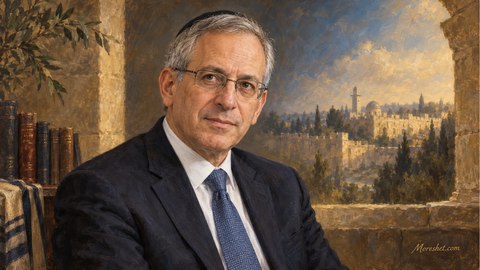
William Owen “Will” Scharf
A Jewish American lawyer whose path from federal prosecution and constitutional litigation led to the center of White House operations
William Owen Scharf, widely known as Will Scharf, is a Jewish American attorney, former federal prosecutor, and policy adviser. His career has moved through appellate law, Missouri government, Supreme Court confirmation efforts, nationally consequential constitutional litigation, and the office responsible for managing the flow of documents to the president of the United States.
Scharf’s significance lies in the range of institutions in which he has worked. He prosecuted federal firearms cases, helped develop state policy, worked on the confirmations of two Supreme Court justices, joined Donald Trump’s legal team in a case that tested the boundaries of presidential immunity, and became White House staff secretary at the beginning of Trump’s second administration. Throughout that ascent, he has maintained a publicly visible Modern Orthodox Jewish identity rooted in family life and Jewish campus leadership.
Early life, Jewish identity, and education
Scharf was born in New York City on March 29, 1986, to Fiona and Michael Scharf. Raised in a Modern Orthodox household, he grew up in New York and North Florida. He attended Phillips Academy in Andover, Massachusetts, graduating in 2004.
At Princeton University, Scharf studied history and graduated magna cum laude in 2008. His undergraduate years combined Jewish communal leadership, campus governance, and political activity. He served as president of the Chabad Student Board, participated in Princeton’s Center for Jewish Life, and led the Charter Club and the university’s Interclub Council. He also worked as press secretary for the Princeton College Republicans and wrote for The Princeton Tory.
Jewish institutional life at Princeton was also important to his family. His parents were leading benefactors of the university’s Chabad house and Center for Jewish Life. Scharf’s own leadership helped sustain a campus environment in which Jewish students could pray, learn, observe Shabbat and festivals, and build community. He has since spoken publicly about maintaining an observant life, including putting on tefillin and attending Chabad services on Shabbat.
Scharf earned his JD from Harvard Law School in 2011. While there, he served as president of the Harvard chapter of the Federalist Society, an influential organization in American conservative legal thought. His education in history and law prepared him for work focused on institutional authority, judicial interpretation, and the constitutional relationship among branches of government.
Appellate training and Missouri policy work
After law school, Scharf clerked for Judge Raymond Gruender of the United States Court of Appeals for the Eighth Circuit. An appellate clerkship requires close attention to precedent, written advocacy, and the reasoning behind judicial decisions—skills that became central to Scharf’s later litigation and government work. He subsequently practiced at Bryan Cave Leighton Paisner and also served as a teaching fellow in Harvard’s Department of Government.
In 2015, Scharf entered Missouri politics as policy director for Catherine Hanaway’s gubernatorial campaign. After Hanaway lost the Republican primary, he moved to Eric Greitens’s campaign in a similar capacity. When Greitens became governor, Scharf joined the administration as policy director and served as vice chair of a state tax-reform committee.
That work placed him between elected officials, legislators, lawyers, and administrative agencies. Rather than merely advocating broad political goals, a policy director must help convert them into statutory language, budget choices, regulatory programs, and implementation plans. Scharf remained in the Missouri administration until June 2018.
Supreme Court confirmations and federal prosecution
Scharf participated in the effort to secure Brett Kavanaugh’s confirmation to the Supreme Court in 2018, including work as a consultant for the Judicial Crisis Network. In 2020, while serving in the Department of Justice, he was detailed to the Office of Legal Policy as nominations counsel for Amy Coney Barrett’s confirmation. These assignments involved the complex intersection of legal records, Senate procedure, public communication, and competing ideas about the judiciary’s constitutional role.
In June 2020, Scharf became an assistant United States attorney in the Eastern District of Missouri. Working in the violent-crimes unit, he handled federal cases involving felony firearm possession and violations of supervised release. The role shifted his focus from abstract legal policy to day-to-day enforcement: evaluating evidence, making charging decisions, appearing in court, and assuming responsibility for cases that directly affected defendants, victims, and local communities. He left the office in November 2022.
A statewide campaign and constitutional litigation
In February 2023, Scharf announced his candidacy for Missouri attorney general. The campaign allowed him to present his own approach to state law enforcement, the powers of an attorney general, and the relationship between state and federal authority. He was defeated by incumbent Attorney General Andrew Bailey in the Republican primary on August 6, 2024.
While campaigning, Scharf joined Donald Trump’s appellate legal team in 2023 and worked with attorney D. John Sauer. He participated in appeals and constitutional arguments arising from legal proceedings against the former president. The most consequential concerned the extent to which a former president may be criminally prosecuted for conduct undertaken while in office.
The Supreme Court’s 2024 decision drew distinctions among exercises of a president’s core constitutional powers, other official conduct, and unofficial acts. The ruling’s importance reaches beyond any individual litigant: it shapes how the American legal system balances presidential independence against criminal accountability and the rule of law. Scharf’s involvement placed him within one of the defining constitutional cases of his generation.
White House staff secretary
On November 16, 2024, President-elect Trump announced that Scharf would become White House staff secretary. He assumed the position when the new administration began on January 20, 2025.
The staff secretary usually works outside public view, but the office sits at the center of presidential decision-making. It controls the flow of memoranda, policy papers, reports, briefings, executive orders, and other documents sent to the president. The staff secretary helps ensure that relevant officials and agencies have reviewed a proposal, that competing perspectives reach the president when appropriate, and that documents are ready for decision or signature.
For Scharf, the position brought together the main strands of his career: legal drafting, policy review, coordination among government offices, and disciplined management under intense time pressure. His public appearances presenting executive orders for presidential signature also made this normally discreet administrative role more visible, illustrating how the White House turns political objectives into formal governmental action.
Visible Jewish life in American public service
Scharf’s story offers a contemporary example of an Orthodox Jewish lawyer reaching senior levels of American government without concealing his religious practice. His Jewish identity should not be treated as an explanation for every professional position he has taken. Its historical significance instead lies in visibility: he belongs to a long line of Jewish Americans who have entered law, public administration, and presidential service while remaining connected to Jewish ritual and community.
His direct contribution to Jewish communal life is clearest in his Princeton years, when he led the Chabad Student Board and participated in the Center for Jewish Life. Campus organizations of this kind provide religious services, education, holiday programs, meals, and a social home for students living away from their families. His later ability to combine observant practice with demanding legal and governmental roles has also supplied younger Jews with a visible example of participation in public life without necessarily surrendering an open Jewish identity.
Editorial note on inclusion
Will Scharf is included on the site even though this person and their public record are controversial among broad sections of the public. Inclusion does not determine whether the influence is positive or negative; it reflects the significant place this figure holds in shaping the lived experience, culture and way of life of the public. Naturally, some regard this activity as positive and even heroic, while others see it as contrary to their worldview. The very existence of opposing assessments is part of the historical record that justifies including this significant and influential figure in the heritage of the Jewish people.
Why William Owen “Will” Scharf belongs in Moreshet
Will Scharf merits documentation for the unusual combination of federal prosecution, state policy work, Supreme Court confirmation efforts, major constitutional litigation, and service close to the president. Each field affects how public authority is interpreted or exercised. Taken together, they trace the movement of a lawyer from courtroom practice and policy development to the operational center of the American executive branch.
For Moreshet, his life also documents a distinctly contemporary form of Jewish experience: campus leadership at Chabad, sustained ties to Jewish institutions, and visible Orthodox observance alongside a demanding public career. His inclusion on Moreshet.com does not endorse every position or legal cause with which he has been associated. It records a consequential Jewish presence in American law and government, as well as his participation in institutional and constitutional questions that will continue to shape public life. Scharf’s career therefore forms part of the broader history of Jewish participation in democratic institutions and the continuing contribution of Jewish professionals to American civic life.