Noam Shimshon Sohlberg
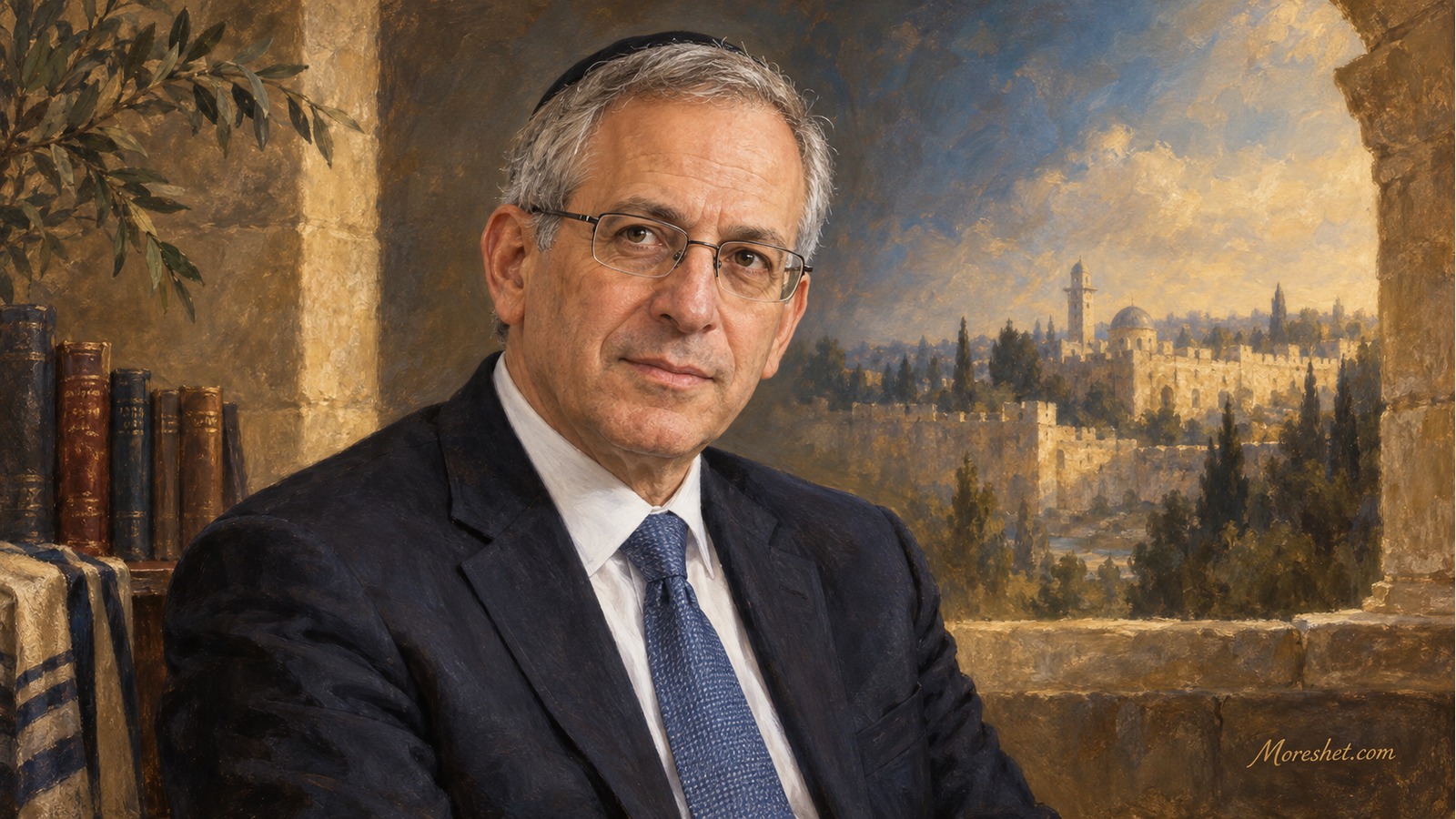
Noam Sohlberg — AI-generated artistic portrait · Moreshet.com
Deputy President of Israel’s Supreme Court, Israeli jurist and central judicial voice in debates over restraint, interpretation, rights and separation of powers
Noam Shimshon Sohlberg is an Israeli jurist, justice of the Supreme Court of Israel and Deputy President of the Supreme Court. Since his appointment to the Court in 2012, he has become one of the prominent voices in Israeli public law, including constitutional law, administrative law, freedom of expression, privacy, defamation, election law, criminal law and the relationship among state institutions in a Jewish and democratic state.
Sohlberg is publicly identified as a conservative and restrained justice, but his legal contribution is broader than that label. His jurisprudence seeks to distinguish necessary judicial review from replacing the discretion of other branches; rights from the limits of authority; interpretation of law from the judicial creation of new arrangements; and modern civil law from the deeper cultural resources of Jewish tradition. For that reason, he is a central figure for understanding Israel’s contemporary debate over the Supreme Court, rule of law, the authority of the Knesset and government, and public trust in state institutions.
Family roots, religious-Zionist education and service to the state
Sohlberg was born in Haifa on January 22, 1962, to Yehudit and Shaul Sohlberg, Holocaust survivors from the Netherlands. This family background places his life within a wider Jewish story of destruction, survival, aliyah, rebuilding and integration into the institutions of the state. On his mother’s side, he is connected to the family of Rabbi Shimon de Vries, an important figure in Dutch Jewish tradition.
He studied at Yavne Yeshiva High School in Haifa and later at Yeshivat Har Etzion in Alon Shvut. This education combined Torah study, civic responsibility, religious Zionism and commitment to service. He then enlisted in the Israel Defense Forces, served in the Air Force and completed his service with the rank of major. This combination of religious education, legal learning and military service is also visible in his judicial language: a language that sees law as a state institution, but also as part of a deeper moral and cultural tradition.
Legal studies and early public legal service
Sohlberg studied law at the Hebrew University of Jerusalem. He completed his LL.B. in 1990 and later earned an LL.M. from the same university with distinction. During his studies, he served as a teaching and research assistant at the Faculty of Law and was also connected with the Israeli National Council for the Promotion of the Rule of Law and Democracy.
After law school, he interned in the civil law department of the State Attorney’s Office, at the Supreme Court and in the Attorney General’s Office. He was admitted to the Israel Bar in 1991 and then served as legal assistant to Attorney General Yosef Harish. From 1993 to 1994 he served as a prosecutor in the State Attorney’s Office, and later as senior legal assistant to Attorneys General Michael Ben-Yair and Elyakim Rubinstein.
These years gave him deep familiarity with public law from within: government legal advice, prosecution work, civil matters, questions of authority, governmental responsibility and the constant tension between law and policy. At the same time, he lectured at Bar-Ilan University’s Faculty of Law. This created a professional foundation combining practice, teaching, legal writing and close acquaintance with the core of Israel’s public legal service.
Judge in Jerusalem and justice of the Supreme Court
In 1998 Sohlberg was appointed judge of the Jerusalem Magistrates Court. In 2005 he was appointed judge of the Jerusalem District Court. His service in the Jerusalem courts exposed him to a wide variety of cases: civil law, criminal law, administrative law, defamation, freedom of information, rights, religion and state, security and sensitive public disputes. Jerusalem, more than most cities, confronts a judge daily with the meeting of law, history, community, nation and religion.
In January 2012 he was selected for the Supreme Court, and on February 21, 2012, he began serving as a justice of the Court. His appointment was significant because it brought into the Court a judicial voice associated with restraint, careful interpretation and institutional caution. Over the years, however, his jurisprudence has proved impossible to reduce to a single headline. He has written judgments in many fields, sometimes for the majority and sometimes in dissent, gradually building a consistent legal language: respect for law, concern over excessive expansion of judicial power, and willingness to intervene when the legal defect is clear and substantial.
In March 2024 he was appointed a member of the Judicial Selection Committee. In January 2025 he was chosen as Deputy President of the Supreme Court, and on April 10, 2025, he entered the role. Under the seniority system traditionally used by the Supreme Court, he is expected to serve as President of the Supreme Court after the end of President Yitzhak Amit’s term, assuming no change occurs in the appointment system or in personal and institutional circumstances.
Deputy President and chair of the Central Elections Committee
Sohlberg’s role as Deputy President of the Supreme Court gives him a central position in the leadership of Israel’s judiciary. Beyond writing judgments, the role touches court administration, institutional leadership, panel composition, public responsibility and representation of the Court at a time when relations between the judiciary and elected branches are especially charged.
As of September 2026, Sohlberg also serves as chair of the Central Elections Committee for the 26th Knesset. This role places him at the center of one of the most important mechanisms in Israeli democracy. The Committee is responsible for managing the election, safeguarding election integrity, issuing decisions on campaign propaganda, handling candidate lists, voting arrangements and maintaining public confidence in the process through which citizens exercise sovereignty.
In a reality in which elections are exposed to political pressure, digital campaigns, false information, suspicions of interference and harsh public discourse, chairing the Central Elections Committee is not merely a technical position. It requires legal understanding, independence, caution, authority and willingness to issue reasoned decisions under pressure. The role fits Sohlberg’s broader approach: preserving democratic institutions through rules, procedure, balance and trust.
Judicial restraint and the reasonableness doctrine
One of the issues most closely associated with Sohlberg is the reasonableness doctrine. He does not reject judicial review of public administration, but seeks to limit overly broad and vague use of the doctrine when value-laden or policy decisions of elected officials are at stake. In his view, the Court should be cautious about using general concepts such as reasonableness and proportionality in a way that allows judges to replace the discretion of the government, the Knesset or ministers.
His position on this issue became central in the public debate over judicial reform in Israel. When his writings were used as part of the public discussion around legislative amendments, Sohlberg clarified that his original thinking concerned a jurisprudential development rather than necessarily a legislative amendment. That distinction matters: it shows the tension between a legal idea developed in judgments and articles and the public and political use later made of it.
In the judgment concerning the amendment to Basic Law: The Judiciary dealing with reasonableness, Sohlberg opposed striking down the amendment, among other reasons because of his principled position regarding the Court’s authority to review Basic Laws. In doing so, he expressed a consistent view: even when the issue is highly public and sensitive, the Court should first examine the source and limits of its own authority.
Constitutional review, legislative procedure and respect for the Knesset
Sohlberg is known for a cautious approach to striking down primary legislation of the Knesset. At the same time, he is not unwilling to intervene when he sees a substantial defect. An important example is the judgment on the multiple-residence tax, in which he wrote the central majority opinion invalidating a law because of a serious flaw in the legislative process. For him, protecting the Knesset does not mean only avoiding invalidation of laws; it also means protecting the ability of Knesset members to participate meaningfully and knowingly in legislation.
This position highlights an important side of his approach: judicial restraint is not submission to the legislative or executive branch, but a strict division of functions. The Knesset is authorized to legislate, but it must do so through a process that allows real deliberation. The government is authorized to govern, but it must act within the law. The Court is authorized to review, but it must explain the basis of its authority and avoid expanding it without a clear foundation.
In this sense, Sohlberg’s contribution to Israeli constitutional discourse is an attempt to return the debate to basic questions: who is authorized to decide, under which law, through what process, within what limits, and to what extent the Court may intervene in decisions made by other institutions.
Administrative law, rights and institutional responsibility
In administrative law, Sohlberg is considered a restrained judge, but his jurisprudence shows that he is not indifferent to rights or real injury. He tends to seek a clear legal ground: discrimination, lack of authority, defective procedure, disproportionate harm or violation of law. When such a ground exists, he is willing to intervene; when it does not, he is cautious about replacing the authority’s discretion.
He has addressed questions involving public housing, freedom of information, Health Ministry policy, tenders, passports, nationality in official documents and local authority conduct. In some cases he refused to intervene; in others he accepted petitions or criticized the authorities. The common line is not always the result, but the method of reasoning: seeking a defined legal ground and avoiding broad open-ended concepts when more precise legal tools can decide the case.
In 2025 he ruled that the Chief Rabbinate must allow women to sit for halakhic examinations it conducts, after finding that blocking women from the examinations was prohibited discrimination without sufficient justification. This ruling demonstrates that his restrained approach does not necessarily produce socially conservative outcomes in the simple sense; it can also protect equality when the legal injury is clear.
During the same period, he addressed questions concerning the conscription of Haredi men into the IDF and ordered the state to formulate and implement an effective enforcement policy toward those who received draft orders and did not report. Here too his method is visible: not merely a general declaration, but a demand for procedure, policy, equality in enforcement and the fulfillment of the state’s duties.
Freedom of expression, privacy, freedom of information and defamation
Another field in which Sohlberg stands out is the balance between freedom of expression and other rights. He has dealt with cases involving privacy, reputation, defamation, freedom of information, journalism and publication. His jurisprudence reflects the understanding that freedom of expression is essential to a democratic society, but that it does not erase human dignity, privacy or the right not to be harmed by false or partial publication.
In a well-known case concerning the prohibition on publishing a novel that violated privacy, Sohlberg wrote about the balance between literary expression and the core of the right to privacy. The judgment emphasized that when the injury to privacy is severe, freedom of expression may sometimes have to yield, even where literary expression is involved. The judgment reflects one feature of his writing: the use of constitutional doctrine, comparative law, moral reasoning and sometimes sources from Jewish culture.
In defamation cases, already during his service in the magistrates and district courts, Sohlberg dealt with claims against newspapers, journalists and public figures. His rulings emphasized that partial publication can be misleading even when some of its components are true, and that a short response does not always correct the negative impression left with the reader. At the same time, he recognized the importance of journalistic style, exaggeration and the expressive space required for public criticism.
In this way, he contributed to core questions of Israeli society: how to protect a free press without leaving private individuals or public employees defenseless; how to distinguish between criticism and injury; and how to balance the public’s right to know against privacy, personal safety and fairness.
Civil law, criminal law and intellectual property
Sohlberg’s work is not limited to public law. He has also dealt with corporate law, contracts, torts, intellectual property and criminal law. In corporate law, he addressed questions concerning transactions with controlling shareholders and personal interest in shareholder votes. In contract law, he has sometimes emphasized contractual language and legal certainty.
In tort law, he has handled complex questions of responsibility in medical institutions, risk, autonomy, human life and quality of life. In cases involving psychiatric hospitals, for example, he addressed the balance between protecting patients’ lives and allowing them an environment as human and free as possible. Such cases reveal another side of his work: not only the great institutions of the state, but also delicate human situations in which law must choose among weighty values.
In intellectual property and competition law, a 2024 judgment concerning the pharmaceutical company Sanofi accepted the position that a misleading presentation to the patent registrar could lead to disgorgement of profits under unjust enrichment when it harmed competition. That judgment shows his engagement with complex economic law, innovation, patents and fair competition.
In criminal law, his jurisprudence shows attention to the burden of proof, criminal responsibility, the limits of appeal and the role of enforcement authorities. At times he has been among the stricter judges, and at times among those who acquitted or refused to intervene in an acquittal. The central line is loyalty to criminal procedure: conviction only beyond a reasonable doubt, but also willingness to impose responsibility when the evidence and the law justify it.
Jewish law, writing style and caution about dicta
One of Sohlberg’s cultural characteristics is his use of sources from Jewish law and Jewish tradition. Sometimes these sources appear as conceptual expansion after the decision under Israeli law; sometimes they are integrated into the legal analysis itself. This does not turn Israeli law into religious law, but suggests that Jewish sources form part of a cultural and legal treasury that can illuminate questions of neighbors, responsibility, human dignity, speech, justice and proportionality.
Sohlberg is also known for caution against broad dicta. More than once he has noted that constitutional or public questions not required for the actual outcome of a case should not be decided. In his view, a judge should not use every case as an opportunity to state a general doctrine. The judge should decide what is required, explain the reasoning and leave other questions for the proper time.
This style is especially important in a supreme court. Every sentence in a supreme court judgment can affect future cases, state authorities and public discourse. Sohlberg’s caution reflects the view that the Court’s power requires linguistic restraint, precision and avoidance of unnecessary rulings.
Personal life and public resilience
Sohlberg lives in Alon Shvut in Gush Etzion. He is married to Meira, and they have five daughters. Their daughter Hadas, who suffered from Rett syndrome, died in 2018 at the age of 33. This personal fact is not part of a legal case, but it adds a human dimension to a public figure most often associated with judgments, principles and institutions.
In 2026, against the background of rulings and decisions concerning Haredi conscription, protesters came to his home and caused damage. The incident marked the intensity of pressures placed on judges in Israel during a period of public polarization. Institutionally, it demonstrated that judicial independence is not merely an abstract idea; it also depends on the ability of judges to act without personal fear, even when their decisions are uncomfortable to different groups.
Editorial note on inclusion
Noam Sohlberg is included on the site even though this person and their public record are controversial among broad sections of the public. Inclusion does not determine whether the influence is positive or negative; it reflects the significant place this figure holds in shaping the lived experience, culture and way of life of the public. Naturally, some regard this activity as positive and even heroic, while others see it as contrary to their worldview. The very existence of opposing assessments is part of the historical record that justifies including this significant and influential figure in the heritage of the Jewish people.
Why this legacy belongs in Moreshet
Noam Shimshon Sohlberg merits inclusion in Moreshet because he is one of the central jurists shaping contemporary Israeli law. His path connects a family of Holocaust survivors, religious-Zionist education, IDF service, the State Attorney’s Office, the Attorney General’s Office, the Jerusalem courts, the Supreme Court, leadership of the judiciary and the chairmanship of the Central Elections Committee.
Moreshet.com documents Sohlberg because Jewish and Israeli heritage also includes the people who shape society’s rules of the game: judges, jurists and public officials who define the boundaries of power, the meaning of law, the responsibility of authorities and the relationship among Judaism, democracy, rights and institutional restraint. Noam Shimshon Sohlberg’s place in Moreshet rests on his contribution to the discourse of law and justice in Israel — a discourse in which statutory language, Jewish tradition, rule of law and public trust meet in one of the most important arenas of Israeli life.