Yair Golan
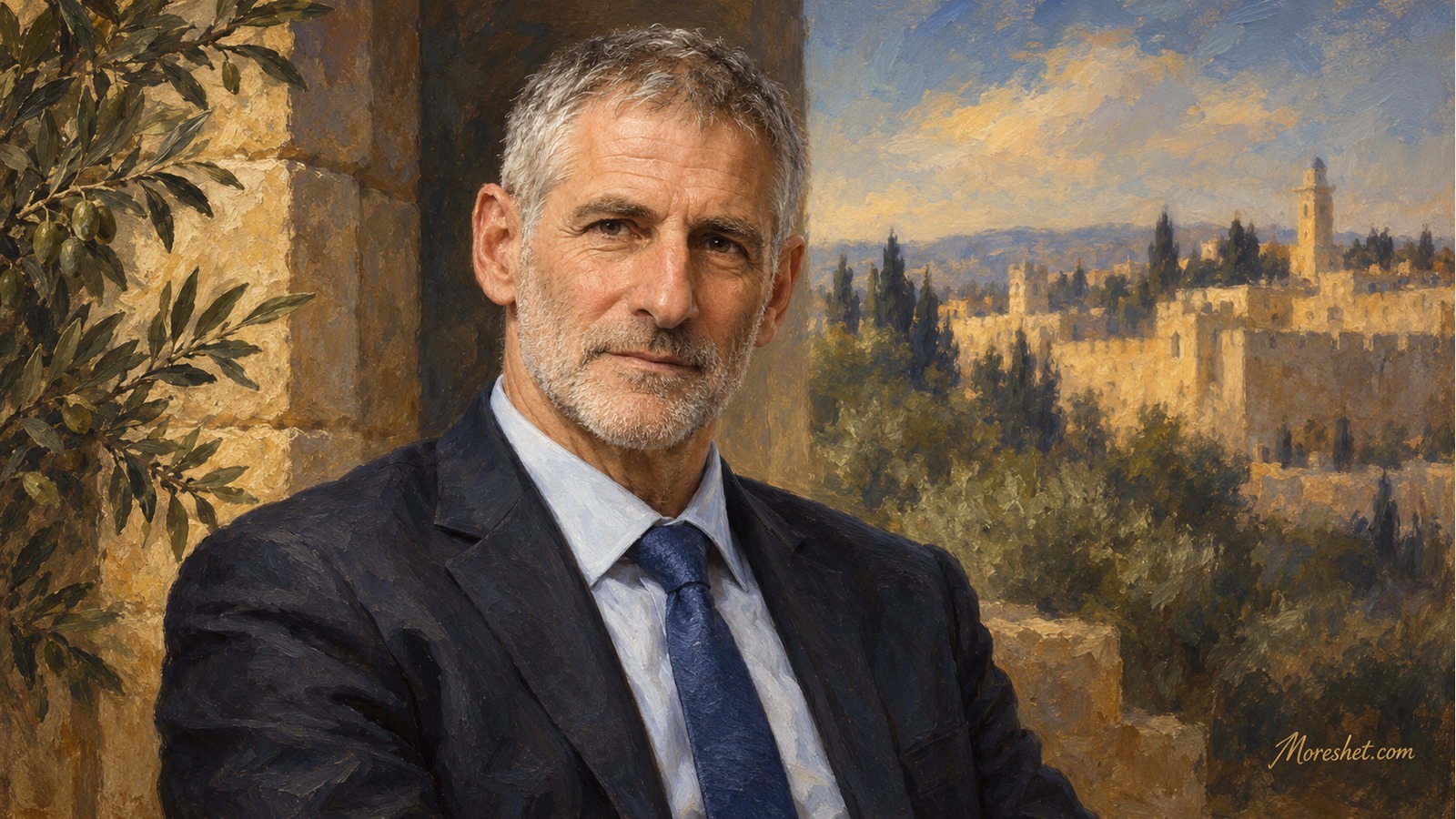
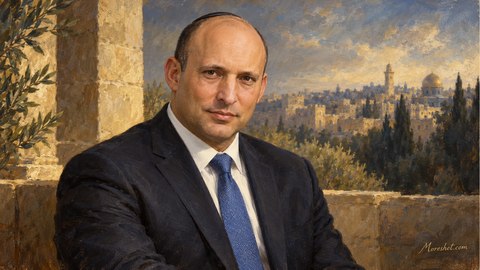
Yair Golan — AI-generated artistic portrait · Moreshet.com
Retired major general, former IDF deputy chief of staff, former Knesset member and leader of The Democrats, linking military command, civic responsibility and security-minded Zionist left politics
Yair Golan is a retired major general in the Israel Defense Forces, an Israeli politician and leader of The Democrats party. During nearly four decades of military service, he held senior command positions, including commander of the Nahal Brigade, commander of the Judea and Samaria Division, commander of Home Front Command, commander of Northern Command and Deputy Chief of the General Staff. After retiring from the IDF, he entered politics, served as a Knesset member for the Democratic Union and Meretz and as Deputy Minister of Economy and Industry, and later led the merger of Labor and Meretz into a new political framework called The Democrats.
Golan’s importance for contemporary Israeli and Jewish heritage lies in the way his life connects three powerful circles: senior combat command, visible civic and political engagement, and personal action during a national emergency. On the morning of October 7, 2023, he drove south as a civilian and helped rescue survivors from the area of the Nova festival massacre. That act, together with his long military service and political path, made him a figure associated by many with personal responsibility, civic courage, security, public debate and the attempt to rebuild an Israeli political camp.
Family roots, Rishon LeZion and Zionist education
Yair Golan was born on May 14, 1962, in Rishon LeZion and grew up there. His father, Gershon Goldner, fled Nazi Germany with his family to Mandatory Palestine in 1935, served in the IDF and reached a senior technical role in communications and electronics. His mother, Rachel, was born in Tel Aviv to a family with roots in Jewish immigration from Ukraine and in the workers’ settlement of Nachalat Yehuda. His family story combines rescue from Nazi Europe, Hebrew settlement and Israeli renewal.
Golan studied at Haviv and Yadlin schools in Rishon LeZion and later at ORT Singalovsky in Tel Aviv. As a young man he was active in the HaNoar HaOved VeHaLomed youth movement and served as head of the Rishon LeZion nest council. This placed him early within a tradition of movement Zionism, social responsibility, youth leadership and education for work, service and public life.
He later completed a bachelor’s degree in political science at Tel Aviv University and a master’s degree in public administration policy at Harvard University, through a program connected with the Wexner Foundation and the Kennedy School of Government. This education connected Israeli military experience with institutional learning and international public-policy training.
The beginning of military service and the Paratroopers
In 1980 Golan enlisted in the IDF. Although he passed the entrance tests for the flight academy, he chose to volunteer for the Paratroopers Brigade, following his brother’s path. He served as a soldier and commander, fought in the First Lebanon War, completed infantry officers’ training and returned to the Paratroopers as a platoon commander. He later commanded the brigade’s anti-tank company and the 890th Battalion, one of the most symbolic battalions in the Paratroopers.
His early years in the Paratroopers shaped him as a field commander. He served in Lebanon, the First Intifada and southern Lebanon, learning at close range the complexity of fighting guerrilla organizations, terrorism and civilian terrain. This period required young commanders to show courage, rapid decision-making, terrain understanding and the ability to lead soldiers when information was partial and risk was high.
In 1997 he was wounded in an encounter with a Hezbollah cell near the Sujud outpost, yet continued to command and manage the battle. Such events built his image as a practical commander who did not keep his distance from operational risk, but stayed with his soldiers in the field.
Senior command: Nahal, Judea and Samaria, the home front and the north
From 2000 to 2002, Golan commanded the Nahal Brigade during the Second Intifada. He was among the commanders who pushed for proactive operations against Palestinian terrorist infrastructure in casbahs and refugee camps, despite the fact that these were dense and complex urban spaces. Under his command, the brigade participated in Operation Defensive Shield and additional operations throughout Judea and Samaria.
He was later promoted to brigadier general and commanded the Galilee Formation, and then the Judea and Samaria Division. These roles required him to confront the Lebanon border, terrorism, friction between populations, responsibility toward Israeli and Palestinian civilians, work with the Shin Bet and police, and the constant question of how military force should be used inside a complex political and civilian reality.
In 2008 he was promoted to major general and appointed commander of Home Front Command. He commanded the command during Operation Cast Lead, when the Israeli home front was an inseparable part of the campaign. This role widened his perspective from the battlefield to civilian defense, national preparedness, missile threats, emergency response, rescue, local authorities and public trust in state systems during crisis.
In 2011 he was appointed commander of Northern Command. During his term, Israel dealt with the spillover of the Syrian civil war, threats from Hezbollah and a changing reality on the Golan Heights. One step associated with his command was the admission of wounded Syrians for treatment in Israel, a move that began as a humanitarian-security response in the field and was later approved by senior military and political authorities. It illustrated Israel’s northern complexity: hostile borders, security calculations, human responsibility and the possibility of regional influence.
Deputy chief of staff and thinking about readiness for war
On December 15, 2014, Golan entered the role of Deputy Chief of the General Staff. In that position he was involved in IDF force building, strategic planning, readiness for war, the balance between routine security and preparation for large-scale conflict, and questions of technology, drones, ground forces and changing threats.
Golan emphasized that the IDF must preserve its readiness for war even when routine security activity consumes many resources. In his view, the State of Israel can endure local failures in routine security, however undesirable, but cannot afford failure in war. This reflects a security approach in which Israel’s strength is measured not only by responses to daily incidents, but by the capacity to prepare for larger tests before they arrive.
During these years, Golan also became a public voice within the military on questions of morality, society and responsibility. His 2016 Holocaust Remembrance Day speech generated fierce debate, but it also marked him as a senior officer who believed that the IDF and Israeli society must examine themselves constantly. He later clarified that he had not intended to compare Israel or the IDF to Nazi Germany, but to warn against dangerous social processes. The debate around his words became part of Israel’s wider discussion of Holocaust memory, military ethics and internal criticism.
Entering politics: Meretz, the Knesset and the Economy Ministry
After retiring from the IDF in 2018, Golan entered politics. In 2019 he joined Ehud Barak’s Israel Democratic Party initiative, later became part of the Democratic Union list and was elected to the 22nd Knesset. He then moved into the Meretz framework, was elected to the 24th Knesset and served as a Knesset member until 2022.
In the Knesset, he served on committees dealing with security, economy, society and immigration absorption. In 2021 he was appointed Deputy Minister of Economy and Industry in Israel’s 36th government. In that role he sought to work on issues including occupational safety and health, workplace accidents, productivity, employment and the integration of populations into the economy. His move from the military to the Economy Ministry shows that his public outlook is not only security-based; it also includes work, equal opportunity, social infrastructure and the state’s responsibility to its citizens.
After Meretz failed to cross the electoral threshold in the 2022 election, Golan continued to operate in public and political life outside the Knesset. He became one of the prominent voices in the protest movement against the judicial reform proposed by the Netanyahu government in 2023, calling for nonviolent civil resistance. This activity strengthened his position as a political figure identified with Israel’s liberal-democratic camp.
October 7, 2023: rescuing civilians in chaos
On the morning of October 7, 2023, as the Hamas attack on southern Israel and the Nova festival began, Golan arrived as a civilian at the Southern District headquarters of Home Front Command and asked to be re-enlisted. He received a weapon and equipment, drove his private vehicle to the Gaza border area and the Nova festival zone, and helped rescue young people and civilians trapped in the area, including by using locations they sent him by phone.
The act resonated widely because it took place during the first hours of one of the most difficult days in Israel’s history. Golan did not then hold an active official military post, but acted from the responsibility of a former commander and citizen. In terms of Israeli heritage, it was a moment in which public life, military experience and civic responsibility converged in one concrete action.
The rescues he performed do not erase the disagreements surrounding his public figure, but they add an important layer to understanding him. They show that beyond ideological debate, Golan remained a person who identifies danger and acts. For many Israelis, the images and stories of the rescue became a symbol of civic initiative on a day when many systems collapsed or were delayed.
Uniting Labor and Meretz and founding The Democrats
In 2024 Golan ran for the leadership of the Israeli Labor Party and won by a very large margin. He presented his candidacy around a clear goal: not merely to lead a historic party, but to reunite Israel’s Zionist and liberal left after years of political decline, fragmentation and loss of public confidence. In June 2024, Labor and Meretz announced an agreement to form a united framework called The Democrats, and the move was approved by the parties’ institutions in July 2024.
The Democrats under his leadership seek to combine the historical Labor tradition, Meretz’s legacy, the democracy protest, rights discourse, national security, separation of religion and state, equal service and a liberal-Zionist outlook. As of September 2026, Golan leads the party ahead of the election and is trying to build a political camp that defines itself as left-wing, Zionist, security-minded and liberal.
The importance of the move is not only partisan. Labor and Meretz were for decades central parts of Israel’s political history. Their unification under the leadership of a former major general attempts to answer a larger question: whether an ideological camp can be renewed through organization, leadership, security language and a sense of responsibility, rather than through nostalgia alone.
Public positions: Zionist left, security and democracy
Golan defines himself as a liberal Zionist leftist, but also as a security hawk. He supports a two-state solution while preserving major settlement blocs and Israel’s security, opposes Israeli withdrawal from the Golan Heights, and supports a firm struggle against terrorism and BDS. At the same time, he stresses the need to separate from the Palestinians in order to preserve Israel’s Jewish and democratic character.
On religion and state, he supports broader separation between state institutions and the religious establishment, civil marriage, LGBTQ rights, public transportation on Shabbat and core curriculum studies in Haredi education. Economically, he speaks of equal opportunity, education, infrastructure, center and periphery, and integrating citizens into productive employment.
His positions provoke sharp debate, but they also present a clear political model: an Israeli left that does not give up security language, and a former senior officer who does not give up the language of human rights and democracy. That tension is central to his contribution to Israeli public discourse.
Writing and public thought
Golan has published texts over the years on command, security and society. His writings include On Command, published in a professional IDF framework, and in 2024 he published Rage and Hope, a short book addressing the fields in which he believes Israeli society must be repaired after the great crisis of recent years.
This writing completes his profile as commander and politician. It presents him not only as someone who acted in the military and political arenas, but as someone trying to formulate a worldview: what command is, what responsibility is, what a Jewish and democratic state is, how public trust can be rebuilt, and how security can be connected to civil society.
Personal life
Golan is married to Ruthie, is the father of five sons and lives in Rosh HaAyin. In 2005 he suffered a mild stroke, but continued his service and command path. His family and personal life appear in public discourse mainly around his image as a father, former soldier and political leader, but his public profile rests first and foremost on his service, actions and positions.
The fact that his five sons served in the IDF, according to party and public statements, fits the public message he seeks to lead around service, shared burden and civic responsibility. For him, the discussion of service is not merely an abstract idea, but part of a concept of active citizenship in a state facing ongoing security threats.
Editorial note on inclusion
Yair Golan is included on the site even though this person and their public record are controversial among broad sections of the public. Inclusion does not determine whether the influence is positive or negative; it reflects the significant place this figure holds in shaping the lived experience, culture and way of life of the public. Naturally, some regard this activity as positive and even heroic, while others see it as contrary to their worldview. The very existence of opposing assessments is part of the historical record that justifies including this significant and influential figure in the heritage of the Jewish people.
Why this legacy belongs in Moreshet
Yair Golan merits inclusion in Moreshet because his story connects combat service and senior IDF command, civilian rescue during a national catastrophe, political activity, a public struggle over democracy and an attempt to reorganize Israel’s Zionist left. He embodies an Israeli figure in which security, morality, civic responsibility and politics are not separate fields but parts of the same question: how to defend the State of Israel and its character.
Moreshet.com documents Golan because contemporary Israeli and Jewish heritage also includes figures who force society to confront difficult questions about power, responsibility, service, democracy, rights and Zionist identity. Yair Golan’s place in Moreshet rests on the way he moved from the highest levels of combat command into the civic and political arena, and on his influence on Israeli public debate at a time when Israeli society is required to redefine the boundaries of security, solidarity and hope.