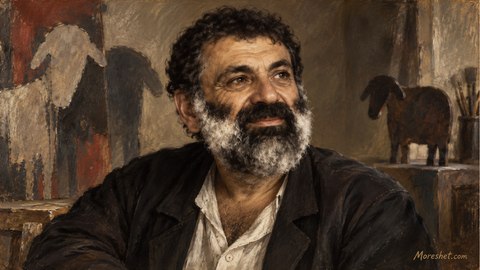
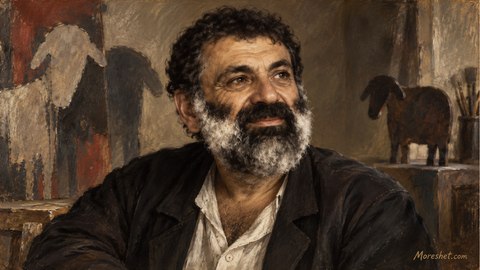
Yair Garbuz
Painter, writer and satirist whose interplay of image and language helped shape Israeli art and cultural conversation
Yair Garbuz (1945–2026) was an Israeli painter, writer, satirist and art educator. Images, sentences, memories and jokes meet in a distinctive visual and literary language. He became a significant participant in Israeli art from the late 1960s onward, while his books, newspaper writing and television appearances reached audiences beyond galleries. His contribution includes both the work he made and the sustained conversation he encouraged about culture, memory and artistic practice.
A visual language rooted in its surroundings
Born in Givatayim, Garbuz spent time as a member of Kibbutz Kfar HaHoresh and studied with Raffi Lavie and at the Avni Institute. His first solo exhibition took place in 1967. His paintings brought together drawing, collage, text and everyday imagery, placing international artistic influences in contact with recognisably local details.
Viewers often move between reading and looking. A sentence changes the meaning of an image, while an image can turn a familiar statement into a question. Humour and cultural reference are part of the construction of the work, not merely commentary added afterwards. This approach allowed his art to speak about its own methods and about the society around it.
Writing and satire
Under the pen name Y. Polani, Garbuz contributed to Davar Aher, the satirical supplement of Davar. Always Polish transformed family experience, kibbutz memories and daily life into humorous prose with a recognisable voice. Books including Paris–Tel Aviv, A House in the Galilee and Expected Changes in My Distant Past continued to combine recollection, observation, essay and verbal play.
This writing gave Jewish family memory a place within contemporary Israeli life. A habit, accent or familiar response could become a story and reveal a form of belonging. His journalism received the Sokolov Prize; his visual art was recognised with the EMET and Rappaport prizes.
Education and public influence
Garbuz taught for many years at HaMidrasha, the art school at Beit Berl College, and served as its director. Working with students was a major part of his influence. He helped train artists and teachers and sustain a setting in which ideas could be questioned and individual artistic languages developed. Museum and gallery exhibitions, including I Am Painters at the Tel Aviv Museum of Art, presented the range of his work.
His public statements also attracted attention. A speech in 2015 provoked intense controversy and offended many listeners; recognition of his artistic contribution does not erase that context. He died in April 2026, leaving a substantial body of painting, literature and satire.
Why Yair Garbuz belongs in Moreshet
Yair Garbuz belongs in Moreshet at Moreshet.com for his influence on Israeli art, satirical writing and art education. He expanded the encounter between image and language and recorded a cultural world in which family memory, identity and creative work continually interact.
He is included despite widespread controversy surrounding his public role. Inclusion does not decide that every influence is positive or negative; it records a significant part in shaping cultural experience. Some people regard a figure's activity as positive or even heroic, while others see it as contrary to their convictions. Such opposing assessments are part of the historical record, allowing the archive to acknowledge cultural significance without demanding agreement with every statement.