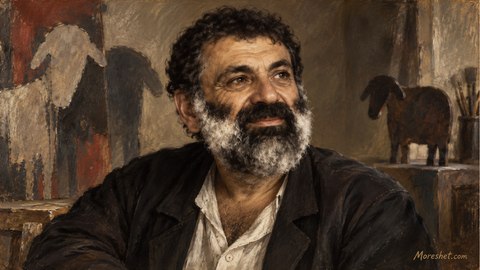
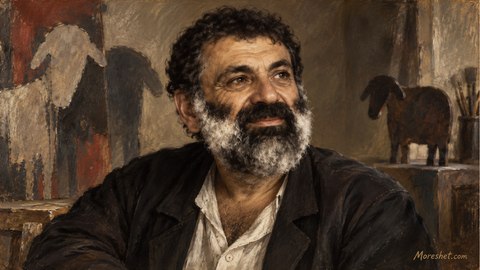
Amos Kenan
Writer, satirist and visual artist whose sharp language and imaginative landscapes became a distinctive part of Israeli culture
Amos Kenan (1927–2009) was an Israeli writer, journalist, satirist, playwright, painter and sculptor. His work moved between a short newspaper column, a dystopian novel, drama and visual art. He regarded the country as a tangible place of landscape, memory and language, and Israeli society as a subject for continuing inquiry. The Road to Ein Harod and his satirical writing remain particularly associated with his independent voice.
Places and intellectual encounters
Born Amos Levine in Tel Aviv, Kenan grew up in a family connected with the labour movement. He worked to help support the family and joined Lehi as a young man. After the War of Independence he became increasingly active as a writer. Years in Paris during the 1950s and early 1960s brought him into contact with a wider artistic environment and deepened his engagement with theatre and visual art.
His association with the Canaanite movement informed an interest in ancient Middle Eastern cultures and the relationship between the land and its successive histories. Yet his work cannot be reduced to an ideological label. He approached places, objects and stories through several artistic forms, each allowing a different kind of observation.
Satire as a change of perspective
In Uzi & Co. for Haaretz, and later in his writing for Yedioth Ahronoth, Kenan developed a concise, sharp and unpredictable style. Everyday logic could be turned slightly to reveal an absurdity within a familiar statement or collective habit. The humour encouraged readers to pause over something they had accepted without examination.
This was also a contribution to Hebrew prose. Conversational language could possess its own rhythm and precision while carrying a serious public argument. His newspaper work helped establish a space in which journalism could include literary experiment and imagination as well as the reporting of events.
Fiction, landscape and visual art
The Road to Ein Harod follows a journey through an imagined Israel under military rule. Familiar geography becomes unsettling, and travel becomes a search for a place of freedom. The dystopian form allows questions about power, belonging and the possibility of another path to emerge through a story. Landscape and cultural memory also recur in his other prose and dramatic work.
As a painter and sculptor, Kenan developed imagery connected with the local and ancient world. He participated in the establishment of the Open Museum at Tefen and its early curatorial work, helping create an encounter with art beyond the country's usual urban cultural centres.
His public life also involved profound controversy, including the 1952 case in which he was tried on suspicion of involvement in bombing the transport minister's home and acquitted. Recognition of his creative work does not require overlooking the complexity of his history.
Why Amos Kenan belongs in Moreshet
Amos Kenan is included in Moreshet at Moreshet.com for his contribution to Israeli satire, literature and art. He left original ways of looking at landscape and language and of considering the relationships between a person, a place and a society.
He is included despite widespread controversy surrounding his life and public role. Inclusion records cultural influence rather than determining that every aspect of it is positive. Different assessments of an influential figure are themselves part of the historical record. The archive can acknowledge the reach of the work while leaving room for an honest consideration of the person who made it.