Sergey Brin
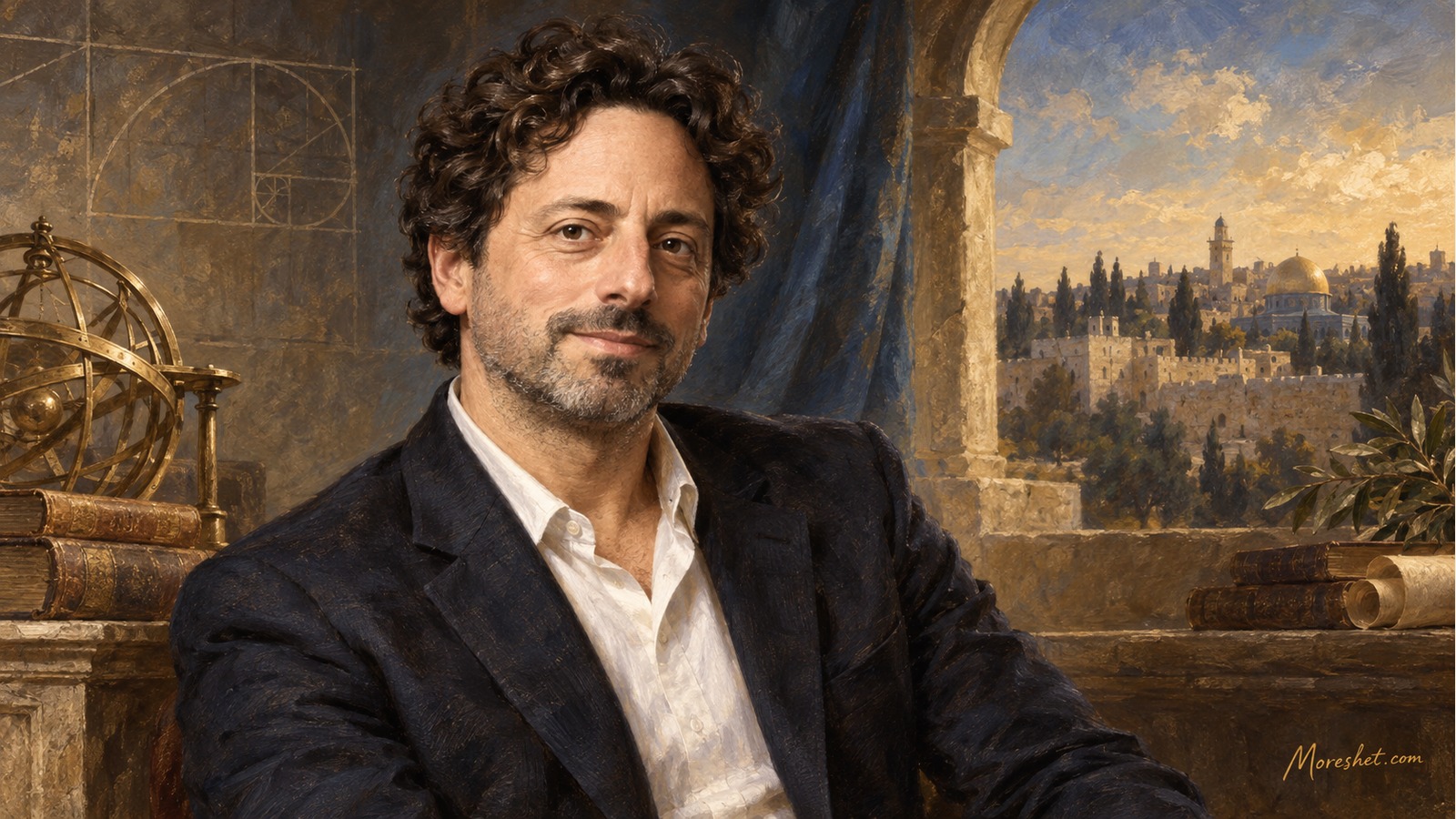
Sergey Brin — AI-generated artistic portrait · Moreshet.com 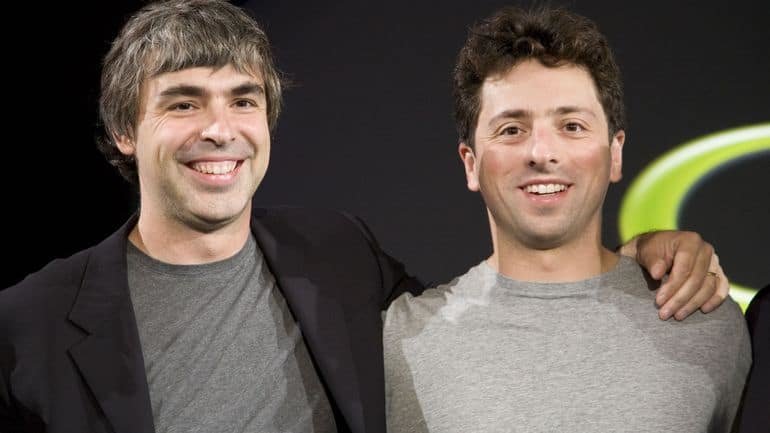
Sergey Brin — image from the Moreshet archive
Jewish-American computer scientist and entrepreneur, co-founder of Google and Alphabet, who turned internet search into a central infrastructure of the digital world
Sergey Mikhailovich Brin is a Jewish-American computer scientist, entrepreneur, investor and philanthropist, born in Moscow, and one of the founders of Google. With Larry Page, he developed at Stanford University the PageRank idea and the search engine that became Google, one of the most influential companies in the history of technology, economics and digital culture.
Brin’s importance is not limited to creating a successful company. Google changed the relationship between human beings and knowledge: it turned search, maps, email, video, digital advertising, mobile computing, cloud services, translation and artificial intelligence into everyday infrastructure. His personal path connects Soviet Jewish emigration, antisemitic barriers to education and science, mathematical excellence, American entrepreneurship and the creation of a global information system that continues to shape the lives of billions.
Jewish childhood in Moscow and departure from the Soviet Union
Brin was born in Moscow on August 21, 1973, to a Russian-Jewish family. His father, Mikhail Brin, was a mathematician who studied at Moscow State University and later became a mathematics professor at the University of Maryland. His mother, Eugenia Brin, was a scientist and researcher who later worked at NASA’s Goddard Space Flight Center. The family lived in a Moscow apartment within a Soviet reality in which many Jews faced both explicit and implicit barriers to higher education and professional advancement.
Brin’s father later described how, after attending a mathematics conference in Poland, he understood how deeply Soviet discrimination restricted his family’s future. In 1978 the family applied for exit visas. As a result, his father lost his job, and his mother also had to leave her position. For months the family lived in uncertainty, like many Jewish families waiting for permission to leave the Soviet Union.
In 1979 the family received permission to leave, traveled through Vienna and Paris, and arrived in the United States in October of that year. HIAS, the Jewish organization that aided refugees and immigrants, was part of the assistance network that helped the family begin a new life. This story became a core element of Brin’s identity: a six-year-old Jewish child leaving a country that closed possibilities to his family and arriving in a society where mathematical and technological talent could become a world-changing force.
Education, mathematics and computer science
In the United States, Brin grew up in Maryland. He attended Eleanor Roosevelt High School, and from an early age his ability in mathematics, computing and problem-solving was visible. His family encouraged learning, curiosity and scientific education. His parents did not only provide models of academic excellence; they also brought with them the memory of a society in which science could be blocked for political reasons and the understanding that intellectual freedom matters.
Brin studied at the University of Maryland, where he completed a Bachelor of Science degree in computer science and mathematics in 1993 with high honors. He then moved to Stanford University for graduate studies in computer science, receiving a Master of Science degree in 1995. Although he did not complete the doctorate, his work there became the basis for one of the greatest revolutions in the history of the internet.
The combination of mathematics and computer science was decisive. Google was not born only as a business idea, but as a scientific solution to a mathematical-computational problem: how to rank the importance of web pages within a rapidly expanding network, when the number of pages and links had grown beyond human organization.
Stanford, Larry Page and the birth of PageRank
At Stanford, Brin met Larry Page. At first the two argued often, but they quickly became close intellectual partners. Page was interested in the idea that the importance of a web page could be understood through links pointing to it, much as a scientific paper gains importance through citations. Brin, whose focus included data mining and information systems, brought the mathematical and computational ability to turn the idea into a working system.
Together they developed the algorithm that became known as PageRank, and presented their ideas in the academic paper The Anatomy of a Large-Scale Hypertextual Web Search Engine. The idea was easy to grasp but deep in execution: not every link is equal, and important pages confer greater importance on the pages to which they link. This made it possible to create a ranking of relevance that produced results far better than those common at the time.
The initial system, called BackRub, ran on Stanford infrastructure and grew quickly. Dorm rooms filled with inexpensive computers, drives, servers and hardware components needed to support a growing number of searches. Before long, Brin and Page understood that they did not merely have a research project; they had a tool that could change the internet itself.
The founding of Google and search as world infrastructure
In 1998 Brin and Page founded Google, first in Susan Wojcicki’s garage in Menlo Park. The name, derived from the mathematical term googol, expressed the ambition to organize an immense quantity of information. From the beginning, Google stood out for its clean, fast and relatively precise search page at a time when many websites were crowded with advertising, portals and unfocused content.
Its success came from a rare combination of algorithm, computing infrastructure, product design, engineering culture and business model. Google did not merely find information; it ranked it, made it accessible and turned searching into a natural act of modern life. The phrase to google became a verb in many languages, a sign that the product itself had become a cultural habit.
Over the years Google expanded far beyond search: Gmail, Google Maps, Google Earth, YouTube, Android, Chrome, Google Books, Google Translate, Google Cloud and artificial intelligence. Although Brin was not solely responsible for each of these products, he was one of the founders of the organizational and technological culture that enabled the company to think at global scale.
Information, advertising and the digital economy
One of Google’s greatest contributions was the creation of a new economic model around search and targeted advertising. Digital advertising based on queries, intent and relevance became a giant revenue engine and changed the economics of journalism, commerce, marketing and the internet. Small and large businesses could reach customers through search terms, and users received many services without direct payment.
This change also created broad questions: who controls information, how visibility is determined, what privacy means in the age of search, how paid advertising affects knowledge, and what responsibility a private company has when it becomes the main gateway through which the world accesses information. Brin, as a founder of Google and a major shareholder, is associated with both the immense technological achievement and the institutional questions that followed from it.
Economically, Google and Alphabet became one of the largest corporate groups in the world. They influenced the technology labor market, data science, advertising, cloud infrastructure, mobile operating systems, digital video and the way companies think about scale, speed, experimentation and information.
Alphabet, advanced research and ambitious projects
In 2015 Alphabet was created as Google’s parent company, in a move designed to separate the core search and advertising business more clearly from wider projects. Brin served as president of Alphabet until 2019, when he stepped back from daily management together with Larry Page. Even so, he and Page remained founders, controlling shareholders and board members, and therefore continued to hold deep influence over the company.
Under the Alphabet framework, fields such as Waymo in autonomous vehicles, Verily in life sciences, DeepMind in artificial intelligence, X in future projects, and cloud and computing infrastructure continued or developed. Not every project became commercially successful, but they express the legacy Brin and Page tried to build: a company able to finance large-scale technological experiments even when the road to profitability is long and uncertain.
In 2023, as global competition in artificial intelligence intensified, Brin was reported to have become more involved again in AI efforts inside Google and Alphabet, especially around the Gemini family of models. His return to technical involvement shows that even after leaving formal executive office, he remained connected to the core technological questions of the company he founded.
Science, artificial intelligence and the U.S. science advisory council
Brin was elected to the U.S. National Academy of Engineering in 2009, an honor considered among the highest in engineering and technology. The election recognized his contribution to the development of rapid indexing and retrieval of relevant information from the web. This is important because it places Google not only as a business success, but as an engineering and scientific achievement.
In the age of artificial intelligence, Brin’s contribution takes on new meaning. Internet search was in many ways the first stage of organizing digital knowledge; AI represents a further stage in which systems do not only find information, but summarize, formulate, translate, code and assist decision-making. Google, built on search, became one of the central competitors in the struggle over the future of AI.
In 2026 Brin was appointed a member of the U.S. President’s Council of Advisors on Science and Technology, PCAST. The appointment reflects his standing as one of the technology figures with broad scientific and public influence in the United States. It positions him not only as a company founder, but as part of the national discussion on science, innovation, competitiveness, AI and future infrastructure.
Philanthropy, Parkinson’s disease and HIAS
One of the most prominent areas of Brin’s philanthropy is Parkinson’s disease research. His mother, Eugenia, was diagnosed with Parkinson’s, and Brin himself learned that he carries a genetic variant associated with increased risk of the disease. He consequently became a major donor to Parkinson’s research, including through large gifts to the Michael J. Fox Foundation and other research efforts.
His philanthropy in this field matters because it combines personal biography, science, genetics, medicine and large-scale funding capacity. Brin did not limit himself to symbolic giving; according to numerous reports, he became one of the largest private donors to Parkinson’s research, supporting basic science, scientific collaboration and efforts to accelerate understanding and treatment of the disease.
In 2009, Brin and Anne Wojcicki donated one million dollars to HIAS, the organization that helped his family during its immigration journey. That gift carries special heritage meaning: it closes a circle between a refugee-immigrant child who reached the United States with Jewish assistance and a person of wealth and influence helping others find a path to safety, freedom and a new beginning.
Jewish identity, immigration and public responsibility
Brin was raised Jewish, though he is not usually described as religious. The Jewish meaning of his story lies not mainly in religious practice, but in immigration, Soviet antisemitism, the importance of education, the memory of closed doors and the possibility of opening new doors through knowledge. He is one of the leading symbols of the immense contribution made by Jewish immigration from the former Soviet Union to science, technology, academia and business in the United States.
His biography also raises broad Jewish and universal questions: what freedom of information means, how knowledge becomes power, how technology can liberate but also concentrate authority, and how a person from a family that experienced restrictions on movement and learning became one of the people most influential in the flow of information worldwide.
In recent years Brin has also spoken on sensitive public subjects, including the war in Gaza, antisemitism and political discourse in the United States. Like any public figure with great influence, his statements and positions can generate agreement or disagreement. But the fact that a Jewish, Soviet-born founder of Google participates in debates about memory, identity, science and policy is part of the wider significance of his public life.
Personal life and further projects
Brin was married to biotechnology entrepreneur Anne Wojcicki, co-founder of 23andMe, and they had two children. He later married Nicole Shanahan, a legal technology entrepreneur, and they had a daughter. His personal life has often received media coverage, but his historical importance rests primarily on his scientific, technological, business and philanthropic work.
Beyond Google and Alphabet, Brin has supported or invested in ventures in air transport, airships, science, health and future technologies. He is associated with LTA Research, a company developing large airships, a field that reflects interest in infrastructure technologies not limited to screens or the internet.
Brin is among the richest people in the world, but the way his wealth was created is directly tied to a structural transformation of human information. It is not only a private financial success, but a story about infrastructure that became part of the global public environment: people search, navigate, learn, work, watch, translate and manage businesses through tools born from the company he founded.
Why this legacy belongs in Moreshet
Sergey Mikhailovich Brin merits inclusion in Moreshet because his story connects Jewish emigration from the Soviet Union, resistance to antisemitic discrimination, mathematical excellence, computer science, global entrepreneurship, medical philanthropy and enormous influence on the daily life of humanity. He is one of the most prominent Jews to shape the digital age, and the technology he helped create changed the way human beings access knowledge.
Moreshet.com documents Brin because Jewish and Israeli heritage includes not only figures who acted inside Jewish communities or the State of Israel, but also Jews who worked on the world stage and changed the infrastructure of modern life. Sergey Brin’s place in Moreshet rests on the way a child from a Jewish family that emigrated in search of educational and scientific freedom became one of the central people in organizing human knowledge. It is a story of immigration, freedom, science, technology and public responsibility — a defining chapter in the Jewish heritage of the digital era.