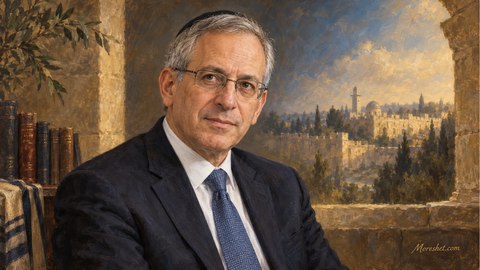
Shai Yeshayahu Nitzan
Israeli jurist, former State Attorney, and Head of the National Library of Israel’s Content Cluster
Shai Yeshayahu Nitzan is an Israeli jurist whose public career has spanned some of the country’s most consequential legal and cultural institutions. As Israel’s 11th State Attorney from 2013 to 2019, he led the national prosecution service while it handled major criminal, public-corruption, and security cases. Earlier, he represented the state in landmark High Court of Justice proceedings, oversaw security and special assignments within the State Attorney’s Office, and served as Deputy Attorney General for Special Assignments.
After leaving the prosecution service, Nitzan entered a different sphere of public responsibility at the National Library of Israel, the institution charged with collecting, preserving, and making accessible the documentary heritage of Israel and the Jewish people. Appointed the library’s rector in 2021, he became Head of its Content Cluster when the position was retitled in February 2024. His career therefore connects the administration of justice with the preservation of national memory—two fields that shape how a society understands its principles, institutions, and history.
A Jerusalem upbringing and military service
Nitzan was born in Jerusalem on November 29, 1959, to Chava and Yaakov Nitzan, who had immigrated to Mandatory Palestine from Hungary and Czechoslovakia in 1934. Raised in a religious home in Jerusalem’s Kiryat Moshe neighborhood, he attended the Bnei Akiva Netiv Meir yeshiva. At 23 he stopped wearing a kippah, while continuing to observe Shabbat and maintain a religious way of life.
In 1978 he enlisted in the Israel Defense Forces, volunteered for the Paratroopers Brigade, and served in its 890th Battalion. He completed infantry combat and squad-commanders training and took part in operational activity with the battalion and brigade. That early experience introduced him to the responsibilities of state service and to the practical intersection of security, public authority, and individual duty—themes that later became central to his legal work.
Legal, historical, and national-security education
At the Hebrew University of Jerusalem, Nitzan studied both law and Jewish history, graduating with honors in 1985. The combination gave him formal legal training together with an academic grounding in the historical development of the Jewish people and its institutions. His professional training included a clerkship at the Supreme Court with Justice Aharon Barak, later president of the Court, followed by work with attorney Yaakov Rubin, a former head of the Israel Bar Association.
Nitzan completed a master’s degree in law at the Hebrew University in 1989, again with honors. In 1999 he graduated from Israel’s National Security College and earned an additional master’s degree, in political science, from the University of Haifa with honors. This unusually broad preparation in law, history, government, and national security suited a career involving not only criminal prosecution but also constitutional questions and the conduct of public authorities during emergencies and political conflict.
Three decades in the State Attorney’s Office
From senior aide to special assignments
From 1989 to 1993, Nitzan served as personal assistant to State Attorney Dorit Beinisch, who later became president of the Supreme Court. Between 1994 and 2002 he worked as an attorney in the High Court of Justice Department of the State Attorney’s Office. The department represents government authorities in petitions brought before the Supreme Court sitting as the High Court of Justice, placing its attorneys at the center of disputes over administrative power, individual rights, security policy, and the legal duties of the state.
Alongside that work, Nitzan was responsible for security matters in the State Attorney’s Office from 1997 to 2002. He then headed its Special Assignments field in 2002–2003 and was subsequently appointed Deputy State Attorney for Special Assignments. These responsibilities frequently required coordination among prosecutors, police, security bodies, and government ministries in matters that did not fit an ordinary prosecutorial track.
Representing the state in defining cases
Nitzan represented the government in proceedings that helped define the legal limits of state power. They included the High Court petition concerning Israel’s targeted-killing policy and the Public Committee Against Torture in Israel case dealing with interrogation methods used by the Israel Security Agency. Such proceedings required the Court to examine the state’s response to security threats alongside legal restraints and protections for human rights. Nitzan also worked on legal aspects of the Bar-On–Hebron affair and the Moshe Katsav case.
In 2005, he oversaw the legal dimension of implementing Israel’s Disengagement Plan and the enforcement system’s preparations for the protests and arrests surrounding it. Special courts were established near detention facilities as part of those preparations. He also carried responsibility for law-enforcement matters in the West Bank, a sensitive field in which security needs, civil rights, government policy, and intense public disagreement regularly converge.
The cases and enforcement policies under his responsibility often exposed him to personal pressure. Demonstrations were held outside his home, and in January 2011 an online video called for his murder. Security protection was assigned to him for a period, and a suspect was arrested in connection with producing and distributing the video. He again received protection near the end of his term as State Attorney because of threats related to prominent public cases.
Deputy Attorney General and State Attorney
In September 2012, the government approved Nitzan’s appointment as Deputy Attorney General for Special Assignments. His senior responsibilities also included work against racism and incitement. In 2019, he expressed the priority he attached to that mission when he said, “The fight against corruption is important, but the fight against racism is more important.” The statement reflected a view of law enforcement that extended beyond misconduct in government to the protection of social groups and civic life against discrimination and hatred.
A search committee recommended Nitzan for State Attorney in November 2013. After government approval, he took office on December 16, succeeding Moshe Lador. For the next six years he headed the State Attorney’s Office, which represents the state in court, conducts a substantial portion of Israel’s criminal prosecution, and sets professional policy across thousands of proceedings.
His tenure was marked by sustained attention to public corruption and investigations involving senior officials. During these years, the prosecution service continued proceedings that culminated in the conviction of former prime minister Ehud Olmert, as well as cases involving municipal leaders in Ashkelon, Or Yehuda, Immanuel, and other communities. The office also worked on the Yisrael Beiteinu affair, the Bezeq cases, the submarines affair, and other investigations of major public interest.
Near the end of Nitzan’s term, the prosecution service was deeply involved in the investigations concerning Prime Minister Benjamin Netanyahu. In November 2019, the attorney general announced the decision to file an indictment. Responsibility in cases of this kind is distributed among investigators, senior prosecutors, the State Attorney, and the attorney general. Nitzan’s institutional role was to lead the professional prosecution system that examined the evidence and prepared legal recommendations under extraordinary public scrutiny.
Nitzan completed his six-year term on December 16, 2019. His career in the State Attorney’s Office illustrates the demanding position of Israel’s public legal service: exercising enforcement authority in the name of the state, maintaining professional judgment, and defending government action before the courts even when the underlying issues provoke sharp political and social disagreement.
From law to the National Library of Israel
In November 2021, Nitzan’s appointment as rector of the National Library of Israel was approved. The newly created position was designed to oversee the library’s broad content domains. In February 2024 its title was changed to Head of the Content Cluster. The role places him within the national institution that collects and preserves books, manuscripts, archives, newspapers, music, and other records documenting Jewish life, Israeli society, and the cultures of the region.
The National Library occupies a distinctive place at the intersection of scholarship, education, and historical memory. Oversight of its content affects how national collections are interpreted, made accessible to the public, and used by researchers, students, creators, and Jewish communities in Israel and around the world. Nitzan brought to this work decades of experience in managing public systems and addressing questions of law, government, and national identity.
Writing on a Jewish and democratic state
Nitzan has also contributed to Israeli legal writing. His publications include the 2020 essay To Be a Jewish and Democratic People in Our Land—On Disqualifying Lists and Candidates for the Knesset, published by Nevo in the volume Roots in Law, edited by Dina Zilber. Its subject lies at the heart of Israeli public law: how a democracy protects itself and its foundational character while preserving political representation, freedom of expression, and an open electoral process.
Personal life
Nitzan lives in Jerusalem. He is married to Tamar Nitzan, a teacher of Arabic, and they have five children. His brother, Professor Shmuel Nitzan, is an economist, while his son Ido Nitzan is a literary scholar and translator. Jerusalem—his birthplace, the setting of his education, and the center of much of his professional life—has remained a consistent thread through his personal and public story.
Why this legacy belongs in Moreshet
Shai Yeshayahu Nitzan merits inclusion in Moreshet because his career touches several institutions that shape life in the State of Israel: the State Attorney’s Office, the attorney general’s legal service, the Supreme Court, and the National Library of Israel. Across three decades in public law, he worked on the practical boundaries of government power, criminal enforcement, national security, public corruption, racism, and democratic accountability.
His relevance to Jewish and Israeli heritage comes not from a single office but from the continuum of his work. He studied Jewish history, helped formulate and implement legal policy in cases of lasting public significance, led Israel’s national prosecution service, and then moved to an institution entrusted with preserving the cultural memory of Israel and the Jewish people. This profile at Moreshet.com records his contribution to law as a living institution—one that affects public trust, civil rights, the accountability of leaders, and the capacity of a Jewish and democratic society to preserve both its principles and its sources for future generations.