Safra Ada Catz
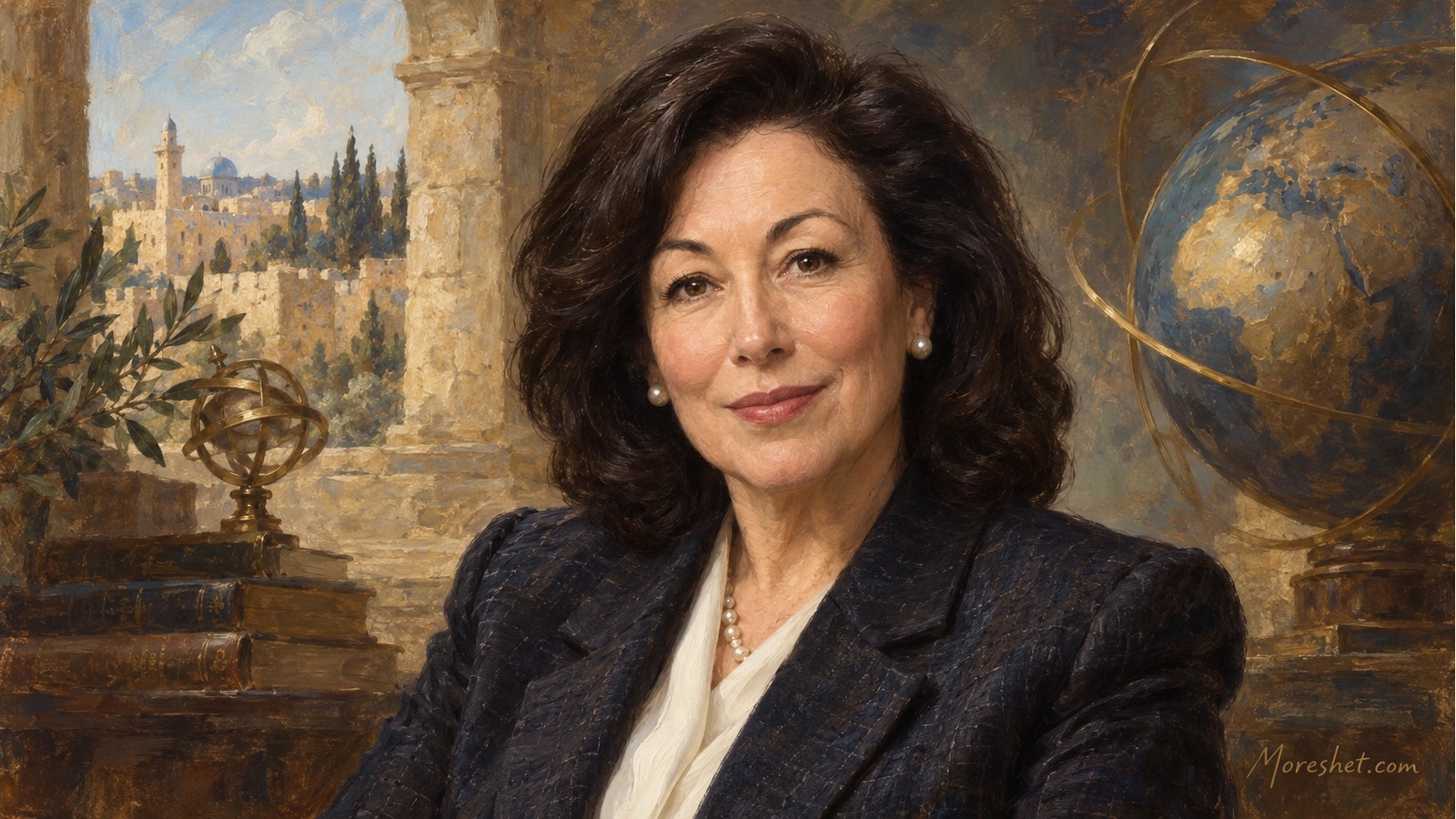
Safra Catz — AI-generated artistic portrait · Moreshet.com
Israeli-born Jewish business executive, Oracle executive vice chair and former CEO who led the company through cloud, major acquisitions and the AI era
Safra Ada Catz is an Israeli-born Jewish-American business executive, executive vice chair of the Oracle board of directors and former chief executive officer of Oracle. She is one of the most influential women in the global technology industry, and a central figure in the story of Oracle’s transformation from a mature database and enterprise-software company into one of the world’s important cloud, infrastructure and artificial-intelligence companies.
Catz’s importance lies in a rare combination of financial discipline, deal judgment, operational command and decision-making at global scale. For more than two decades at Oracle, she helped shape the company’s acquisition strategy, financial management, cloud expansion and continued relevance during deep technological change. As an Israeli-born executive from Holon who reached the top of one of the world’s largest technology companies, her story is also an important chapter in the heritage of Israelis and Jews in international business.
Childhood in Holon and the move to the United States
Catz was born in Holon, Israel, in December 1961, to Jewish parents. At the age of six she moved with her family to the United States and grew up in Brookline, Massachusetts. The move from Israel to America came early in life, but her Israeli origins remained an important part of her public biography. She belongs to a small group of Israeli-born figures who reached leadership positions in major American corporations.
In Brookline she attended the local high school and then went on to the University of Pennsylvania. She earned a bachelor’s degree from the Wharton School in 1983, and later completed a J.D. at the University of Pennsylvania Law School in 1986. The combination of business, legal and financial training formed the basis for a career in which deals, capital structure, strategy and corporate governance were always central.
Investment banking and preparation for deal-making
Before joining Oracle, Catz worked in investment banking, especially at Donaldson, Lufkin & Jenrette. She held senior roles there, including senior vice president and managing director in investment banking. That world gave her deep familiarity with technology companies, mergers and acquisitions, valuation, risk management, negotiation and transaction structure.
This chapter matters because it explains the imprint she later brought to Oracle. Catz did not enter the company as a software engineer or product executive, but as a financial and strategic expert who could read balance sheets, identify value, manage an acquisition process and connect a transaction to operational outcomes. At Oracle, that capability became one of her central sources of power.
Joining Oracle and rising quickly to leadership
Catz joined Oracle in April 1999 as a senior vice president. Within a short time, she became one of Larry Ellison’s closest executives and one of the company’s most influential figures. In 2001 she joined Oracle’s board of directors, and in early 2004 she was named president of the company. She later served as chief financial officer during significant periods before becoming co-chief executive in 2014.
Her rapid rise inside a competitive and demanding company such as Oracle showed an unusual ability to translate financial knowledge into strategic leadership. Oracle was already a large and successful company when Catz joined, but it operated in a rapidly changing market: internet growth, enterprise software, databases, global customers, competition with SAP, IBM, Microsoft and later Amazon and the cloud giants.
Catz became one of the figures who allowed Oracle to operate not only as a product company, but as a broad corporate-strategy machine: a company that acquires, integrates, cuts, streamlines, expands and redefines lines of business without losing business discipline.
Acquisition strategy and Oracle’s expansion
One of the areas most closely associated with Catz is mergers and acquisitions. She was a central figure in Oracle’s 2005 acquisition of PeopleSoft for about 10.3 billion dollars, one of the most important and difficult transactions in Oracle’s history. The acquisition strengthened Oracle’s position in enterprise applications and demonstrated the company’s willingness to use large acquisitions to change the balance of power in the market.
Catz was later involved in a long series of transactions that expanded Oracle in enterprise software, infrastructure, databases, hardware, cloud and health. Notable moves included the acquisitions of Siebel, BEA Systems, Sun Microsystems, NetSuite and Cerner. Each of these required not only the signing of an agreement, but the integration of employees, products, customers, technologies and organizational cultures.
Catz’s strength was the ability to see an acquisition as part of a larger system: not only price and balance sheet, but also synergy, cash flow, profitability, product control, customer expansion and the removal of duplication. This approach made her one of the executives most closely identified with Oracle as a major consolidator of the enterprise-software industry.
CEO of Oracle: between mature software and cloud
In 2014, after Larry Ellison moved from CEO to chairman and CTO, Safra Catz and Mark Hurd were appointed co-CEOs of Oracle. After Hurd’s medical leave and later death in 2019, Catz became sole CEO. She led the company during a period when the enterprise-software industry was moving from traditional licensing and maintenance models to cloud, subscriptions and ongoing services.
The move to cloud was not simple for a mature company such as Oracle. The company had to build competitive cloud infrastructure, retain large customers, move complex systems into new models, compete against AWS, Microsoft Azure and Google Cloud, and prove that its databases and enterprise applications remained relevant in a new world of flexible infrastructure.
During her leadership, Oracle continued to develop Oracle Cloud Infrastructure, expand enterprise cloud applications, strengthen its autonomous database and present itself as a central infrastructure company for the artificial-intelligence era. Catz was associated with profitability, capital return to shareholders, cost discipline and a careful but determined shift toward new models.
Oracle, artificial intelligence and future infrastructure
In the third decade of the 21st century, Oracle acquired a new role in the market: not only a database and applications company, but a cloud-infrastructure provider for large AI systems. Data centers, GPU chips, network capacity, fast storage and enterprise databases all became part of the competition over the future of artificial intelligence.
Catz led Oracle during the period in which the company signed major cloud deals, expanded data-center capacity and positioned itself as an infrastructure provider for companies and organizations needing large-scale computing. This shift connected Oracle’s long-standing database heritage with the new need of organizations to manage data, models and AI applications securely and reliably.
In September 2025, Oracle announced that Clay Magouyrk and Mike Sicilia would become co-CEOs and that Catz would move to the role of executive vice chair of the board. The transition pointed to an orderly succession process in which Catz remained in a senior position of influence while operating executives led the next phase of cloud and AI growth.
Boards, national security and technology policy
Catz’s influence is not limited to Oracle. She served on the board of HSBC, on the board of The Walt Disney Company, and later joined the board of Paramount Skydance. She also serves as a trustee of In-Q-Tel, a strategic investment organization supporting the United States national-security community, and has held advisory roles connected with policy, technology and security.
Catz was a member of the U.S. National Security Commission on Artificial Intelligence, which issued a broad report in 2021 on the impact of AI on national security, technological competition and the future economy. In 2022 she was appointed to the Homeland Security Advisory Council, and in 2026 she was appointed to the U.S. President’s Council of Advisors on Science and Technology, PCAST.
These appointments reflect her standing as a business leader who understands the intersection of software, cloud, data, AI, security, government and international competition. In an era when enterprise technology is both economic infrastructure and a strategic asset, her experience at Oracle made her relevant to public-policy circles as well.
Women, Israelis and leadership in global business
For years Catz has been recognized as one of the most senior and influential women in global business. She has repeatedly appeared on Forbes and Fortune lists of powerful and influential women, and at times on lists of highly paid executives. Her presence at the top of a company of Oracle’s scale was significant in an era when the number of women leading giant corporations remained small.
The heritage meaning of her path is double: on one hand, she is a woman who reached the summit of global corporate technology; on the other, she is an Israeli-born Jew whose influence developed in the American and global arena. Her story shows that Israeli and Jewish identity can be present at major centers of business and technological power, not only through startup entrepreneurship but also through the management of a mature corporation with systemic influence.
Catz is not usually a sentimental or publicity-driven public figure. Her style is often seen as focused, tough, financial and results-oriented. Precisely for that reason, she is historically interesting: she demonstrates that leadership can be built less on public performance and more on control of details, numbers, deals, discipline and outcomes.
Education and the next generation
Alongside her business roles, Catz has also been connected with technology education. She is a lecturer in accounting at the Stanford Graduate School of Business, and has been a member of the board of the Oracle Education Foundation since its founding in 2000 and chair of the foundation since 2004. The foundation works in technology education, design thinking, engineering, data and preparing students for a new world of digital creation.
This connection matters because it points to a broader understanding of technology: not only as a product or source of revenue, but as a human capability that must be taught, made accessible and developed. For someone who led an enormous enterprise company, involvement in technology education links the corporate world with responsibility for the next generation of students, developers, designers and leaders.
Personal life
Safra Catz has been married to Gal Tirosh, a former soccer coach, since 1997, and they have two sons. She resides in the United States and has in recent years been associated with Florida. Although her personal life is not the center of her public profile, it completes the picture of an Israeli-born woman who built an exceptional American career.
Her choice to maintain a generally businesslike public profile, focused on company, strategy and policy, has contributed to her image as an executive of results rather than noise. In a world where many executives build highly visible personal brands, Catz built influence through roles, transactions, decisions and numbers.
Why this legacy belongs in Moreshet
Safra Ada Catz merits inclusion in Moreshet because she is one of the most prominent Jewish and Israeli-born women in the history of global business and technology. Her path connects Holon, Brookline, Wharton, investment banking, Oracle, cloud, artificial intelligence and international technology policy. She did not only reach the top; she remained there for many years and influenced a company that serves as infrastructure for businesses, governments and institutions around the world.
Moreshet.com documents Catz because Jewish and Israeli heritage also includes women and men who worked outside Israel while carrying a story of identity, education, migration and global achievement. Safra Catz’s place in Moreshet rests on her influence on enterprise software, the shift to cloud and AI, the representation of women and Israelis at the top of business, and her contribution to the broader discussion of how technology, economics and public security intersect in the digital age.