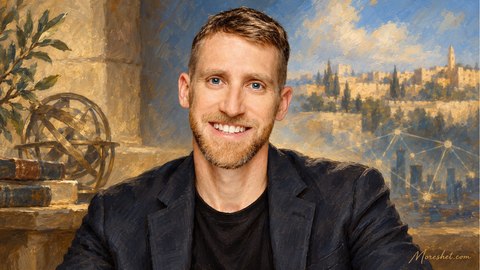
Paul Baran
The Jewish American engineer whose pioneering design for packet-switched, distributed networks helped lay the foundations of modern digital communication (1926–2011)
Paul Baran was a Jewish American engineer, inventor, and technology entrepreneur whose work helped change how computers communicate. At the RAND Corporation in the early 1960s, he developed a detailed design for a distributed network that could continue operating even after extensive damage. Information would be divided into units, transmitted across shared links by different routes, and reassembled at its destination. This method became one of the foundations of packet-switched computer networks and, eventually, the Internet.
Baran did not single-handedly invent the Internet, nor was he the only originator of packet switching. British computer scientist Donald Davies independently developed a closely related approach and introduced the term “packet.” Baran's distinctive achievement was to bring several ideas together in a comprehensive network architecture: distributed control, redundant paths, adaptive routing, store-and-forward transmission, and the division of messages into blocks. His RAND reports were among the materials considered by the people who built ARPANET, the pioneering network from which the Internet later emerged.
From a Jewish immigrant family to early computing
Baran was born Pesach Baran on April 29, 1926, in Grodno, then part of Poland and now in Belarus. He was the youngest of three children in a Lithuanian Jewish family. In May 1928, the family immigrated to the United States, settling first in Boston and later in Philadelphia. His father, Morris “Moshe” Baran, opened a grocery store, where Paul helped as a boy.
His life followed a path familiar to many Jewish immigrant families who rebuilt their lives in America, but it led him into an unusually consequential field. Within one generation, the child of an Eastern European shopkeeper had entered the emerging worlds of commercial computing, radar processing, and digital communications.
Baran earned a degree in electrical engineering from the Drexel Institute of Technology, now Drexel University, in 1949. He then joined the Eckert-Mauchly Computer Company and performed technical work on UNIVAC machines, among the earliest commercial computers in the United States. This experience placed him near the beginning of an industry that was still dominated by large, expensive, centralized systems.
In 1955 he married Evelyn Murphy and moved to Los Angeles. There he worked for Hughes Aircraft on radar data-processing systems while attending evening classes at the University of California, Los Angeles. He completed a master's degree in engineering in 1959; his thesis concerned character recognition. He began doctoral studies but did not complete them because of the demands of his work and travel.
Designing a network that could survive destruction
A Cold War communications problem
Baran joined RAND in 1959 and took on a question with grave Cold War implications: how could a communications system continue connecting its endpoints after a nuclear attack had destroyed parts of the network? Many military communications systems depended on vulnerable high-frequency links or centralized facilities whose loss could isolate entire regions.
Baran proposed a different model. Rather than protecting one indispensable center, the network would distribute its communications capacity across many interconnected nodes. If one route failed, traffic could travel along another. No single switching center would have to control the whole system, and the network could route around damage.
Redundancy as a source of resilience
Baran and his colleagues used computer simulations to test networks with different numbers of links per node. They randomly removed nodes and measured how much of the remaining network stayed connected. The results demonstrated that a network in which each node had several connections could retain substantial connectivity even after losing a large share of its components.
The insight was simple but powerful: redundancy was not waste; it was resilience. Multiple possible paths allowed the system to withstand failures that would disable a centralized or sparsely connected network. The same broad principle now supports the reliability of communications systems serving billions of people.
Breaking messages into blocks
Another essential element of Baran's design was the division of information into what he called “message blocks.” Traditional telephone systems established a dedicated circuit for the duration of a call. In Baran's proposed system, blocks could be transmitted separately over shared lines, take different routes through the network, and be reassembled at their destination.
This approach used communications capacity more efficiently and made it possible to route information around damaged or congested areas. Baran also described store-and-forward switching, routing methods, and the roles of the network's internal nodes and intelligent endpoint devices. Instead of requiring every component at the center to be exceptionally expensive and reliable, the architecture derived reliability from the structure of the network as a whole.
On Distributed Communications
Baran began publishing his findings in a RAND report in 1960. In 1964 RAND issued the extensive On Distributed Communications series, which addressed how such a system could operate, what its components would do, and what it might cost. It was more than an abstract suggestion: Baran attempted to provide a practical engineering blueprint.
The proposal challenged the assumptions of the established telephone industry, which was built around dedicated circuits and highly reliable central equipment. Some telephone engineers initially dismissed the notion of carrying voice through nondedicated connections. Yet when the U.S. Advanced Research Projects Agency began developing ARPANET later in the decade, Baran's reports formed part of the technical background considered by its designers. ARPANET was not a direct copy of his proposed system, but his work helped establish the intellectual case for distributed, packet-switched communication.
Independent invention and a shared technological breakthrough
At Britain's National Physical Laboratory, Donald Davies independently arrived at a similar method intended for a general-purpose computer network. Davies called the units of information “packets,” the term that became standard, and his work attracted the direct attention of ARPANET developers at a 1967 conference.
Baran readily acknowledged Davies's independent achievement. Historians and institutions including the U.S. National Inventors Hall of Fame consequently recognize Baran and Davies as independent inventors of digital packet switching. That shared recognition sharpens rather than diminishes Baran's place in history. His contribution lay in combining packet-like message blocks with a thoroughly distributed, redundant architecture designed to preserve connectivity under extreme conditions.
Turning network ideas into companies and products
Baran's career extended well beyond his foundational RAND research. In 1968 he helped found the Institute for the Future, an organization devoted to long-range thinking about technological and social change. He also wrote about computer systems, privacy, and the public policies needed to govern powerful new technologies. In 1976 he participated with Stanford cryptographers Martin Hellman and Whitfield Diffie in a review of the proposed U.S. Data Encryption Standard.
As early as 1971, Baran anticipated the emergence of household electronic mail as a significant service. The prediction reflected his understanding that digital networks would not remain confined to military and research institutions. They would enter homes and become part of ordinary social and economic life.
Packetized voice and high-speed modems
In the early 1980s Baran founded PacketCable, also known as Packet Technologies. Its work included packetized voice, and it spun off StrataCom to commercialize the technology for telephone networks. This effort led to an early commercial product based on technology that preceded the standardization of Asynchronous Transfer Mode, or ATM. It showed that packet methods could carry voice as well as computer data.
Baran later founded Telebit after conceiving a discrete multitone modem technology. Telebit's modems became early commercial uses of techniques related to orthogonal frequency-division multiplexing, a family of methods later deployed widely in DSL broadband and Wi-Fi systems. The company translated sophisticated signal-processing ideas into practical tools for faster data communication over existing lines.
Wireless, cable, and home networking
In 1985 Baran founded Metricom, which developed Ricochet, an early public wireless mesh data network. At a time when mobile Internet access was far from routine, Ricochet demonstrated how users could connect through a distributed web of radio units rather than relying solely on wired connections.
In 1992 he founded Com21, an early cable-modem company. He later founded and served as president of GoBackTV, which developed digital television and cable IPTV infrastructure for network operators. His subsequent venture, Plaster Networks, worked on connecting devices in homes and small offices through existing electrical wiring.
These businesses were not repetitions of a single invention. Together they applied Baran's thinking to telephone service, modems, wireless access, cable networks, television infrastructure, and home connectivity. His career illustrates a rare combination of systems-level research and sustained entrepreneurship: he could imagine a new network architecture and then continue testing how communications principles might become useful products.
Recognition and enduring engineering influence
Baran received major honors for his contributions to communications and network architecture. They included the IEEE Alexander Graham Bell Medal in 1990, the Marconi Prize in 1991, the Bower Award and Prize for Achievement in Science in 2001, and the National Medal of Technology and Innovation for 2007. He was elected a Fellow of the American Academy of Arts and Sciences and a Fellow of the Computer History Museum, and he was inducted into the National Inventors Hall of Fame. Drexel awarded him an honorary doctorate in 1997. In 2012, after his death, he was inducted into the Internet Hall of Fame.
Baran died in Palo Alto, California, on March 26, 2011, at the age of 84, from complications of lung cancer. His influence persists whenever a network divides information into manageable units, shares capacity among many users, finds alternate routes, or continues operating despite failures. Principles developed in response to an extreme military problem became part of a global civilian infrastructure supporting education, medicine, commerce, science, culture, and personal relationships.
Why Paul Baran's legacy belongs in Moreshet
Paul Baran merits a substantial place in Moreshet because his life connects the Jewish immigrant experience with one of the defining technological transformations of the modern age. Born Pesach Baran in an Eastern European Jewish family, he became an American engineer whose careful research helped make resilient digital networking technically credible. He did not merely offer a memorable idea: he simulated it, developed an architecture around it, documented how it could be built, and spent decades bringing advanced communications technologies into practical use.
His work also has a tangible, if universal, bearing on contemporary Jewish and Israeli life. The networked world enables Jewish communities to maintain relationships across continents, gives students access to Jewish texts and languages, supports Israeli research and enterprise, and allows archives, schools, cultural institutions, and families to share knowledge across borders. Baran did not design his network specifically for those purposes, but the infrastructure he helped make possible serves them every day.
By preserving his story, Moreshet.com highlights a Jewish legacy of intellectual courage, technical rigor, and useful invention without assigning the creation of the entire Internet to one person. Baran's verified achievement is both more precise and more compelling: he was an independent inventor of packet switching and one of the earliest architects of resilient distributed networking, an idea that permanently changed how the world communicates.