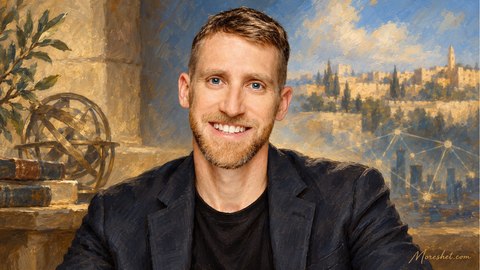
Dario Amodei
The AI researcher who built a major institution around advanced systems and the responsibility to make them safer
Dario Amodei is an American artificial-intelligence researcher, entrepreneur, co-founder, and chief executive of Anthropic. Trained in physics and biophysics, he moved through research positions at Baidu, Google, and OpenAI before helping establish one of the leading organizations developing general-purpose AI. Anthropic created the Claude family of large language models while making safety, evaluation, and the study of model behavior central to its mission.
Amodei’s significance extends beyond the products he has helped bring into the world. He works at the intersection of scientific research, institution building, and the creation of norms for a technology that is rapidly affecting work, education, medicine, culture, security, and public life. In his writing and public testimony, he has advanced a deliberately two-sided argument: powerful AI could help humanity solve extraordinarily difficult problems, but its promise makes serious preparation for misuse, loss of control, and social disruption more—not less—important.
From neural circuits to artificial intelligence
Amodei was born in San Francisco in 1983 to a Jewish American mother and an Italian American father. He grew up in the city and attended Lowell High School. His early ability in science was already evident in 2000, when he was a member of the United States Physics Olympiad team.
He began his undergraduate education at the California Institute of Technology and later transferred to Stanford University, where he earned a bachelor’s degree in physics. At Princeton University, he pursued graduate work in biophysics and studied the collective behavior of biological neural networks. His 2011 doctoral thesis examined network-scale electrophysiology and methods for measuring and understanding neural circuits. He received a Hertz Foundation fellowship during his graduate training and later the foundation’s thesis prize. He then conducted postdoctoral research at Stanford University School of Medicine.
This background gave Amodei a distinctive route into AI. He entered the field not only as a programmer or product builder, but as a scientist trained to ask how complex behavior emerges from networks of interacting units. His transition from biological neural circuits to machine-learning systems also placed him at the boundary between experimental science and a new generation of technologies capable of operating at enormous scale.
Industry research and leadership at OpenAI
Amodei joined Baidu in November 2014 and worked there until the following year, after which he moved to Google. In 2016, he joined OpenAI during an early phase of the organization’s development. He eventually became vice president of research and took part in work on deep-learning systems and increasingly capable general-purpose models.
Those years coincided with a fundamental shift in artificial intelligence. Machine learning was moving from gradual advances on specialized benchmarks toward systems able to perform a much wider variety of tasks. For Amodei, the expansion of model capabilities sharpened the need to understand how such systems behave, how their limitations can be measured, and what safeguards may be necessary as they become more powerful and widely deployed. AI safety therefore became not a separate philosophical concern, but an organizing principle of his scientific and managerial work.
Founding Anthropic and developing Claude
In 2021, Dario and his sister, Daniela Amodei, founded Anthropic with a group of other former senior OpenAI colleagues. Dario became chief executive, while Daniela assumed a central operational and leadership role. Creating Anthropic was the defining institutional achievement of his career: rather than limiting his contribution to warnings about AI, he helped build a research laboratory and commercial company intended to develop advanced systems while investing in safety, evaluation, and a better understanding of model behavior.
The company is best known for Claude, its family of large language models and AI assistants. Claude placed Anthropic among the central organizations developing general-purpose systems for tasks that include writing, analysis, programming, research, and information work. Amodei consequently became more than a scientist and research manager. He became the builder of an institution with a practical influence on technological competition, business adoption, and the standards by which advanced AI systems are assessed.
The effort to combine safety research with commercial development is an important part of his contribution. It reflects the view that responsibility cannot be addressed entirely from outside the laboratories building powerful models. Developers must also create testing methods, oversight practices, and decision-making principles appropriate to the systems they release. Anthropic’s growth gave that approach practical weight and helped move safety questions into discussions among companies, governments, researchers, and users.
A public voice on promise and risk
Amodei has become a prominent public voice on the future of artificial intelligence. In July 2023, he testified before a subcommittee of the United States Senate and warned about dangers that could accompany advanced capabilities, including the possibility that AI systems might assist in the development of highly destructive weapons. His testimony illustrated how AI safety had moved from an internal laboratory discussion to an issue of public policy and national security.
At the same time, Amodei has emphasized the technology’s constructive potential. In his October 2024 essay Machines of Loving Grace, he described how powerful AI—if its risks can be managed successfully—might accelerate research in biology and neuroscience, improve health, support economic development, and expand humanity’s ability to address complex problems. He has connected his interest in faster medical progress to personal experience: his father died from hepatitis C only a few years before an effective treatment became available. The possibility of shortening the path from scientific discovery to lifesaving therapy offers a concrete example of what Amodei believes advanced tools could contribute to human welfare.
His outlook does not treat technological progress as automatically beneficial. Instead, it is built around the tension between far-reaching opportunity and equally far-reaching responsibility. The greater the systems’ potential contribution, his work suggests, the stronger the obligation to examine their reliability, possible uses, and cumulative effects on individuals and societies.
Influence and recognition
Dario and Daniela Amodei were included in the 2023 TIME100 AI list, and Dario was named to the broader TIME100 list of the world’s most influential people in 2025. The recognition reflected not only Anthropic’s rapid emergence, but also his place in the international debate over the direction of AI development.
His influence is especially visible in the effort to treat technical excellence and safety as connected rather than competing goals. Whether advanced systems are used by scientists, physicians, teachers, entrepreneurs, or governments, choices made during their development may ultimately affect millions of people. Amodei has helped ensure that those choices are discussed not only in terms of speed, performance, and commercial value, but also in terms of control, responsibility, and human benefit.
Why Dario Amodei’s legacy belongs in Moreshet
Dario Amodei merits inclusion in Moreshet as a Jewish American scientist and entrepreneur helping to build part of the technological infrastructure of the twenty-first century. He progressed from fundamental research on neural circuits to leading one of the major companies in artificial intelligence, while turning safety from an abstract principle into an institutional undertaking connected to systems used in the real world.
The Jewish and Israeli relevance of his story should be described accurately. The available record does not establish a career devoted specifically to Israeli or Jewish institutions. Its significance instead lies in his place within a long record of Jewish participation in scientific and intellectual life, and in the global consequences of the field he is shaping. For Israel—a society deeply invested in science, technology, medicine, and innovation—the questions Amodei raises about responsibility, security, automation, and beneficial research are especially consequential. By documenting his work, Moreshet.com preserves the story of a contemporary figure whose scientific training, institution building, and public reasoning are influencing how humanity approaches one of its most powerful new technologies.