Miriam Adelson
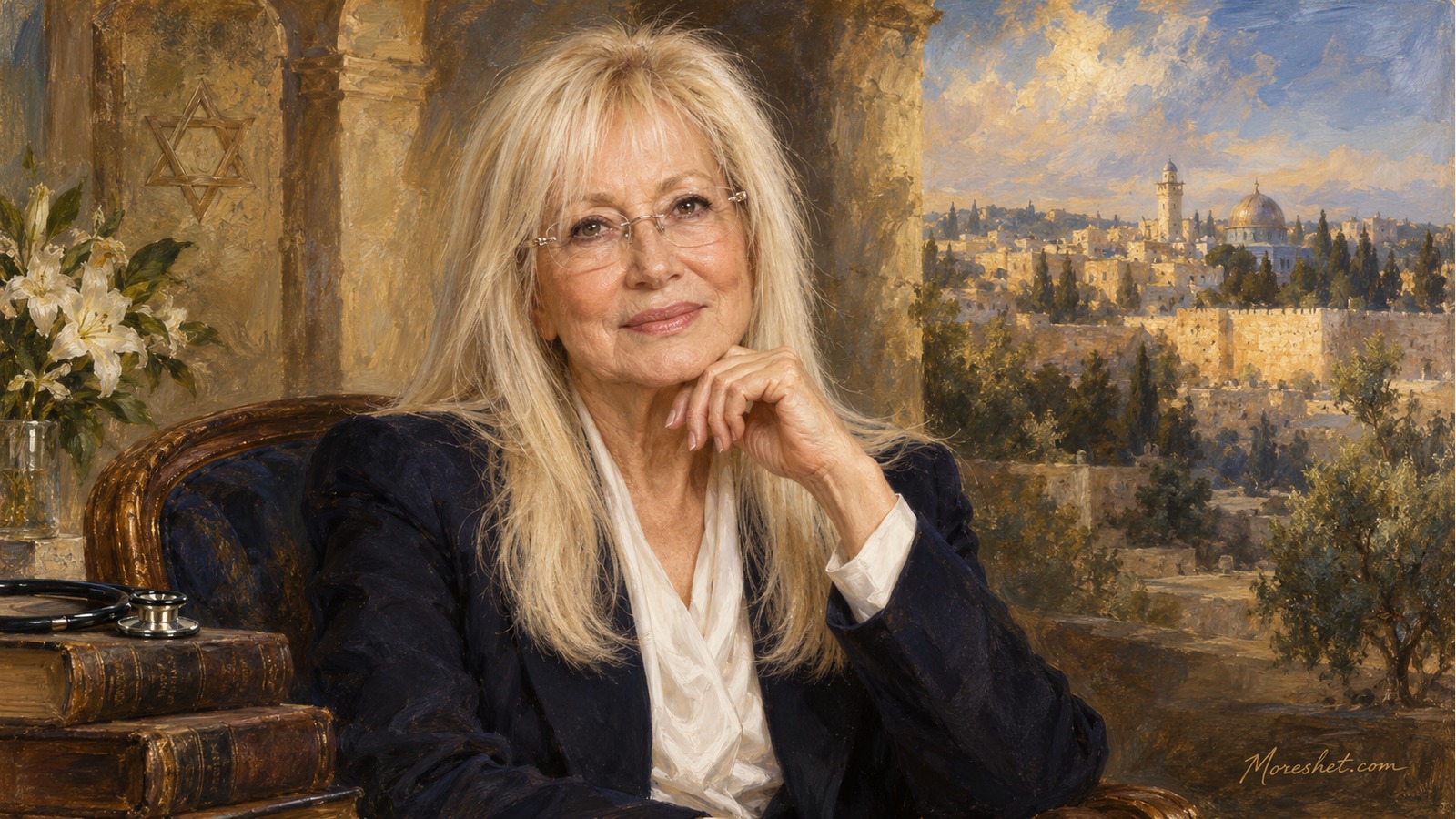
Miriam Adelson — AI-generated artistic portrait · Moreshet.com
Israeli-American physician, addiction researcher, major philanthropist, publisher of Israel Hayom and influential supporter of medicine, Jewish identity and Israel
Miriam Adelson, born Miriam Farbstein, is an Israeli-American physician, addiction researcher, philanthropist, publisher and businesswoman who ranks among the most influential figures in contemporary Jewish and Israeli life. Her story connects Hebrew childhood in the Land of Israel, medical service in the IDF, clinical research, treatment of people suffering from opioid addiction, Jewish and Israeli philanthropy on a very large scale, ownership of a major Israeli media institution and stewardship of significant business assets after the death of her husband, Sheldon Adelson.
Adelson’s importance lies not only in the scale of the wealth available to her and her family, but in the combination of genuine medical training with large-scale institutional giving. She worked as a physician and researcher before becoming a global figure in philanthropy and business, and continued to see medicine, Israel, Jewish memory and the strengthening of Jewish identity as central fields of commitment. For that reason, her life touches several circles of heritage: medicine, philanthropy, journalism, Jewish education, Holocaust memory, Israel-diaspora relations and public influence.
Early life in the Land of Israel and Haifa
Miriam Adelson was born in Tel Aviv on October 10, 1945, during the British Mandate, to parents who had immigrated from Poland before the Holocaust. Her father, Simcha Farbstein, was involved in Israeli public life and was a central member of Mapam, later operating movie theaters in Haifa. Her mother, Menucha, came from a Hasidic family, and her grandmother Miriam, for whom she was named, was murdered in the Holocaust. From the beginning of her life, several themes that would accompany her were already present: Hebrew identity, Zionism, Jewish memory, public culture and civic life in a state being built.
In the 1950s her family moved to Haifa, where Adelson studied at the Hebrew Reali School. The Reali, one of the important institutions of modern Hebrew education, placed her within a tradition of excellence, public service, Hebrew culture, science and civic responsibility. She grew up in an Israel in which state-building, immigration, security, education and medicine were national missions as well as professional fields.
During her military service, she served as a medical officer in the IDF Medical Corps, including at Ness Ziona. This service was a natural part of her path toward medicine: not only as a personal career, but as part of the public and national infrastructure of the State of Israel.
Medical training and addiction research
Adelson studied microbiology and genetics at the Hebrew University of Jerusalem, and then continued to medical studies at Tel Aviv University’s Faculty of Medicine. She completed her medical degree with distinction and later specialized in internal medicine. She worked at Rokach Hospital, connected with Hadassah Hospital in Tel Aviv, and served as chief internist in the emergency room.
In 1986 she traveled to the United States and joined Rockefeller University in New York, where she specialized in and researched drug addiction. She worked with Professor Mary Jeanne Kreek, one of the important figures in the development of methadone treatment and the medical approach to heroin and opioid addiction. This field required a combination of science, clinical compassion and public courage, because addiction was long treated by many as a moral failure rather than as an illness requiring medical care.
Adelson’s research and treatment work in addiction gave her an independent contribution not dependent on family wealth. She worked in one of the most difficult and sensitive areas of modern medicine: how to help people whose lives have been damaged by addiction, how to reduce suffering, how to combine pharmacological treatment and psychosocial support, and how to base treatment policy on medical knowledge rather than stigma.
The Adelson clinics and addiction treatment in Israel and the United States
In 1993 the Adelson Clinic for Drug Abuse Treatment and Research opened in Tel Aviv, connected to Tel Aviv Sourasky Medical Center and the Tel Aviv University Faculty of Medicine. The clinic focused on treating people suffering from opioid addiction, including heroin addiction, and combined methadone treatment with clinical research and therapeutic support.
In 2000, an additional treatment and research center bearing the names Miriam and Sheldon Adelson opened in Las Vegas. These centers expressed her medical philosophy: addiction is an illness that should be treated with medical seriousness, follow-up, research and respect for patients. Socially, it is a field in which medicine can change the lives of individuals and families, reduce community harm and help people return to function and hope.
Her contribution in this field is especially important because it bridges academic research and actual care. This was not merely a financial donation to a medical institution, but the establishment and advancement of treatment frameworks based on her own professional expertise. In a heritage profile, this is one of the central elements of her life: a physician who acted from knowledge, experience and commitment to a population that often suffers from exclusion and stigma.
Life with Sheldon Adelson and a major Jewish philanthropic center
In 1989 Miriam Farbstein met Sheldon Adelson on a blind date, and the two married in 1991. Their marriage created both a personal partnership and a philanthropic partnership with wide influence. Together the Adelsons became one of the most important centers of giving in the Jewish and Israeli world, with an emphasis on Israel, Jewish education, medicine, Holocaust memory, diaspora ties and pro-Israel organizations.
Adelson had two daughters from her first marriage to physician Ariel Ochshorn, including Yasmin Lukatz, an Israeli entrepreneur and investor. With Sheldon Adelson she had two sons, Matan and Adam. After Sheldon Adelson died in 2021, Miriam Adelson became the central figure in the Adelson family in terms of business ownership, philanthropy and public influence.
The partnership with Sheldon Adelson connected different worlds: medicine and science on one side, global business and major philanthropy on the other. According to various sources, Miriam Adelson deeply influenced Sheldon Adelson’s commitment to Israel and Zionist causes. Even though the couple’s public profile generated political controversy, the institutional impact of their support for Jewish and Israeli organizations is difficult to overstate.
Philanthropy: Birthright, Yad Vashem, medicine and Jewish education
Adelson’s philanthropy has focused strongly on strengthening the Jewish people and the State of Israel. The Adelsons were among the largest donors to Birthright Israel, which brings young Jews from around the world to Israel on educational visits. Birthright has affected hundreds of thousands of young Jews, strengthened personal ties with Israel, created powerful identity experiences and become one of the major projects linking Israel and the diaspora.
Adelson and her husband also donated to Yad Vashem, Jewish schools, Israel-supporting organizations, community institutions and medical initiatives. A significant gift supported the establishment of the medical school at Ariel University, inaugurated in 2021 and named for Miriam and Sheldon Adelson. These gifts reflected a view of philanthropy not as occasional assistance, but as the building of infrastructure: institutions that train doctors, educators, researchers, leaders and communities.
The couple also donated to Magen David Adom’s national blood center in Ramla, a project of strategic importance to Israel’s health and emergency systems. This kind of giving combines medicine, civil security, emergency preparedness and daily life. It shows how private wealth can support public infrastructure of national importance.
Adelson’s importance as a Jewish philanthropist comes from the fact that her giving has operated across generations and circles: young Jews in the diaspora, Holocaust memory, medical students, Israeli institutions, rescue and health organizations, and the strengthening of Jewish identity in both the American and Israeli spheres.
Israel Hayom and Israeli media
Since 2018, Adelson has served as publisher of Israel Hayom, one of Israel’s major newspapers. The paper, established with the support of the Adelson family, quickly became a widely circulated media institution with significant influence on Israeli public discourse. Her role as publisher places her not only as a philanthropist and businesswoman, but also as a figure involved in the media space where public opinion is shaped.
Her connection to Israel Hayom is important for understanding her influence in Israel. Journalism is not only a business; it is an institution that affects agendas, political framing, public language and the way citizens understand reality. Therefore Adelson’s role in the media world is part of her legacy of influence, even when it is politically and publicly debated.
In a heritage profile, controversy surrounding a media outlet does not erase its significance. On the contrary, it demonstrates how a central newspaper can become part of the history of Israeli society. Adelson belongs to this chapter as the owner and publisher of a media institution that became a permanent part of Israel’s journalistic map.
Business, Las Vegas Sands and the Dallas Mavericks
After Sheldon Adelson’s death, Miriam Adelson became the central controlling figure in major business assets, including Las Vegas Sands. She thereby became one of the wealthiest women in the world and one of the most prominent Jewish business figures. This is not merely a financial fact; it affects her ability to continue supporting institutions, shaping initiatives and serving as an economic and public force.
In December 2023, the NBA Board of Governors approved the sale of the controlling interest in the Dallas Mavericks to the Adelson and Dumont families. The acquisition brought her family into ownership of a major American professional basketball team. Patrick Dumont, Adelson’s son-in-law, serves as the team’s representative on the NBA Board of Governors. The purchase expanded the family’s influence from hospitality and casino assets into sports, entertainment, urban development and the experience economy.
The move from traditional business ownership into professional sports illustrates the scale of Adelson’s economic influence after her husband’s death. She is not only an heir to wealth, but a figure continuing to navigate holdings, institutions and public influence in a complex American and global environment.
Political involvement and support for Israel
Adelson is also known as a major political donor in the United States, especially to the Republican Party and Donald Trump. She and her husband supported candidates and initiatives identified with pro-Israel and conservative positions, and were among the most prominent political donors in the United States. This activity placed her at a sensitive intersection of wealth, foreign policy, U.S.-Israel relations and American politics.
From the standpoint of Jewish and Israeli heritage, her political involvement is best understood through its influence on the pro-Israel agenda in the American arena. Adelson supported policies and organizations that regarded the strengthening of Israel, opposition to boycotts and the connection between American Jewry and the State of Israel as central goals. In this sense, she belongs to a long tradition of American Jews using economic and civic power to influence public policy concerning Israel.
At the same time, her political influence is one reason her public figure is controversial. A heritage profile does not need to turn controversy into consensus; it needs to document historical influence. In Adelson’s case, that influence is visible both in the institutions funded by her wealth and in the political arena in which she has acted.
Honors and recognition
Adelson has received recognition over the years for her medical, philanthropic and public activity. In 2007 she received an honorary doctorate from Tel Aviv University. In 2018, President Donald Trump awarded her the Presidential Medal of Freedom, the highest civilian honor in the United States. The official announcement emphasized her contribution to medical research, addiction treatment, Jewish schools, Holocaust memorial organizations, Friends of the Israel Defense Forces and Birthright Israel.
She has also received honorary citizenship of Jerusalem, additional awards and honorary doctorates from Israeli institutions. These honors reflect the dual dimension of her public life: a physician and researcher on one side, and a Jewish-Israeli philanthropist of exceptional public influence on the other.
Editorial note on inclusion
Miriam Adelson is included on the site even though this person and their public record are controversial among broad sections of the public. Inclusion does not determine whether the influence is positive or negative; it reflects the significant place this figure holds in shaping the lived experience, culture and way of life of the public. Naturally, some regard this activity as positive and even heroic, while others see it as contrary to their worldview. The very existence of opposing assessments is part of the historical record that justifies including this significant and influential figure in the heritage of the Jewish people.
Why this legacy belongs in Moreshet
Miriam Adelson merits inclusion in Moreshet because her story connects Israeli medicine, addiction research, large-scale Jewish philanthropy, the strengthening of health and educational institutions in Israel, Holocaust memory, Israel-diaspora relations and influence on media and politics. She represents a modern form of Jewish influence: the combination of professional knowledge, private wealth, identity-based commitment and institution building.
Moreshet.com documents Adelson because heritage is not created only through formal political leadership or cultural creation, but also through physicians, philanthropists, publishers and institution builders who influence community life, health, education, memory and identity. Miriam Adelson’s place in Moreshet rests on the way she turned the personal path of an Israeli-born physician into a global sphere of influence that strengthened Jewish and Israeli institutions, supported the connection between young Jews and Israel, and left a lasting mark on Israeli and Jewish society in the 21st century.