Michael Dell
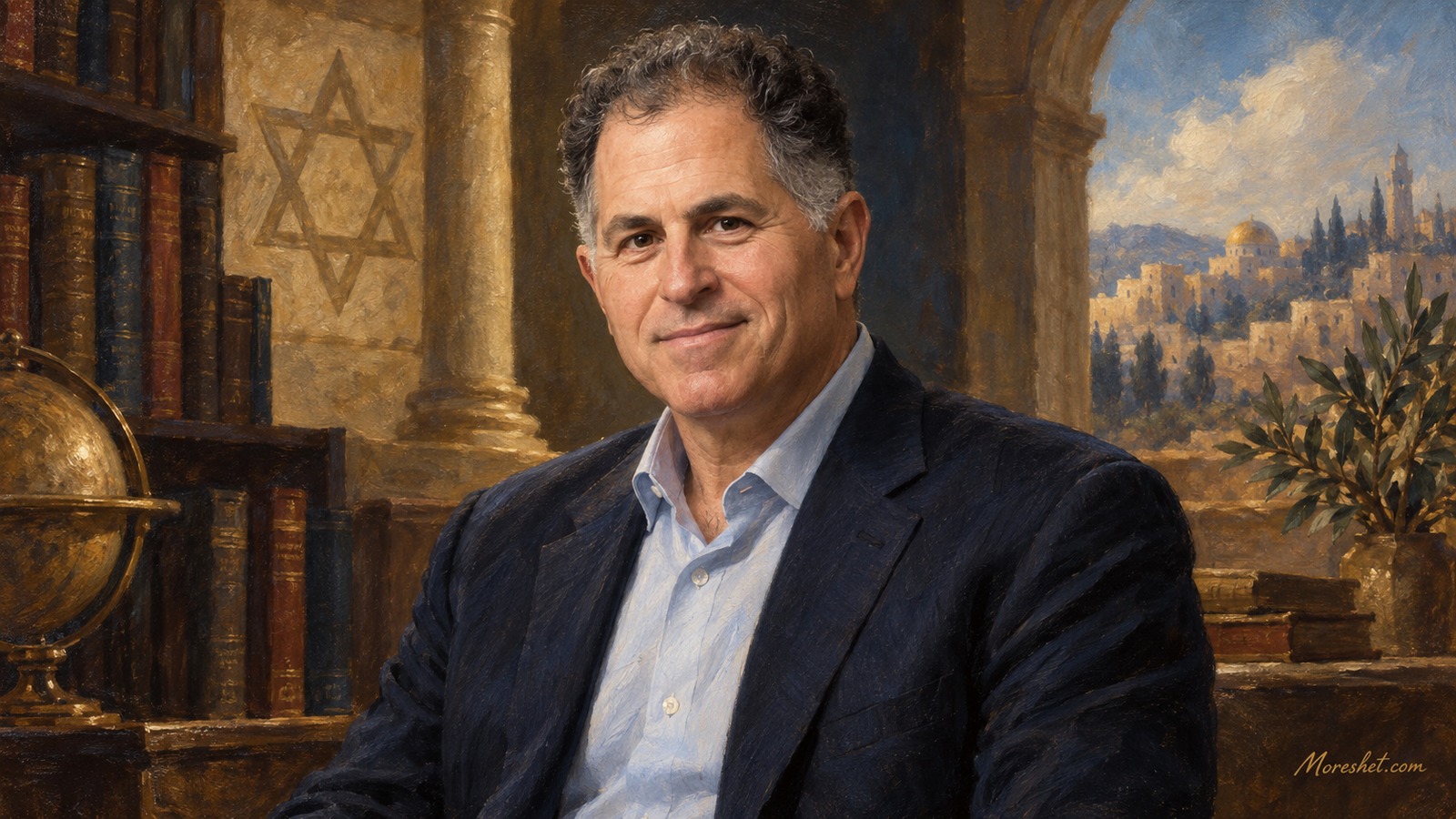
Michael Dell — AI-generated artistic portrait · Moreshet.com 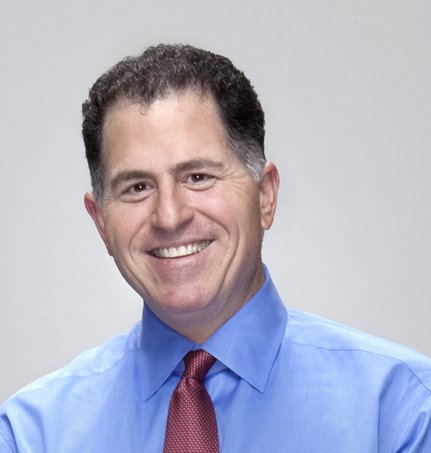
Michael Dell — image from the Moreshet archive
Jewish-American entrepreneur, founder of Dell Technologies, enterprise-computing leader and philanthropist who turned a dorm-room idea into one of the world’s major technology infrastructures
Michael Saul Dell is a Jewish-American entrepreneur, investor, philanthropist, and the founder, chairman and chief executive officer of Dell Technologies. He is one of the most influential business figures in the history of personal and enterprise computing, because he turned a simple but powerful idea — selling computers directly to customers and building them to order — into a global company providing PCs, servers, storage, cloud infrastructure, security and AI solutions to organizations, governments, schools and households.
Dell belongs to the generation of entrepreneurs who built the infrastructure of the digital age not through a single invention alone, but through a change in how technology was manufactured, sold, delivered and supported. The company he began in a University of Texas dorm room became one of the world’s largest technology infrastructure companies. Alongside it, the foundation he created with his wife Susan became one of the significant philanthropic institutions in the United States and beyond, focused on children, education, health, economic mobility, poverty and opportunity.
Childhood in Houston and a Jewish family
Michael Dell was born in Houston, Texas, on February 23, 1965, to a Jewish family. His father, Alexander Dell, was an orthodontist, and his mother, Lorraine Charlotte Langfan Dell, was a stockbroker. He grew up in an environment where education, hard work, personal responsibility and familiarity with money and commerce were part of everyday life.
From childhood, he showed business curiosity and an ability to identify the gap between product, price and customer. According to biographies of his life, he traded stamps, became interested in stocks and precious metals, and tried to understand how markets worked. This was not merely a desire to make money; it was an early tendency to take systems apart, understand their value chain and find a more efficient way to operate inside them.
At Memorial High School in Houston, he sold subscriptions to the Houston Post. Instead of approaching potential buyers randomly, he identified newly married couples and families moving to new homes as more likely subscribers, gathered public information and addressed them directly. Already, the pattern that would define his career appeared: data, customer targeting, reduced intermediation and direct sales.
The University of Texas dorm room and the birth of Dell
In 1983 Dell began studying at the University of Texas at Austin as a pre-med student, largely to satisfy his parents’ hope that he would become a doctor. His real interest, however, was personal computers. At the time, the PC market was developing quickly, but many computers were sold through stores, intermediaries and costly distribution systems. Dell saw that it was possible to assemble a high-quality computer from components, customize it for the customer and sell it at a competitive price.
From his room in the Dobie Center residence hall, he began assembling and selling upgrade kits and computer components. In 1984 he founded PC’s Limited, which later became Dell Computer Corporation. The initial capital was small, but the business idea was sharp: instead of producing large inventories and waiting for buyers, the company would build computers after receiving orders, sell directly to the customer and use that direct relationship to understand market needs better.
At 19, Dell left the university to devote himself to the company. The decision was risky, but it fit a historical moment in which the personal computer was moving from a product for hobbyists and specialists into a basic tool of work, learning and communication. Dell understood early that the market did not need only another computer; it needed a more efficient system of customization, delivery and service.
The direct model that changed the computer industry
Dell’s great innovation was not only the computer itself, but the business model. Direct selling allowed the company to lower costs, reduce inventory, learn from the customer, customize components and deliver computers relatively quickly. The model turned the supply chain into a competitive advantage rather than a back-office process.
During the 1990s Dell grew rapidly. In 1992, at 27, Michael Dell became the youngest CEO of a company included in the Fortune 500. In 1996 the company began selling computers over the internet, a move especially well suited to its direct model. Within a short time, the company’s website became a major sales channel, and by 1997 dell.com was already reporting large daily sales.
In 2001 Dell overtook Compaq to become the world’s largest personal-computer maker by market share. The achievement represented more than one company’s success. It showed that an entire industry could be changed when a company built itself around efficiency, information, reduced distance between producer and customer, and intense operational discipline.
From personal computers to enterprise infrastructure
Over time it became clear that the personal-computer market alone was not enough to build a long-term technology company. Dell expanded into servers, storage, enterprise services, data-center infrastructure, cloud computing, cybersecurity and solutions for large businesses. This shift reflected a wider change in the digital economy: the computer on the desk mattered, but behind it were servers, networks, storage, data management and enterprise infrastructure.
In 2004 Dell stepped down as CEO and remained chairman of the board, but in 2007 he returned as chief executive at the board’s request. His return reflected the recognition that the company needed founder-led leadership to navigate a changing market in which PCs had become more competitive, margins were under pressure and customers were moving toward mobile computing, cloud and more complex infrastructure.
In 2013 Dell led, together with Silver Lake and other partners, a major transaction to take Dell private. The deal allowed the company to operate outside the quarterly pressure of public markets and carry out a deep strategic shift. For Dell, privatization was a way to restore freedom of maneuver, long-term investment and renewed focus on customers and infrastructure.
The EMC acquisition and the creation of Dell Technologies
In 2015 Dell announced the acquisition of EMC, one of the world’s most important enterprise storage and infrastructure companies, in a transaction valued at about 67 billion dollars. The deal closed in 2016 and was then widely described as the largest technology acquisition in history. It created Dell Technologies and brought personal computers, servers, storage, virtualization, cloud infrastructure and enterprise services under one umbrella.
The acquisition was a broad strategic move. It shifted the company’s center of gravity from personal computers alone to the infrastructure of the digital enterprise. In an era when every company was becoming, in some sense, a software and data company, Dell Technologies supplied the hardware, storage, services and infrastructure on which modern systems operate.
After the EMC acquisition, Dell also held VMware, central to virtualization and enterprise infrastructure, until its acquisition by Broadcom in 2023. The combination of Dell, EMC and VMware made Michael Dell not only a personal-computer entrepreneur, but one of the central figures in shaping 21st-century enterprise computing infrastructure.
Dell Technologies in the age of artificial intelligence
In the third decade of the 21st century, Dell Technologies also became an important player in artificial intelligence infrastructure. Organizations that want to run large models, internal AI systems and data-based applications need servers, storage, cooling, networks, workstations and implementation services. Here Dell entered a new stage: not only personal computing or cloud, but end-to-end AI infrastructure.
In 2024 the company announced Dell AI Factory with NVIDIA, a set of solutions designed to help organizations build, deploy and manage AI capabilities inside the enterprise, from data center to edge. Partnerships with NVIDIA, ServiceNow and other companies later expanded the effort to support AI agents, data systems and intelligent workflows in secure and governed ways.
In that sense, Michael Dell returned to the starting point of his career: making complex technology more usable for customers. Just as the direct model made personal computers more accessible in the 1980s and 1990s, Dell Technologies now seeks to make AI infrastructure usable for organizations in a world where data and computing are basic conditions of competition.
Business leadership and books
Dell has written two central books about his business and management path. In 1999 he published Direct from Dell with Catherine Fredman, presenting the direct-sales strategy and how the company changed the computer industry. In 2021 he published Play Nice But Win with James Kaplan, describing his path from young founder to leader of a giant corporation, including crisis, privatization, business battles and the return to growth.
The books matter because they are not only business memoirs. They reflect a management philosophy in which simplicity, information, speed, direct connection to the customer and willingness to make large decisions stand at the center. Dell presents leadership based not on empty charisma alone, but on operational discipline and deep understanding of the economic system in which the company operates.
Over the years Dell has received many honors, including entrepreneur and CEO awards from business magazines, the Golden Plate Award of the American Academy of Achievement and the Franklin Institute’s Bower Award for Business Leadership in 2013. The recognition reflects his status as one of the entrepreneurs who helped turn the computer from a technology product into a basic component of the world economy.
Philanthropy: the Michael & Susan Dell Foundation
In 1999 Michael and Susan Dell established the Michael & Susan Dell Foundation. The foundation focuses on children, families and communities, especially in education, health, economic stability, opportunity and system improvement. Unlike philanthropy limited to one-time gifts, the foundation often works through measurement, partnerships, data, social investments and multi-year programs.
Over the years the foundation has supported initiatives in the United States, India, South Africa, Israel and other countries. In Austin, Texas, the Dells donated tens of millions of dollars to the University of Texas, pediatric research, education, child health and the establishment of the Dell Medical School. These efforts made their name part of the educational and health infrastructure of the city where the company grew.
The foundation also has activity connected to Israel and Jewish life. It has supported programs in education, opportunity and recovery, and various publications have mentioned initiatives in Israel. From a heritage perspective, this matters because it connects Jewish-American business success with social responsibility that extends beyond the marketplace and seeks to create opportunity for children and families.
The 6.25 billion dollar gift for children in the United States
In 2025 Michael and Susan Dell announced an extraordinary philanthropic commitment of 6.25 billion dollars to deposits in investment accounts for children in the United States, connected to the Invest America initiative and accounts publicly known as Trump Accounts. According to the announcement, the goal was to deposit 250 dollars for 25 million children aged ten and under in areas below a defined median-income threshold, encouraging savings, ownership and early capital for the future.
The significance of the gift goes beyond the amount. It expresses a view that economic mobility is not built only through immediate assistance, but also through ownership, savings, early investment and a sense of participation in the future. The gift also reflects the willingness of the Dells to act at national scale, in cooperation with public systems, to create a new tool of opportunity for children.
Like every major philanthropic initiative implemented through public policy, this effort will be judged over time by execution, reach, transparency and outcomes. Yet the commitment itself places Dell among the major philanthropists of his generation and emphasizes that his legacy is not limited to computers, servers and infrastructure, but also includes an attempt to affect the economic future of millions of children.
Public activity, science and technology
Dell is a member of major business and technology forums, including the Business Roundtable and the Technology CEO Council. He has also been connected to World Economic Forum bodies and policy discussions on technology, economics, innovation and competitiveness. During the COVID-19 pandemic, he participated in advisory and recovery initiatives in Texas and technology coalitions aimed at helping respond to the crisis.
In 2026 he was reappointed to the U.S. President’s Council of Advisors on Science and Technology, PCAST. The appointment reflects his standing not only as the CEO of a large company, but as someone governments see as a source of knowledge on infrastructure, innovation, computing, AI and international technological competition.
That same year Dell also acquired a minority stake in the Las Vegas Raiders football team. Although secondary to his technology and philanthropic work, the move illustrates the breadth of his investment activity and involvement in business, sports and wider social infrastructure.
Personal life and Jewish identity
Michael Dell has been married to Susan Lieberman Dell since 1989, and the couple has four children. They live in Austin, Texas, and have made the city a center of their business and philanthropic life. The deep connection to Texas matters in understanding him: Dell is not only a Silicon Valley entrepreneur, but a business figure built in Austin who helped place the city on the world technology map.
His identity as a Jewish-American entrepreneur does not define all of his work, but it is an important part of his heritage profile. Like other Jewish entrepreneurs who influenced the infrastructure of knowledge, commerce and technology, Dell represents a combination of education, initiative, discipline, social capital, innovation and public responsibility. He did not build a classic Jewish institution, but his influence touches Jewish and non-Jewish lives worldwide through everyday tools of work, learning, connection and information management.
Why this legacy belongs in Moreshet
Michael Saul Dell merits inclusion in Moreshet because his story connects Jewish-American entrepreneurship, the democratization of computing, the building of global technology infrastructure and philanthropy at major scale. He began as a student assembling computers in a dorm room and became the founder, chairman and CEO of a company that supplies part of the infrastructure through which people and organizations work, learn and communicate in the digital world.
Moreshet.com documents Dell because Jewish and Israeli heritage also includes Jewish figures who acted on the world stage and influenced basic tools of modern life: computers, servers, data, infrastructure, education, health and opportunity. Michael Dell’s place in Moreshet rests on the way business entrepreneurship became broad public infrastructure, and on the way enormous economic success was also translated into philanthropy that seeks to open doors for children, families and communities beyond the marketplace itself.