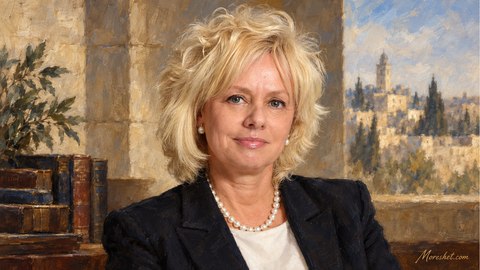
Jennifer Leigh Mnookin
The legal scholar and academic leader connecting evidence law, forensic science and public responsibility
Jennifer Leigh Mnookin is an American Jewish legal scholar, evidence expert and academic leader whose work addresses a question fundamental to every justice system: how can a court know whether scientific evidence or expert testimony deserves its confidence? Her scholarship has examined the meeting point of law, science and technology, from the history of photographic evidence to the reliability of fingerprint comparison. In doing so, she helped move discussion of forensic proof away from reliance on professional authority alone and toward empirical testing, transparent standards and recognition of human limitations.
Alongside her scholarship, Mnookin has held senior leadership roles at three major American public universities. She served on the University of Virginia law faculty, became a professor and later dean of the UCLA School of Law, and took office in August 2022 as the 30th chancellor of the University of Wisconsin–Madison. Her career joins rigorous inquiry with the practical responsibility of leading institutions that educate, employ and support tens of thousands of people.
Jewish roots and an interdisciplinary education
Mnookin was born in Cambridge, Massachusetts, in 1967 and grew up in the San Francisco Bay Area in a Jewish family. Her father, Robert Mnookin, became a Harvard Law School professor known for his work on negotiation and dispute resolution; her mother is Dale Mnookin. In accounts of her family history, Jennifer Mnookin has recalled asking questions about Jewish belonging and communal participation while still a child. That background became part of a life spent as a Jewish scholar and leader at the center of influential American institutions.
Her education reflects the interdisciplinary character of her later work. She graduated from Harvard University in 1988 and worked as an editor at The Harvard Crimson. She earned her JD from Yale Law School in 1995 and completed a PhD in the history and sociology of science and technology at the Massachusetts Institute of Technology in 1999. Her dissertation, on evidence, expertise and technologies of knowledge in the American courtroom, established the questions that would shape much of her scholarship: how technologies acquire the authority of truth, how judges and juries assess experts, and what happens when professional confidence outruns the available research.
From the history of proof to forensic science
How courts decide what to trust
Mnookin's research goes beyond asking whether evidence is legally admissible. It examines how that evidence acquired scientific and cultural authority, what is actually known about its accuracy, and how its limitations should be explained to the people responsible for deciding a case. She has written about the history of photographic proof, the role of experts and the relationship between new technologies and legal ideas about proof and persuasion.
A central part of her work concerns pattern-comparison forensics, particularly latent fingerprint examination. Such disciplines were long presented in court with great confidence, sometimes without enough experimental research to measure error rates, variation among examiners or the effect of a comparison's difficulty. Mnookin was among the scholars who helped place basic scientific questions at the center of the legal debate: Has a method been tested under realistic conditions? Can examiner performance be measured? How should an expert describe a conclusion without conveying more certainty than the data permit?
Influence on scientific and legal institutions
Her forensic-science scholarship was cited extensively in the National Academy of Sciences' influential 2009 report on strengthening the scientific foundations of forensic practice in the United States. The report had practical importance because it drew the attention of courts, laboratories, researchers and policymakers to gaps between the strength of some courtroom claims and the empirical studies available to support them.
Mnookin also served as principal investigator of a National Institute of Justice project that sought objective ways to measure the difficulty of fingerprint comparisons. Work of this kind can improve training, quality control and the study of errors. A clear, information-rich comparison is not equivalent to one involving a partial, blurred or distorted mark; understanding difficulty is therefore part of understanding the reliability of the resulting judgment.
In 2016, Mnookin co-chaired an advisory group to the President's Council of Advisors on Science and Technology. The group contributed to a report examining the scientific validity of forensic methods used in criminal proceedings. This work demonstrated her ability to translate legal, historical and scientific scholarship into institutional questions with direct consequences for trials, defendants, victims and public confidence in justice.
Expert evidence and the right of confrontation
Another important strand of Mnookin's scholarship concerns the Confrontation Clause of the Sixth Amendment, which protects a criminal defendant's right to confront the witnesses against them. As laboratory reports and technical analyses have become increasingly important in criminal cases, courts have had to decide who must be available for cross-examination: the analyst who performed the test, the person who signed the report or another expert relying on the results. The Supreme Court of the United States cited and discussed Mnookin's scholarship in Williams v. Illinois in 2012. Her research thus entered one of the country's most consequential legal forums and helped frame the relationship between scientific expertise and procedural rights.
She is also a co-author of the expert-evidence volume of The New Wigmore: A Treatise on Evidence, a professional work that gives lawyers and scholars a systematic framework for understanding evidence doctrine. Her combination of conceptual scholarship, empirical research and practical legal reference writing has carried her influence from academic debate into legal education and professional practice.
A career in legal education and institutional leadership
From 1998 to 2005, Mnookin taught at the University of Virginia School of Law, spending the 2002–2003 academic year as a visiting professor at Harvard Law School. She joined the UCLA School of Law in 2005 and gradually assumed broader institutional responsibilities. She served as vice dean for faculty and research from 2007 to 2009 and as vice dean for faculty recruitment and intellectual life from 2012 to 2013.
Mnookin became dean of UCLA Law in August 2015 and served until June 2022. The position placed her in charge not only of teaching and scholarship but also of faculty recruitment, student support, budgeting and the law school's relationships with the legal profession and the wider community. Her background as a scholar of evidence and expertise was especially relevant to the leadership of an institution that trains lawyers to make responsible judgments amid uncertainty, competing claims and incomplete information.
Leading the University of Wisconsin–Madison
In May 2022, the University of Wisconsin System Board of Regents unanimously selected Mnookin as the 30th chancellor of the University of Wisconsin–Madison. She took office on August 4 of that year. Moving from the deanship of a law school to the leadership of a large public research university greatly expanded her responsibilities. They extended across the humanities, engineering, agriculture, medicine, data science and the social sciences, as well as student access and the university's obligations to the people of Wisconsin.
Expanding research and access
One of the major initiatives launched during her leadership was Wisconsin RISE, a university-wide effort to strengthen research and innovation in areas with broad social impact. When announced in February 2024, the program envisioned hiring between 120 and 150 new faculty members over several years, including as many as 50 specialists in artificial intelligence. The significance of such a program extends beyond the number of positions. Concentrated hiring can create interdisciplinary research communities, train a new generation of students and connect computational methods with questions in health, agriculture, science, society and public policy.
The university also advanced financial-support initiatives intended to reduce barriers for Wisconsin students. In December 2023, it announced the Wisconsin Tribal Educational Promise, providing support for eligible students from the state's federally recognized American Indian tribes. The program reflects a central obligation of a public university: not only to produce knowledge, but also to widen access to it for communities that have endured generations of exclusion and inequality.
Civic dialogue, free expression and campus safety
Leading a major American university also means confronting public disputes that enter the campus. Beginning in 2023, Mnookin promoted Deliberation Dinners, structured opportunities for students, faculty and staff to discuss contentious subjects. The initiative reflected an understanding that free expression alone does not guarantee a useful conversation. Educational institutions must also cultivate listening, attention to evidence and the capacity to disagree without denying the humanity of others.
After the Hamas attack on Israel on October 7, 2023, and the war that followed, universities across the United States faced fear, grief and intense conflict among Jewish, Israeli, Palestinian, Muslim and other members of their communities. Mnookin condemned the attack on Israeli civilians, expressed sorrow over continuing suffering and warned against both antisemitism and Islamophobia. In spring 2024, the university administration confronted a protest encampment, enforcement of campus rules and negotiations with demonstrators. After an attempted removal and the encampment's reestablishment, further talks took place, and Mnookin met student representatives before an agreement brought the encampment to an end. The episode illustrated the difficult balance among protest rights, compliance with law, continuity of education and the duty to protect community members from intimidation and hatred.
Professional recognition and personal life
Mnookin has served on the National Academy of Sciences' Committee on Science, Technology, and Law and in advisory roles involving privacy, science and public policy. In April 2020, she was elected to the American Academy of Arts and Sciences, recognizing the reach of her scholarly and public contributions at the intersection of law, science and institutions.
She married political theorist Joshua Foa Dienstag in 1996, and they have two children. Their professional lives reflect an academic household in which law, the history of science and political thought meet around questions of truth, authority and civic responsibility.
Why Jennifer Leigh Mnookin belongs in Moreshet
Jennifer Leigh Mnookin merits inclusion in Moreshet because her work reaches one of the practical foundations of a just society: scientific claims used to decide legal cases should themselves withstand scientific scrutiny. Her research on fingerprints, expert evidence and defendants' rights influenced national scientific reports, entered discussion at the Supreme Court of the United States and helped lawyers and scientists think more carefully about reliability, error and accountability. That contribution matters to every community, including Jewish and Israeli communities that depend on trustworthy legal institutions and on a careful distinction between assertion, expertise and proof.
Her life also adds an important chapter to contemporary Jewish heritage: the story of a Jewish scholar exercising leadership in influential American public institutions. As a law-school dean and university chancellor, she assumed responsibility for research, student opportunity, educational access and the preservation of academic life during periods of profound disagreement. Her engagement with antisemitism, the needs of Jewish and Israeli students, and the rights and safety of other communities demonstrates the complexity of institutional responsibility without reducing it to a political slogan.
Documenting Mnookin's career on Moreshet.com therefore connects intellectual achievement with tangible influence: strengthening the scientific foundations of evidence, shaping legal education and leading a major public university. These contributions explain her place in an archive devoted to Jewish heritage, legacy and the wider human impact of Jewish lives.