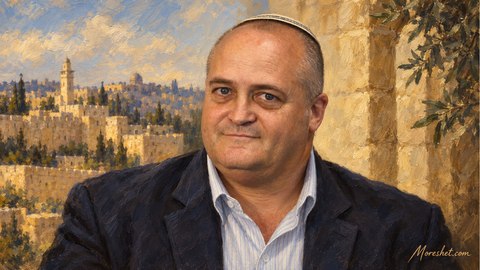
Herman Heine Goldstine
The Jewish American mathematician who helped turn electronic computing from a daring proposal into a foundation of the digital age (September 13, 1913 – June 16, 2004)
Herman Heine Goldstine was a mathematician and computing pioneer who connected an urgent military problem with the emerging possibilities of electronic engineering. During World War II, he recognized the potential of John Mauchly and J. Presper Eckert's proposal for an electronic calculating machine, helped secure United States Army support for ENIAC, and served as the liaison between the Ballistic Research Laboratory and the University of Pennsylvania's Moore School of Electrical Engineering. He later participated in the development and dissemination of stored-program computing, directed the computer project at the Institute for Advanced Study, founded a mathematical research department at IBM, and became an influential historian of computing and mathematics.
Goldstine's importance does not rest on a single invention credited solely to him. His distinctive contribution was the ability to bring people, ideas, government support, and scientific institutions together. His career forms part of the historical chain leading from laborious hand calculations to programmable electronic computers—the infrastructure on which modern science, medicine, security, education, industry, and everyday life in Israel and throughout the world now depend.
A Jewish upbringing and a rigorous mathematical education
Goldstine was born in Chicago on September 13, 1913, to Jewish parents. At the University of Chicago, he earned a bachelor's degree in mathematics in 1933, a master's degree in 1934, and a doctorate in 1936. He then spent three years as a research assistant to Gilbert Ames Bliss, a leading authority on the mathematical theory of external ballistics. That combination of advanced mathematics and practical work on trajectories prepared Goldstine unusually well for the responsibilities he would assume during World War II.
He began teaching at the University of Michigan in 1939. After the United States entered the war, he left the university, joined the Army in July 1942, and received an officer's commission. As an ordnance mathematician at the Ballistic Research Laboratory at Aberdeen Proving Ground in Maryland, he worked on the calculations needed to produce artillery firing tables.
The military calculation problem that accelerated computing
Thousands of trajectories for a single firing table
Artillery crews needed accurate tables showing the elevation and direction required to hit a target under particular conditions. Different weapons, ammunition, ranges, and operating environments demanded different tables. A single trajectory required hundreds of calculations and could occupy a human computer for hours; a completed table contained thousands of trajectories. Much of this demanding work was performed by approximately one hundred women using mechanical calculators, but the rate of production could not keep pace with wartime needs.
The Ballistic Research Laboratory therefore drew on the computing facilities of the Moore School of Electrical Engineering at the University of Pennsylvania. Goldstine became the liaison between the laboratory and the university, placing him at the point where an operational need met a group of engineers searching for a radically faster solution.
From Mauchly's proposal to Army funding
At the suggestion of engineer Joseph Chapline, Goldstine met physicist John Mauchly, who had proposed using vacuum tubes to perform calculations thousands of times faster than mechanical equipment. Goldstine grasped that this was more than an incremental improvement. It offered the possibility of transforming the speed and scale of numerical work. He helped advance Mauchly's proposal through Army channels, and funding for the project was secured in June 1943.
ENIAC was designed and constructed at the Moore School by teams led by Mauchly and Eckert. Completed late in 1945 after roughly 30 months and 200,000 person-hours of work, the machine weighed about 30 tons, contained approximately 18,000 vacuum tubes, and occupied a large room. It had limited internal storage, and preparing it for a new task could require days of setting switches and reconnecting cables. Even so, it demonstrated that fast, general-purpose electronic calculation was practical. The war ended before ENIAC could fulfill its original wartime mission, but the machine opened a new path for science, government, and industry.
Goldstine's role is best understood precisely. He was not ENIAC's principal engineering designer, but he was essential to recognizing the value of the proposal, translating it into a project the Army could support, securing the contract, and coordinating the military sponsor with the developers. Breakthrough engineering often depends on exactly this kind of informed mathematical and institutional leadership.
EDVAC and the stored-program idea
Bringing John von Neumann into the project
Before ENIAC was finished, the team began considering a more capable successor called EDVAC. In the summer of 1944, Goldstine happened to meet the eminent Jewish American mathematician John von Neumann on a railway platform in Aberdeen and described the electronic computer project to him. Von Neumann, who was then also involved in the formidable calculations of the Manhattan Project, immediately understood the potential of high-speed electronic computation and joined the discussions.
The group—including Eckert, Mauchly, Arthur Burks, Goldstine, and von Neumann—examined ways to overcome ENIAC's limitations. A decisive concept was to store program instructions in electronic memory alongside numerical data, rather than prepare every new task by manually rewiring the machine. This stored-program principle became a foundation of most subsequent general-purpose computers.
A report that circulated around the scientific world
Von Neumann prepared the document known as First Draft of a Report on the EDVAC, setting out the architecture under discussion. Goldstine had the draft typed as a 101-page report and circulated copies among people connected with the project in June 1946. Further copies quickly reached researchers in the United States and Britain. The document named von Neumann as its sole author, although important ideas in it had developed through the collaborative work of the EDVAC group before he joined. Its broad circulation nevertheless helped establish the stored-program concept as an international design model, later widely known as the von Neumann architecture.
In the summer of 1946, Goldstine also taught in the celebrated Moore School lecture series, one of the earliest organized efforts to explain how digital electronic computers could be built and used. His lectures addressed numerical methods—the mathematical bridge by which equations and scientific problems could be transformed into procedures executable by a computer.
The Institute for Advanced Study computer
After the war, Goldstine joined von Neumann and Burks at the Institute for Advanced Study in Princeton. There they developed the IAS machine, one of the most influential early stored-program computers. Goldstine initially served as the project's assistant director and became its director after 1954.
The importance of the IAS machine extended well beyond the single installation at Princeton. Its documented design influenced a family of computers built in government laboratories, universities, and industry, including early IBM machines. The project demonstrated how an architecture developed in one research institute could spread through scientific exchange and shape a generation of computer construction. The IAS computer project ended after von Neumann's death in 1957, and Goldstine moved into a new phase of scientific leadership.
Building mathematical research at IBM
Goldstine became the founding director of the Mathematical Sciences Department at IBM's Thomas J. Watson Research Center in Yorktown Heights, New York. He helped establish a strong place for mathematics within industrial research and fostered relationships between IBM researchers and the academic community. That exchange was especially important as computers moved beyond experimental laboratories and into universities, government agencies, and businesses.
In 1969, IBM appointed him an IBM Fellow, the company's highest technical distinction, and he became a consultant to the director of research. His work reflected an expansive understanding of innovation: progress required not only new machines, but also a research culture in which mathematicians, engineers, and computer scientists could exchange ideas and develop durable methods.
Recording the history of computing and mathematics
Alongside his scientific and administrative work, Goldstine devoted considerable attention to preserving the intellectual history of the fields he had helped shape. His book The Computer from Pascal to von Neumann placed the electronic computer within a much longer development extending from mechanical calculators to the work of the twentieth century's computing pioneers. It remains valuable as the account of a direct participant in ENIAC, EDVAC, and the IAS project, while also reflecting Goldstine's particularly strong assessment of von Neumann's contribution.
Goldstine also wrote A History of Numerical Analysis from the 16th Through the 19th Century and A History of the Calculus of Variations from the Seventeenth Through the Nineteenth Century. These works traced the evolution of mathematical methods across generations and showed how practical problems can give rise to new forms of theory. In this way, he extended his contribution beyond building the future: he also helped researchers understand the intellectual foundations on which that future rested.
Scientific service and public recognition
In retirement, Goldstine served from 1985 to 1997 as executive officer of the American Philosophical Society in Philadelphia, the historic learned society founded by Benjamin Franklin. He attracted distinguished visitors and speakers and continued to encourage exchange across scientific and scholarly disciplines.
His honors included the Harry H. Goode Memorial Award in 1979 and the United States National Medal of Science in 1985. He was a charter recipient of the IEEE Computer Society's Computer Pioneer Award. In 1997, he was inducted into the U.S. Army Ordnance Hall of Fame and received the American Philosophical Society's Benjamin Franklin Medal for Distinguished Achievement in the Sciences. He was elected to the National Academy of Sciences, the American Academy of Arts and Sciences, and the American Philosophical Society.
A family partnership in the history of ENIAC
In 1941, Goldstine married Adele Katz Goldstine, a mathematician whose own work occupies an important place in ENIAC's history. She became an ENIAC programmer, helped train other operators, and wrote the machine's technical description. Her contribution illustrates how the women who learned, operated, documented, and programmed the new hardware were indispensable to making electronic computing usable. Herman and Adele had a son and a daughter. Adele died in 1964, and Goldstine married Ellen Watson in 1966.
Herman Goldstine died at his home in Bryn Mawr, Pennsylvania, on June 16, 2004, at the age of 90, following a long struggle with Parkinson's disease. IBM's Thomas J. Watson Research Center commemorated him by naming a postdoctoral fellowship in his honor.
Why Herman Heine Goldstine's legacy belongs in Moreshet
Herman Heine Goldstine merits inclusion in Moreshet because his life documents a consequential Jewish American contribution to one of the defining transformations in human history. He applied mathematical expertise, institutional judgment, and public service to help bring ENIAC into existence, disseminate the stored-program model, build a further generation of computers, and strengthen mathematical research in industry. The effects of those achievements reach every modern society, including Israel, whose medicine, defense, scientific institutions, education, and innovation economy all depend deeply on computing.
His career also preserves an essential lesson about technological progress: a breakthrough is rarely the achievement of one person alone. It grows from cooperation among mathematicians, engineers, programmers, public institutions, and research communities. By documenting Goldstine at Moreshet.com, the Moreshet archive records both the contribution of a Jewish computing pioneer and the larger story of how mathematical knowledge, public purpose, and collaboration can create infrastructure that changes billions of lives.