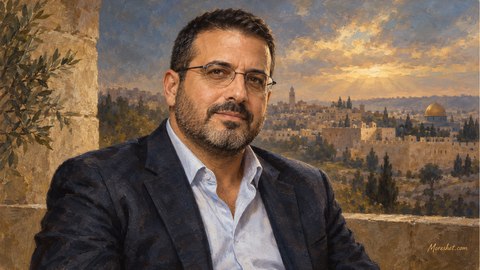
Gavri Levi
Israeli dancer, choreographer, troupe leader, and football administrator
Gavri (Gabriel) Levi (December 24, 1937–August 16, 2018) was an Israeli dancer, choreographer, troupe director, and sports administrator. Across more than six decades, he worked in two influential public spheres: dance, where he helped bring Israeli performance to audiences at home and abroad, and football, where he led the Israel Football Association and participated in important structural and broadcasting changes in the sport.
From Petah Tikva to the international stage
Levi was born in Petah Tikva to a family of Bulgarian origin. He became interested in dance at the age of 15 and joined the Alumim Petah Tikva troupe under the guidance of Yonatan Karmon. Karmon recognized his ability and brought him into the Histadrut labor federation’s central dance group. In 1957, Levi helped establish Yonatan Karmon’s Karmon Dance Troupe and toured internationally with it. From the beginning of his career, he understood that Israeli dance could serve both as artistic expression and as a way of presenting Israeli culture to audiences abroad.
In 1959, Levi moved to the United States, where he founded and worked with the Tzabarim dance troupe for five years. During this period, he broadened his training in several styles, including classical ballet and jazz. He returned to Israel in 1964 and rejoined the Karmon Dance Troupe as assistant to its artistic director. His experience in Israel and the United States gave him a wide professional foundation for working with performers, ensembles, and large-scale productions.
Building troupes and representing Israel
In 1973, Levi was called upon to lead the Israel Defense Forces dance troupe. When the troupe was disbanded in 1976, he worked to preserve the professional community that had grown around it. He brought former members together and initiated the Shalom 1976 dance troupe, directed by Samuel Tzimach. The troupe represented Israel around the world through dance, music, and ensemble performance. Its work continued a tradition in which stage art served as a cultural bridge between Israel and other countries and communities.
Throughout his career, Levi instructed and led numerous dance groups, including ensembles from the Jordan Valley, Jezreel Valley, Sha’ar HaNegev, Western Galilee, Beit Hagefen in Haifa, Hadrim in Rehovot, Pa’amei Aviv in Tel Aviv, veteran performers in Petah Tikva, and Ashkelon. This activity connected central Israel with regional and community-based cultural life and brought together performers of different generations. His contribution was not limited to choreography: he helped create frameworks, train participants, and make group dance part of the life of local communities.
Levi produced and directed the opening and closing ceremonies of the 13th and 14th Maccabiah Games and the 15th Hapoel Games. These events involved thousands of participants and required choreography that could combine movement, music, discipline, and visual storytelling on a vast public stage. He also choreographed productions at Habima Theatre. In 1979, he created the interval segment for the Eurovision Song Contest in Jerusalem, performed by the Shalom troupe. His work received the David’s Harp Award and the Silver Rose Award.
Dance, television, and sport
Levi’s movement between culture and sport made him familiar to broad Israeli audiences. In 2005 and 2006, he served as a judge on the television program Dancing with the Stars. In 2007, he joined the panel of the sports-channel program Yatzia Ha’Itzunim. These appearances brought his knowledge of dance, performance, and public presentation into popular entertainment and sports discussion. After leaving the football association, he returned to managing the Shalom dance troupe.
Leading Israeli football
Levi entered football through Hapoel Petah Tikva, a club with which he remained closely connected. In 1989, he became chairman of the club. He later served as a member of the Israel Football Association and as acting chairman. In September 1996, he was appointed chairman of the Israel Football Association, a position he held until 2003.
During his tenure, Israel’s league structure changed. The Premier League was established as the top division, replacing the National League in that role, and broadcasting rights for Premier League matches were sold to the Sports Channel for the first time. These steps tied Israeli football more closely to sports broadcasting and to the emerging commercial economy of the game, making football an even more prominent part of public life.
During Levi’s term, Richard Nielsen and Avraham Grant were appointed, successively, as coaches of the Israel national team. After leaving the association’s chairmanship, Levi returned to lead Hapoel Petah Tikva. His continuing relationship with the club and with local football reflected the connection between national administration and commitment to the community and city from which he came.
Family and personal life
In 1959, Levi married Leah Levgoran, a dancer in his troupe. They had three children, including football coach Guy Levi. His nephew was the Israeli actor and football figure Yehuda Levi. Levi lived in Petah Tikva for most of his life and spent his final years in Tel Aviv. He died on August 16, 2018, after a serious illness.
Why this legacy belongs in Moreshet
Gavri Levi merits inclusion in Moreshet because his life connected two fields that helped shape Israeli society: cultural performance and organized sport. He participated in the development of modern Israeli dance, founded and guided troupes, trained performers, and created large public ceremonies involving thousands of people. Through groups such as Shalom 1976 and through international performances, he helped present Israel through art, discipline, and collective creativity.
As chairman of the Israel Football Association, he also participated in the transition to a new league structure and a more developed sports-broadcasting system. The combination of artistic creation, institutional management, public representation, and sports leadership gives his career lasting significance. It shows how one individual can influence organizations, communities, and the ways in which people experience culture and sport. For these reasons, his story belongs in the archive of Moreshet.com, which preserves the memory of people whose work left a tangible mark on Israeli life and culture.