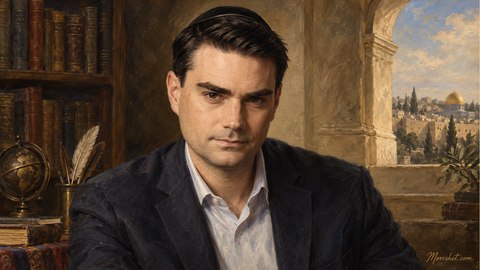
Avishai Ben-Haim
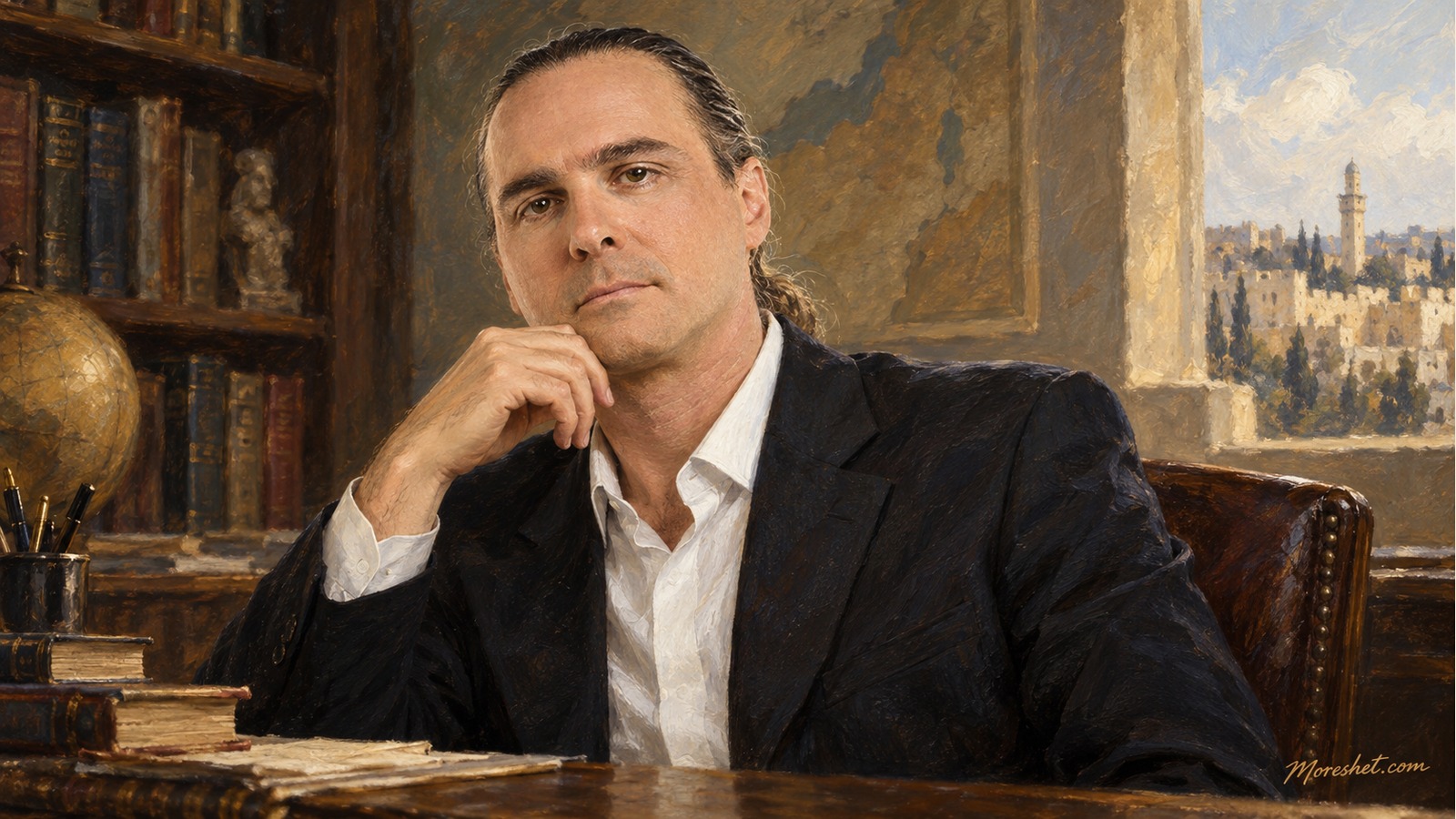
Dr. Avishai Ben-Haim — AI-generated artistic portrait · Moreshet.com
Israeli journalist, commentator, researcher and author whose work on Haredi society, Sephardic Judaism, Mizrahi traditionalism and the idea of a First and Second Israel has shaped national debate
Dr. Avishai Ben-Haim is an Israeli journalist, commentator, researcher and author whose career has moved for more than three decades between field reporting, television, academic research, Jewish thought and the interpretation of Israeli society. He first became widely known as one of Israel’s prominent reporters on Haredi society, Shas and rabbinic leadership, and later broadened his work to questions of Mizrahi identity, traditionalism, social hierarchy, cultural power and the relationship between politics and belonging.
Ben-Haim’s distinctive contribution lies in joining two kinds of work that are often separate: long-term journalism built on direct access to communities, rabbis and political networks, and academic research concerned with ideas, halakhah, Kabbalah and Sephardic and Haredi leadership. Through reporting, television series and books including Ish HaHashkafa, his study of Rabbi Ovadia Yosef, The Second Israel, The Haredim: Know the Beloved and The Traditionalism Manifesto, he has tried to widen Israel’s public story to include communities, memories and traditions that he argues were long underrepresented within the country’s cultural center.
Jerusalem, Dimona and an early encounter with Israeli diversity
Ben-Haim was born in Jerusalem in 1968 to a family of Moroccan Jewish origin. His family spent several years in Dimona during his childhood before returning to Jerusalem. The movement between a development town and the capital, together with a Mizrahi family background and religious-Zionist schooling, later became relevant to many of the questions that would occupy his work.
He studied at the Netiv Meir yeshiva high school and at Himmelfarb High School in Jerusalem. This education gave him familiarity with Jewish texts, religious-Zionist culture and the continuing tension between tradition, statehood and modern life. When he later began reporting on Haredi society, he therefore approached it with some knowledge of its language, sources and religious categories rather than entirely as an outsider.
His Moroccan and Mizrahi background gradually became increasingly important in his public thinking. Ben-Haim came to present Sephardic and Mizrahi traditionalism not merely as ethnic origin, but as a cultural way of life capable of combining attachment to Judaism with full participation in modern society.
Paratrooper officer and reserve lieutenant colonel
Ben-Haim served in the IDF’s 202nd Battalion of the Paratroopers Brigade. After completing infantry officers’ training, he returned to the brigade and served as a platoon commander. In the reserves he continued in command and staff positions and reached the rank of lieutenant colonel.
Military service remained significant long after his regular army career. Following the October 7, 2023 attack and the subsequent war, he spent long periods in reserve service and was largely absent from television for roughly two and a half years. When he left News 13 in 2026, he himself emphasized that his sixteen-year relationship with the news company had included an extended absence for reserve duty.
This combination of journalist, scholar and long-serving reserve officer adds a particular dimension to his public work. His discussion of Israeli social divisions is connected not only to media and academic institutions but also to one of the systems in which people from different sectors of Israeli society continue to meet directly.
Jewish history, Jewish thought and research on Haredi leadership
At the Hebrew University of Jerusalem, Ben-Haim studied the history of the Jewish people, completing undergraduate and master’s degrees before pursuing a doctorate in Jewish thought. His academic training gave a research framework to questions that already interested him as a reporter: how rabbinic authority is constructed, how Haredi Orthodoxy responds to Zionism and modernity, and how halakhah, mysticism, politics and ethnic identity interact.
His doctoral dissertation, supervised by Professor Benjamin Brown and approved in 2017, examined Rabbi Ovadia Yosef’s relationship with Kabbalists and with the world of Jewish esoteric teaching. Rather than treating Rabbi Ovadia as simply opposed to Kabbalah, Ben-Haim argued for a more complex picture: resistance to particular contemporary Kabbalists and Kabbalistic rulings in some cases, combined with acceptance of Kabbalistic traditions in others.
Through this question he sought to understand Rabbi Ovadia’s larger religious and historical project: the creation of authoritative Sephardic halakhic leadership and the rebuilding of collective confidence among Sephardic Jews in Israel.
Rabbi Shach and the ideology of Lithuanian Haredi society
Before completing his doctorate, Ben-Haim had already devoted substantial research to Rabbi Elazar Menachem Man Shach, one of the leading figures of Lithuanian Haredi Judaism in Israel. His book Ish HaHashkafa: The Haredi Ideology According to Rabbi Shach examined Rabbi Shach not merely as a yeshiva head but as a leader with a broad ideological response to Zionism, the state, modernity and the boundaries of Haredi society.
This research established a method that would continue throughout Ben-Haim’s work: trying to understand religious leadership from within its own conceptual world. Instead of describing Haredi society only through its opposition to secularism or Zionism, he investigated the beliefs, fears, institutions and systems of authority that allow such a community to reproduce itself across generations.
He also contributed scholarly writing on Rabbi Shach and Haredi society, further connecting his journalistic experience with historical and academic research.
Maariv and the growth of Haredi reporting
Ben-Haim began his journalistic career at Maariv, where he served for years as a correspondent on Haredi affairs. At a time when Haredi society was often covered mainly through coalition politics or religion-state disputes, he treated it as a continuing field of reporting with institutions, internal factions, leaders, cultural codes and a history of its own.
He wrote the weekly column Knisat HaShabbat and reported extensively on Rabbi Shach, Rabbi Ovadia Yosef, Rabbi Yitzhak Kaduri, Aryeh Deri, the Lithuanian yeshiva world, Kabbalah, Mizrahi traditionalism and religious-state tensions.
His reporting included the burning of New Testament books in Or Yehuda, the Nir Ben-Artzi affair, debates involving Rabbi Shlomo Aviner, Rabbi Haim Amsalem’s call for a more lenient approach to conversion, an exclusive interview with Rabbi Kaduri and repeated reporting on statements made by Rabbi Ovadia Yosef in his public teachings. Such work helped make Ben-Haim a reporter with unusual access to communities that were not always easy for the mainstream press to enter.
Channel 10 and News 13: from Haredi affairs to the whole of Israeli society
Ben-Haim left Maariv in January 2010 and joined Channel 10 News in March as a reporter and commentator on Haredi and religious affairs. Through later changes in Israeli broadcasting, he remained with the same news organization as it became News 13. The relationship lasted approximately sixteen years and made him a widely recognized television figure.
His reporting during this period included the first interview with Rabbi Motti Elon after the affair surrounding him became public, an interview with Ami Popper, and documents concerning a payment of 150,000 shekels to Shas from the state witness in the Holyland affair. Rabbi Ovadia Yosef’s final television interview was conducted with Ben-Haim on Channel 10, reflecting the access he had developed to the Shas leader and his circle.
Over time, his work expanded beyond Haredi affairs. He increasingly addressed structural questions about Israel itself: Mizrahim and Ashkenazim, center and periphery, traditional and secular identities, elite institutions and excluded groups, the relationship between the judiciary and politics, and the gap between how groups understand themselves and how they are described by the media establishment.
Television series that turned research into public conversation
At Channel 10 and News 13, Ben-Haim created a long series of television projects that translated complex social structures into accessible public journalism. Among the best known were Haredim – The Disintegration, about changes in the structure of Haredi society; The Myth of the Haredi Majority, which challenged widely repeated demographic assumptions; The Haredi Autonomy, about the voluntary communal separation built within the Zionist state; and Rule of the Rabbi, which explored the implications of growing Haredi influence.
Other series addressed leading rabbis, Kabbalah, Breslov Hasidism and messianic ideas in Israeli society. Ben-Haim attempted to show that subjects often treated as marginal, mystical or internally religious have direct consequences for Israeli culture, elections, institutions and identity.
Before the 2015 election he produced a series on ethnicity and the ballot box, examining the connection between Mizrahi identity, Shas and political choice. His later work gradually shifted from describing a separate Haredi world toward a broader interpretation of the entire Israeli social order.
The First Israel and the Second Israel
In 2018 Ben-Haim created the television series They Stole Our Country, in which he gave wide public currency to the concepts of a First Israel and a Second Israel. The terminology quickly became one of the most recognizable frameworks in Israeli political and social argument.
In Ben-Haim’s account, the First Israel consists of historical elites and institutions that accumulated cultural, legal, media and political power and that he associates to a significant extent with Ashkenazi, secular and center-left Israel. The Second Israel is centered on Mizrahi, traditional and peripheral populations, although he has widened the category to include other groups that he sees as distant from the old cultural establishment, including Haredim, religious Zionists and parts of additional communities.
A central part of his argument concerns the durable support of many Mizrahi and traditional voters for Likud and Benjamin Netanyahu. Ben-Haim argues that such voting cannot be understood through day-to-day economic interests alone. He interprets it in terms of dignity, identity, historical memory and resistance to an establishment that many voters believe has looked down on their culture.
The framework generated intense debate and is not an academic consensus. Critics have argued that its categories mix ethnicity, class, political preference and cultural identity too freely. Its public influence, however, is clear. The language of First and Second Israel became a recurring framework for discussion of Wadi Salib, the Israeli Black Panthers, Tami, Shas, the Yemenite Children affair, Mizrahi relations with state institutions and long-term voting patterns.
The Second Israel: grievance and the sweet message
In 2022 Ben-Haim published The Second Israel – The Sweet Message, the Bitter Oppression, giving his television thesis a wider historical and interpretive form. The book examined the encounter between Mizrahi and traditional communities and the state’s political, educational, legal and cultural institutions, and argued that experiences of exclusion or insufficient recognition still shape Israeli politics generations after the mass immigration from Muslim-majority countries.
The phrase the sweet message became increasingly important in his later work. Ben-Haim sought to stress that the Second Israel is not, in his view, only a story of grievance. Mizrahi traditionalism also represents a constructive social resource: an ability to remain connected to tradition without demanding complete religious uniformity, and to maintain family and communal bonds across ideological differences.
This marked a gradual change in emphasis from the question of who had been excluded and who had held power toward a broader question: whether traditionalism itself could help reduce the permanent war between Israeli ideological camps.
The Haredim: Know the Beloved
In 2024 Ben-Haim published The Haredim – Know the Beloved: A Journey into the Haredi World. The title expresses the approach that characterized much of his reporting. Rather than treating Haredim merely as a problem to be solved or an alien population, he sought to present a society with its own internal logic, loves, anxieties, ideals and institutions that can be understood even by those who disagree with it.
The book draws on decades of reporting and research and connects journalistic familiarity with leaders and communities to his academic work on Rabbi Shach, Rabbi Ovadia Yosef, Shas and Haredi authority. In that sense it summarizes a major element of his career: helping move Haredi society from the margins of Israeli reporting into a field understood to possess its own history, sociology, theology and politics.
Reserve service and absence from television after October 7
Following the October 7, 2023 attack, Ben-Haim returned to extended reserve service. For much of the following two and a half years he was barely present in the media, placing his television career largely on hold. In May 2026, near the end of this period, he announced that he was leaving News 13 after sixteen years.
In his farewell, he emphasized the freedom the organization had given him to bring a different voice to television and to combine academic knowledge with journalism. He also pointed to the more than twenty television series he had produced in an effort to complete what he regarded as missing parts of Israel’s social story.
His departure ended the media chapter that had begun with Channel 10 in 2010. A new one began almost immediately at Channel 14.
Channel 14 and The Patriots
In June 2026 Ben-Haim joined the panel of The Patriots on Channel 14. He subsequently appeared on the channel as a commentator and interview guest on Israeli society, traditionalism, politics and the relationship between competing social camps.
The move followed sixteen years associated with Channel 10 and News 13 and placed him in a different media environment. Yet the central subjects of his work remained recognizable: representation, Mizrahi identity, Haredi society, Jewish traditionalism and the relationship between established elites and right-leaning or peripheral populations.
The Traditionalism Manifesto and a turn toward reconciliation
In 2026 Yedioth Books published The Traditionalism Manifesto – The Sweet Message, a Framework for Reconciliation. The book marks a significant development in Ben-Haim’s public thought. After years devoted to diagnosing the division between the First and Second Israel, he explicitly tried to move from diagnosis toward a unifying proposal.
At the center of the book is Mizrahi traditionalism as Ben-Haim understands it: not an incomplete compromise between religion and secularism, but a way of life able to contain apparent contradictions. A person can observe some commandments but not others, be fully modern while honoring inherited practice, disagree without ending family relationships, and value belonging over ideological purity.
Ben-Haim presents this tradition as an alternative to a politics in which every camp demands complete victory. The ability to compromise informally, tolerate inconsistency and remain within a shared family or community becomes, in his argument, not merely a description of Mizrahi culture but a possible model for Israeli reconciliation.
Rabbi Ovadia Yosef as a key to modern Sephardic history
One of the major axes of Ben-Haim’s work is Rabbi Ovadia Yosef. His 2018 book Maran Rabbi Ovadia Yosef – A Leader Between Halakhah and Kabbalah, Politics and Mysticism, based on his doctoral dissertation, is an extensive study of Rabbi Ovadia’s religious and public project.
Ben-Haim presents Rabbi Ovadia as a figure who cannot be understood only as a halakhic authority or only as the spiritual leader associated with Shas. He interprets his career as a historical project to restore the authority and confidence of Sephardic Judaism: establishing a strong halakhic center, building rabbinic authority, connecting religious rulings with public leadership and creating an independent voice for a large Mizrahi public in the State of Israel.
This focus is an important element of Ben-Haim’s contribution to Israeli cultural research. It places Sephardic halakhic authority, Kabbalah, Shas and Mizrahi Jewish identity not at the margins of Israeli history but near the center of the story of religion and politics in the state.
Journalist, researcher and public intellectual
Ben-Haim’s career does not fit neatly into one professional category. He has produced reporting and exclusives as a journalist, created long-form television series, written academic and popular nonfiction, occasionally hosted HaMila HaAharona on Army Radio, previously hosted a television series on Shas and edited HaHeder, presented by Dr. Ruth Calderon.
This combination allows him to move between observation and theory. At one moment he may report on a particular rabbinic dispute; at another he may use decades of reporting to formulate a broad claim about Israeli society.
That combination is also the source of both his influence and the disputes surrounding him. When a journalist formulates a large social theory, the border between reporting and interpretation becomes especially visible. Ben-Haim does not hide the fact that he seeks not only to describe Israeli society but to change the way it understands groups, identities and power within itself.
Family and the lived background of traditionalism
Ben-Haim is married to Merav Bukshitzki, a clinical criminologist working in Israel’s health system, and they have three children. The family lives in Har Adar. He is a cousin of Rabbi Rafi Peretz, a former Chief Military Rabbi and Israeli cabinet minister.
His private life is not the center of his public work, but his family and cultural background help explain why traditionalism became more than an academic subject. He describes it as a world he also knows from within: a Judaism that does not force people to choose between inherited practice and full participation in modern Israeli life.
A contribution to the conversation about Jewish and Israeli identity
Ben-Haim’s central influence lies in moving subjects once largely confined to Haredi specialists, sociologists or Mizrahi activists into mainstream Israeli discussion. Rabbi Shach, Rabbi Ovadia, Shas, Kabbalah, traditionalism, Mizrahi status, peripheral communities, legal and media elites and voting patterns became, in his work, elements of one larger story about Israeli identity.
Even those who strongly disagree with his interpretations often use the terminology he helped popularize. This is a form of public intellectual influence: not necessarily creating consensus, but helping create the language in which disagreement takes place.
In the later stage of his work, Ben-Haim has tried to move that language further. If The Second Israel described historical injury and a struggle for recognition, The Traditionalism Manifesto seeks to present a path toward coexistence. In his account, Mizrahi heritage is not only a past whose treatment must be corrected, but also a possible intellectual resource for Israel’s future.
Why this legacy belongs in Moreshet
Avishai Ben-Haim merits inclusion in Moreshet because his work connects journalism, scholarship, Jewish thought and social memory in order to document and interpret major communities within the Jewish people and the State of Israel. His studies of Rabbi Shach and Rabbi Ovadia Yosef have contributed to understanding Haredi and Sephardic leadership; his journalism brought Shas, Kabbalah, Haredi society and Mizrahi traditionalism to a broad audience; and his work on the Second Israel made questions of ethnicity, periphery, representation, cultural authority and dignity central to national debate.
Moreshet.com documents Ben-Haim because Jewish and Israeli heritage is not only a collection of events and personalities from the past. It is also an ongoing struggle over who is included in the common story and how communities describe themselves. Ben-Haim’s place in Moreshet rests on his sustained attempt to give language to Haredi society, Sephardic Judaism and Mizrahi traditionalism, and on his more recent effort to move from a language of exclusion and historical injury toward one of reconciliation, belonging and continued life together without erasing disagreement.