Barbra Streisand
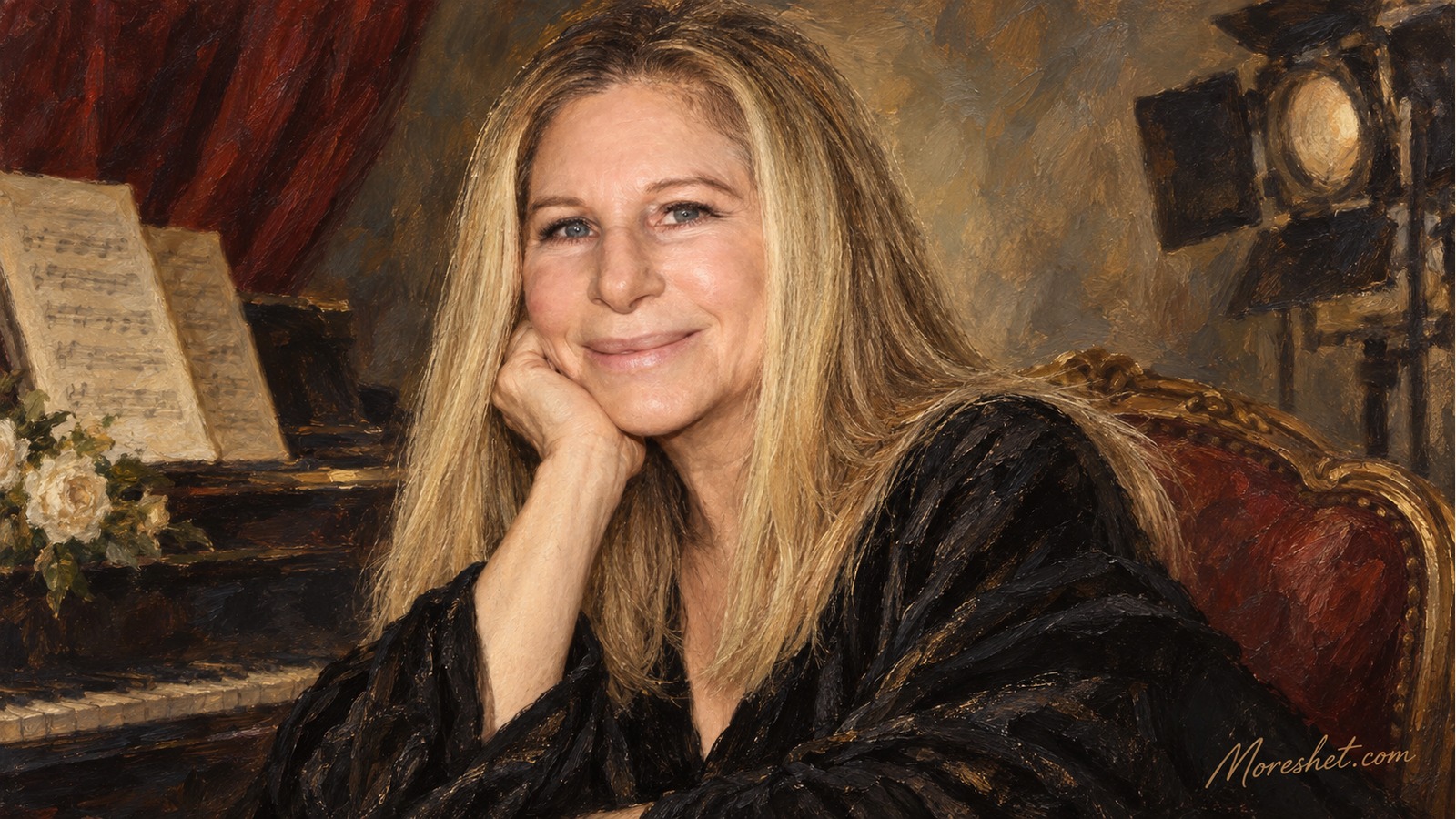
Barbra Streisand — AI-generated artistic portrait · Moreshet.com
The Jewish-American artist who reshaped popular music, film, and cultural possibility
Barbra Streisand is a Jewish-American singer, songwriter, actress, producer, director, and writer whose career has shaped popular culture for more than six decades. She has worked across recording, Broadway, film, television, and public advocacy, earning two Academy Awards, ten Grammy Awards, five Emmy Awards, a Tony Award, four Peabody Awards, nine Golden Globe Awards, and many other distinctions. She is among the rare performers to receive all four major American entertainment honors: the Emmy, Grammy, Oscar, and Tony.
Her importance rests on more than commercial success. Streisand widened the space available to women in entertainment by insisting on artistic control and by taking responsibility for projects as a writer, producer, director, and star. She also brought a distinctly Jewish-American sensibility to international audiences, while turning her fame into support for Israel, education, civil rights, women’s health, and humanitarian causes.
From Brooklyn to Broadway
Streisand was born on April 24, 1942, and raised in Brooklyn in a Jewish family. Her father, Emanuel Streisand, was a teacher who died when she was just over a year old. Her mother, Diana Rosen, raised her children under severe financial pressure. Streisand’s paternal family came from Galicia, in the region now divided between Poland and Ukraine, while her maternal family came from the Russian Empire. She attended a Jewish Orthodox yeshiva in Brooklyn before studying at Erasmus Hall High School.
As a teenager, she was recognized for her voice but not offered an easy path into show business. She wanted to act, worked at whatever jobs she could find, and began performing in nightclubs. Early in her career, people told her that she did not fit conventional ideas of a female star. She refused to reshape herself to meet those expectations, building her public identity around her unmistakable voice, humor, intelligence, and stage presence.
Her nightclub work in Greenwich Village led to Broadway. In 1962 she appeared in I Can Get It for You Wholesale, attracting attention with a performance that made her impossible to overlook. Two years later she became a major star as Fanny Brice in Funny Girl. The role, associated with songs such as “People” and “Don’t Rain on My Parade,” gave her a defining artistic persona: witty, emotionally direct, ambitious, and unwilling to accept the limits others imposed on her.
A voice that transformed popular music
Streisand’s debut album, The Barbra Streisand Album, was released by Columbia Records in 1963. It was a major success and won Grammy Awards. From the beginning, she demanded an unusual degree of artistic control. Her recording contract allowed her to choose much of her own material, an important precedent for performers who wanted to be treated as creative decision-makers rather than interchangeable voices.
Over the course of her career, she recorded dozens of albums spanning pop, ballads, musical theater, film songs, and duets. Her voice could move from dramatic force to intimate restraint, and she brought a strong interpretive intelligence to familiar material. Albums including People, The Way We Were, Guilty, The Broadway Album, and Higher Ground reached broad audiences and demonstrated her ability to renew her artistic identity without abandoning her standards.
Her film songs became part of the shared musical memory of the United States and beyond. “The Way We Were,” “Evergreen,” “Woman in Love,” and “No More Tears (Enough Is Enough),” her duet with Donna Summer, became international hits. For “Evergreen,” written with Paul Williams for A Star Is Born, Streisand won the Academy Award for Best Original Song and became the first woman honored in that category as a composer.
She was also an exceptional live performer. After years away from regular concert work, her return to the stage in the 1990s generated extraordinary demand. Her concerts became major cultural events, selling out rapidly and commanding unusual attention. In 1967 she gave a free concert in New York’s Central Park before an audience estimated at approximately 135,000 people, one of the largest crowds ever assembled for a single performance.
Film, authorship, and women’s creative authority
In 1968 Streisand brought her Broadway success to the screen in Funny Girl. Her performance as Fanny Brice earned her the Academy Award for Best Actress. She went on to star in Hello, Dolly!, What's Up, Doc?, and the drama The Way We Were, among other films.
Her work behind the camera was equally significant. In 1983 she created Yentl, based on a story by Isaac Bashevis Singer. Streisand wrote the screenplay, produced, directed, and starred in the film — an extraordinary achievement at a time when women were rarely allowed to lead major Hollywood productions. The story follows a Jewish woman in Eastern Europe who disguises herself as a man in order to study, exploring faith, education, gender, and the personal cost of social restrictions.
Making Yentl required years of persistence after Hollywood studios repeatedly rejected the project. Its eventual production placed a Jewish story at the center of an international film and presented a Jewish woman as a fully authoritative creator, not merely a performer in front of the camera. Streisand later produced and directed The Prince of Tides and The Mirror Has Two Faces.
Jewish identity and ties to Israel
Jewish identity was not a marginal detail in Streisand’s life or work. She grew up in a Jewish family shaped by Eastern European immigration and placed a Jewish woman’s struggle for learning at the center of Yentl. The film brought questions of tradition, education, and personal freedom to international audiences and gave new visibility to a Jewish story created by Isaac Bashevis Singer.
In 1984 Streisand funded a building and academic facility named for her father, Emanuel Streisand, at the Hebrew University of Jerusalem on Mount Scopus. She attended the dedication ceremony. The gift transformed the memory of a teacher who died when she was a child into an enduring contribution to education and Jewish scholarship in Israel. In 2013, the Hebrew University awarded her an honorary doctorate.
Streisand has consistently expressed support for Israel. In 2011 she appeared at a Friends of the Israel Defense Forces fundraising event in Los Angeles that raised approximately $12 million. In 2013 she performed two concerts in Tel Aviv during a visit to Israel and took part in an event marking Shimon Peres’s ninetieth birthday. These appearances and gifts connected her global stature with Israeli institutions, communities, and audiences.
Public engagement and philanthropy
Streisand has used her public platform to support human rights, civil liberties, women’s rights, LGBT rights, environmental causes, and democratic participation. She has supported the Democratic Party and candidates associated with those causes, appeared at benefit events, and opposed legislation that denied rights to gay people. Her activism has often been practical: performances, foundations, and charitable gifts have directed substantial resources toward social, environmental, medical, and humanitarian work.
Established in 1986, the Streisand Foundation has supported organizations working on environmental preservation, voter education, civil rights, women’s issues, and nuclear disarmament. Streisand also became a major advocate for women’s cardiovascular health. In 2009 she donated $5 million to establish a women’s cardiovascular research and education program at Cedars-Sinai Medical Center; she later helped raise additional funds. The program was named the Barbra Streisand Women’s Heart Center and created a lasting institutional focus on the distinctive risks women face in heart disease.
In 2015 President Barack Obama awarded her the Presidential Medal of Freedom, the highest civilian honor in the United States. In 2018, through the album Walls and particularly the song “Don’t Lie to Me,” she addressed truth, democracy, and the political climate of the United States. In 2022 she helped raise funds for medical care in Ukraine through UNITED24.
Enduring influence
Streisand has influenced generations of singers, actors, filmmakers, and women creators. She demonstrated that a performer could achieve worldwide success without surrendering a personal voice, Jewish identity, humor, or artistic authority. She connected the traditions of musical theater and cabaret with contemporary pop, joined commercial cinema to personal authorship, and treated public visibility as an opportunity for civic responsibility.
Her influence is also visible in cultural memory. Her songs continue to be performed, her image and work are referenced throughout television and popular culture, and her films and recordings have entered national preservation collections. Funny Girl was selected for preservation in the United States National Film Registry, while “People” was selected for the National Recording Registry. These recognitions point beyond individual fame: they show that Streisand’s work has become part of the cultural record of the United States.
Why this legacy belongs in Moreshet
Barbra Streisand merits inclusion because her work connects several central dimensions of Jewish and Israeli cultural life: music, theater, film, education, civil rights, and philanthropy. She turned the experience of a Jewish girl from Brooklyn into one of the world’s most influential artistic careers without severing that success from her origins. Through Yentl, she brought a Jewish story about learning and freedom to international audiences; through her gift to the Hebrew University, she strengthened a major Israeli institution; and through her support for Israel and the IDF, she helped sustain a visible relationship between American Jewish life and Israeli society.
She also offers a practical model of cultural leadership: an artist who demands authorship, opens possibilities for women creators, and directs wealth and attention toward health, education, rights, and humanitarian needs. For these reasons, Moreshet and Moreshet.com present Streisand not simply as an entertainment icon, but as a figure whose work changed who could be heard, who could create, and how Jewish identity could shape influence in the wider world.