Bob Dylan
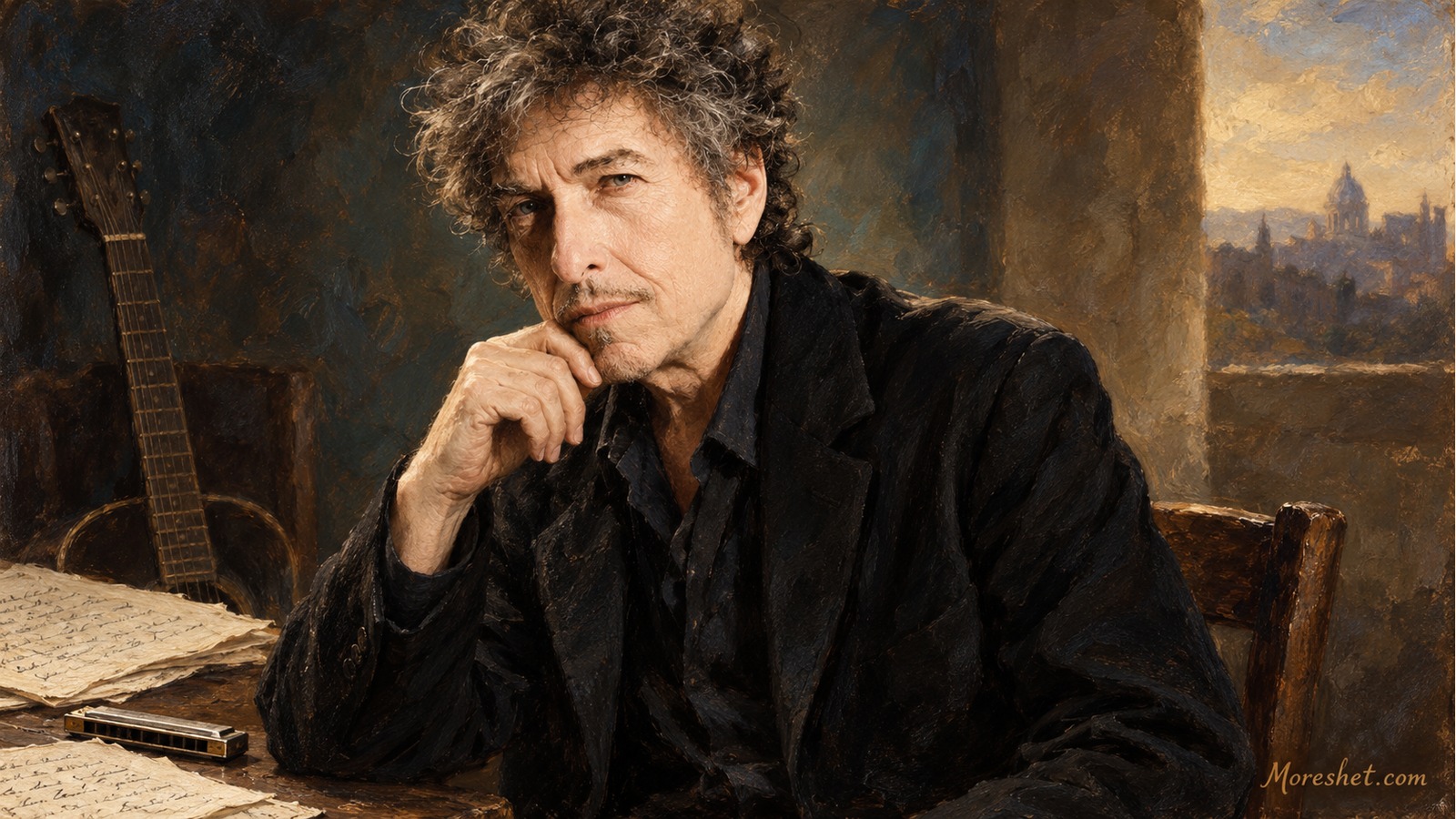
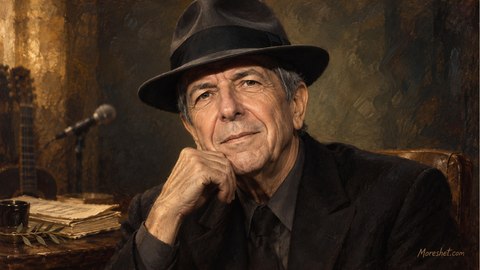
Bob Dylan — AI-generated artistic portrait · Moreshet.com
The Jewish American songwriter who transformed popular music into literary expression, public conscience, and cultural inheritance
Bob Dylan, born Robert Allen Zimmerman on May 24, 1941, is a Jewish American singer-songwriter, musician, author, visual artist, and one of the most consequential figures in modern popular culture. Across more than six decades, he expanded the possibilities of the popular song by bringing literary language, biblical imagery, political thought, philosophical questioning, and personal testimony into forms shaped by folk, blues, country, gospel, rock, jazz, and older traditions of oral song. In 2016 he received the Nobel Prize in Literature, "for having created new poetic expressions within the great American song tradition"—the first musician to receive the award.
Dylan's significance lies in more than his recordings or honors. He changed what audiences expected a popular song to do. A song could be an intricate work of art, a text with the density of poetry, and a public statement capable of giving language to a generation. Dylan resisted being permanently labeled "the voice of a generation," yet songs such as Blowin' in the Wind and The Times They Are a-Changin' became associated with the civil rights movement and with young people's demand for social change.
From a Jewish family in Minnesota to Greenwich Village
Dylan grew up in Duluth and Hibbing, Minnesota, in an Ashkenazi Jewish family. His paternal grandparents had emigrated from Odessa after the pogroms of the early twentieth century, while his maternal family came from Lithuania. His Hebrew name is Shabtai Zisl ben Avraham and Rachel Rivka Zimmerman. His childhood in a small, close-knit Jewish community, together with his exposure to radio, blues, country, and rock and roll, formed the cultural foundation from which his career emerged.
As a teenager he formed bands and played piano. In 1959 he enrolled at the University of Minnesota and performed in the Minneapolis folk scene. In early 1961 he left college and moved to New York, determined to meet his musical hero, Woody Guthrie. In Greenwich Village he played small clubs, absorbed songs from folk, blues, and Irish performers, and created a new artistic identity for himself. Robert Shelton's enthusiastic review in The New York Times on September 29, 1961, helped bring him to wider attention; the following month producer John Hammond signed him to Columbia Records.
His debut album, Bob Dylan, released in 1962, combined folk, blues, and gospel. That year Dylan also signed a management contract with Albert Grossman, who guided his career during its breakthrough period. The following album, The Freewheelin' Bob Dylan, introduced the combination that would define him: melodies grounded in vernacular tradition, paired with words addressing war, racism, love, faith, and injustice.
Songs that became a public language
Blowin' in the Wind asked whether war and injustice would ever end and became widely known through recordings by Peter, Paul and Mary and other artists. A Hard Rain's a-Gonna Fall, built on the structure of an old folk ballad, gave musical form to political anxiety and apocalyptic imagery. Dylan did not merely write simple slogans. He created open-ended songs, full of questions, that listeners could adopt, reinterpret, and carry into their own struggles.
In 1963 Dylan took part in important civil rights events, including the March on Washington for Jobs and Freedom, where Martin Luther King Jr. delivered his "I Have a Dream" speech. The album The Times They Are a-Changin' addressed the murder of civil rights worker Medgar Evers, the collapse of traditional mining and farming communities, and the death of Hattie Carroll. Dylan brought into popular music the stories of individuals and communities often excluded from the dominant public narrative.
Yet Dylan did not remain within the role of protest singer. On Another Side of Bob Dylan he turned toward love songs, humor, uncertainty, and impressionistic imagery. The change expressed one of his central artistic principles: an artist need not remain inside the role assigned by an audience or political movement.
Going electric and inventing folk-rock
In 1965 Dylan moved from acoustic guitar toward electric instrumentation. Bringing It All Back Home, Highway 61 Revisited, and Blonde on Blonde, created between 1965 and 1966, form the core of his early achievement and a decisive moment in modern music. Across these albums Dylan joined folk and blues to rock and roll, Beat poetry, surrealism, humor, and the force of a rock band.
His electric performance at the Newport Folk Festival in July 1965 drew boos from part of the audience, which regarded the move as a betrayal of folk tradition. In retrospect, the performance demonstrated that folk music and protest music need not remain fixed: they could change, become louder, and reach new audiences. Like a Rolling Stone, whose length exceeded normal radio conventions, also expanded the creative and commercial possibilities of the single. Highway 61 Revisited placed direct rock songs beside extended, densely imagined pieces such as Desolation Row.
Dylan's 1965–66 touring band included the Hawks, later known as the Band. Their collaboration helped create a new rock sound and led to recordings made in 1967 in the basement of the house known as Big Pink near Woodstock. Eventually released in part as The Basement Tapes in 1975, the sessions brought together old folk songs, blues, gospel, country, and original material. They influenced the development of country-rock and generations of musicians who followed.
From biblical echoes and folk tradition to country, blues, and film
After a motorcycle accident in 1966, Dylan stopped touring for several years and withdrew from public pressure. The 1967 album John Wesley Harding presented compressed, minimalist songs filled with biblical echoes. All Along the Watchtower, later made famous by Jimi Hendrix, became an example of how a brief text could open a wide space for religious, literary, and musical interpretation.
In 1969 Dylan turned toward country music on Nashville Skyline, including a duet with Johnny Cash. In 1971 he made a surprise appearance at the Concert for Bangladesh organized by George Harrison, performing with Harrison, Ringo Starr, and Leon Russell. In 1972 he wrote the soundtrack for Sam Peckinpah's film Pat Garrett and Billy the Kid and appeared in the film. The soundtrack song Knockin' on Heaven's Door became one of the most frequently covered classics in rock.
Released in 1975, Blood on the Tracks transformed personal marital crisis into layered literary and musical material. That same period produced Hurricane, a long song about boxer Rubin "Hurricane" Carter, who had been convicted of murder and whom Dylan believed had been unjustly imprisoned. The song showed how Dylan could use his public reach to bring a story of alleged injustice before a mass audience.
Faith, Judaism, and Israel
Dylan's relationship to Judaism and religion changed repeatedly. He was raised in a Jewish home, celebrated his bar mitzvah in May 1954, and visited Israel in 1971, including the Western Wall and Kibbutz Ein Dor. In the late 1970s he entered a period of evangelical Christian faith, which shaped Slow Train Coming, Saved, and Shot of Love. He later distanced himself from the label "born again" and moved again toward Jewish identity and practice.
In 1982 he began studying at a Chabad center in Brooklyn and met the Lubavitcher Rebbe. The album Infidels included Neighborhood Bully, a song associated with support for Israel, and its inner artwork showed Dylan kneeling on the Mount of Olives. That year he returned to Israel for his son's bar mitzvah and was photographed at the Western Wall. In 1988 he took part in a Chabad fundraising event and later participated privately in Jewish religious occasions.
Dylan performed in Israel in 1987, 1993, and 2011. Although the various concerts received different responses, his visits and his connection with American Jewish identity made him a familiar and meaningful figure in Israeli cultural life. His influence on Israeli music has been especially strong. Meir Ariel, often called "the Israeli Dylan," regarded him as a central inspiration; Yehonatan Geffen translated some of his songs; and artists including Ehud Banai, Aviv Geffen, Shalom Hanoch, Ariel Zilber, David Broza, Danny Litani, and Shlomi Shaban performed or translated his work. The Israeli group Project Gumiyah released an entire album of Hebrew adaptations.
Even as Dylan's religious identity shifted, the Bible, questions of redemption, sin, responsibility, exile, and hope remained part of his imaginative vocabulary. For many American and Israeli Jews, he represents a complex form of cultural Judaism: an identity expressed not only through observance, but through language, memory, moral tension, and the search for meaning.
A continuing body of work: books, radio, film, and visual art
Dylan continued to reinvent himself after the height of the 1960s. Time Out of Mind, released in 1997, returned him to the center of public attention and won the Grammy Award for Album of the Year. In 2001 he won the Academy Award for Best Original Song for Things Have Changed from Wonder Boys. Modern Times, released in 2006, reached number one in the United States, while Together Through Life in 2009 became his first album to top the Billboard 200 when he was 68.
From 2006 to 2009 he hosted the weekly radio program Theme Time Radio Hour, presenting music from a remarkably broad range of sources, from blues and jazz to pop, rap, and traditional song. The program revealed Dylan not only as a performer but also as a cultural curator, directing listeners toward the roots of American music and toward artists who had disappeared from the center of public attention.
Dylan published the memoir Chronicles: Volume One, the prose-poetry work Tarantula, children's books, collections of lyrics, and The Philosophy of Modern Song, published in 2022, a series of essays on songs by other artists. He also produced drawings and paintings exhibited in galleries and museums, including the National Gallery of Denmark. He later created iron sculptures and wrought-iron gates. His movement among music, writing, and visual art reflects a broad conception of authorship rather than a career limited to singing.
In 2008 he received a special citation from the Pulitzer Prize jury for his contribution to popular music and American culture. In 2012 President Barack Obama awarded him the Presidential Medal of Freedom. He has been inducted into the Rock and Roll Hall of Fame and the Songwriters Hall of Fame, and in 2016 he received the Nobel Prize in Literature.
A legacy of change and artistic freedom
Dylan's central achievement was to create a new space in which popular music could carry literary, historical, and moral weight. He showed that a song could draw simultaneously on an ancient ballad and Ezra Pound, on blues and the Bible, on political protest and personal experience—and still reach millions of listeners. Musicians including the Beatles, Johnny Cash, George Harrison, Bruce Springsteen, Joni Mitchell, Neil Young, Leonard Cohen, and many Israeli artists have drawn from the freedom he demonstrated.
His archive, including drafts, notebooks, recordings, and correspondence, is housed at the Bob Dylan Center in Tulsa, Oklahoma, which opened in 2022. The center allows scholars and the public to follow the creative process—not only finished songs, but also revisions, alternate lines, recordings, and experiments. His work has therefore become a living research heritage, studied through music, literature, history, and Jewish cultural memory.
Why Bob Dylan's legacy belongs in Moreshet
Bob Dylan merits inclusion because he worked simultaneously within several spheres central to Jewish and Israeli life and to global culture. He brought the story of a Jewish American from an immigrant family to an international audience, transformed folk and biblical sources into modern artistic material, and influenced creators and social communities far beyond the original world of popular music.
His legacy can be heard in songs that gave people language for war, racism, freedom, and responsibility; in works that expanded the literary possibilities of songwriting; in his continuing relationship with Judaism and Israel; and in his direct influence on Israeli musicians, especially Meir Ariel. For these reasons, Bob Dylan belongs naturally in Moreshet—not only as an American music icon, but as a Jewish creator whose work shaped culture, moral conversation, and generations of artists and readers. Moreshet.com helps preserve the connection between his life, his art, and the broader story of American Jewry, Israel, and the world.