Lawrence Joseph Ellison
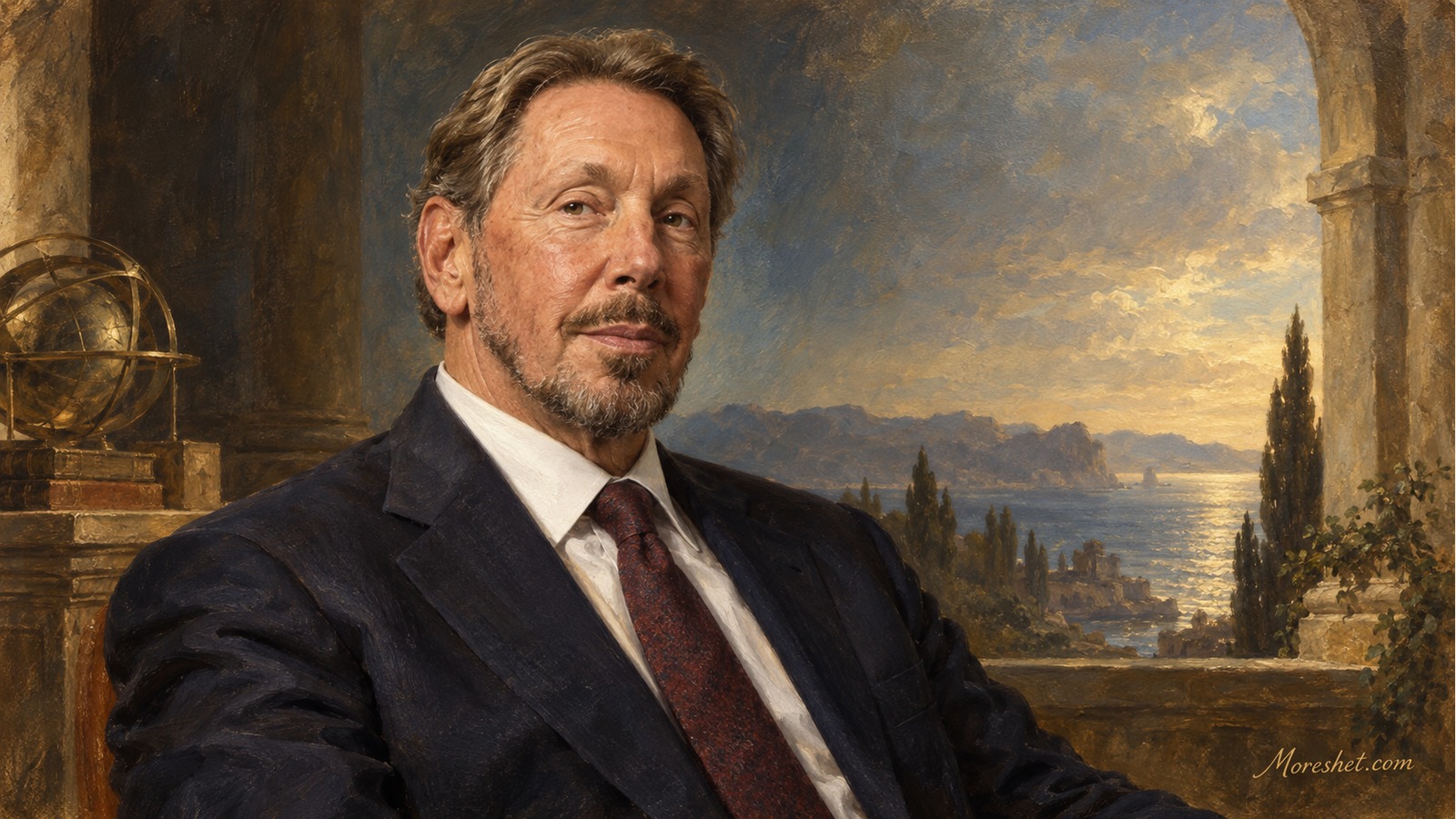
Larry Ellison — AI-generated artistic portrait · Moreshet.com 
Larry Ellison — image from the Moreshet archive
Jewish-American technology entrepreneur, Oracle co-founder, executive chairman and chief technology officer, philanthropist and prominent supporter of Israel whose influence spans databases, enterprise software, cloud and artificial intelligence
Lawrence Joseph Ellison, known as Larry Ellison, is a Jewish-American technology entrepreneur, co-founder of Oracle Corporation, executive chairman of the board and chief technology officer of the company. He is one of the central figures who shaped the modern enterprise-software industry: databases, corporate information systems, cloud infrastructure, software for governments and businesses, and in recent years artificial-intelligence infrastructure at enormous scale.
Ellison’s importance is not measured only by his wealth or by the size of the company he built. Oracle turned the relational database from an academic and laboratory concept into a central tool of economics, government, finance, health care, security, commerce and communication. Over decades, Ellison built a competitive, aggressive and durable company that influenced the way organizations store information, analyze it, manage processes and make decisions. Alongside this, he developed broad philanthropic activity, support for medicine and research, involvement in sailing, technology investments and an explicit connection with Israel and Jewish causes.
Complicated childhood and Jewish identity in Chicago
Ellison was born in New York City on August 17, 1944. His biological mother, Florence Spellman, was Jewish, and his biological father was an Italian-American pilot in the United States Army Air Corps. When Ellison was an infant and contracted pneumonia, his mother gave him to her aunt and uncle, Lillian and Louis Ellison, a Jewish couple in Chicago, to raise and adopt. He grew up in the city’s South Shore neighborhood, in a Reform Jewish and middle-class environment.
Lillian, his adoptive mother, is remembered in biographies as warm and supportive, while his relationship with his adoptive father Louis is often described as difficult and distant. The Ellison surname itself was connected in the family to Ellis Island, the historic gateway for immigrants to the United States. In his name and adoption story were already woven migration, Jewishness, American identity, separation and the drive to build himself anew.
Ellison was raised in a Jewish home but did not become religious. He refused to have a bar mitzvah ceremony at 13, and later described himself as religiously skeptical. Even so, his connection to Judaism and Israel remained meaningful in his public life. He has said that his affection for Israel is tied less to religious belief than to admiration for Israeli innovation, entrepreneurship and determination.
Studies, dropping out and moving to California
Ellison attended South Shore High School in Chicago and then enrolled at the University of Illinois Urbana-Champaign. He studied mathematics and physics, did well academically and was recognized as a strong science student, but left after the death of his adoptive mother without taking final examinations. He later studied briefly at the University of Chicago, where he encountered computer design, but again left without completing a degree.
The move to California became a turning point. During the 1960s and 1970s, Northern California was becoming a new center of computing, software, electronics and entrepreneurship. Ellison moved to Berkeley and the wider Silicon Valley environment, worked as a programmer for several companies, including Amdahl and Ampex, and absorbed the technological culture forming around him: mathematics, engineering, business risk and impatience with old conventions.
Like several other great technology entrepreneurs, Ellison did not build his career through an orderly academic path. He built it through the ability to learn quickly, grasp a deep idea, identify a market, sell it forcefully and gather talented people around it. Dropping out of university was not the end of his education, but the beginning of practical learning in a world where software was becoming a new economic force.
Edgar Codd’s paper and the idea that produced Oracle
During the 1970s, Ellison worked at Ampex, where he was connected to a database project for the CIA code-named Oracle. Around that time he encountered a paper by computer scientist Edgar F. Codd on the relational model of databases. Codd’s idea was revolutionary: organize information in tables and logical relations so it could be queried with a flexible, standard language.
IBM, where Codd worked, was developing research in the field, but Ellison recognized a commercial opportunity before many others did. In 1977 Ellison, Bob Miner, Ed Oates and their colleagues created Software Development Laboratories. Ellison invested a modest amount and took on the business and sales leadership. The company changed its name to Relational Software and later to Oracle, after the product at its center.
Ellison’s choice was bold: to turn a research idea in databases into a commercial product for large organizations. In 1979 the company released Oracle Database under the name Oracle Version 2, even though there was no commercial Version 1. The name itself expressed marketing confidence: a product meant to appear mature, strong and ready for the enterprise market.
Databases and the birth of modern enterprise software
Oracle grew because databases became the core of the modern organization. Banks, airlines, governments, universities, hospitals, manufacturers, retailers and communications companies needed systems that could store critical information, retrieve it quickly, protect it and allow many applications to work on it. Ellison understood early that whoever controlled the database would influence the deep infrastructure of business.
The company competed with IBM, Sybase, Informix, Microsoft and others, and developed a reputation for powerful products, determined sales and uncompromising leadership. In the 1990s Oracle faced crises, including revenue-recognition problems, layoffs and restatements, but the company recovered and continued to grow. Ellison himself later acknowledged serious business mistakes, yet he turned the crisis into a school for managing a large software corporation.
Over the years Oracle became one of the largest software companies in the world. Its databases became infrastructure for critical systems, and the company expanded into enterprise applications, development tools, middleware, hardware, cloud, services and infrastructure. In this way Ellison became one of the people who shaped the movement from a world in which computers were mainly calculating machines to a world in which information itself is a central asset.
Leadership style: competition, ambition and technological control
Ellison became known for a sharp, competitive and sometimes provocative leadership style. He was not a cautious manager in the traditional sense, but an entrepreneur who saw the market as an arena of combat. His rivalries with companies such as IBM, Microsoft, Sybase, Informix, SAP and others became part of Silicon Valley folklore. He knew how to use forceful language to present Oracle as a company that challenged old giants and refused to settle for second place.
Behind the style, however, stood a clear principle: deep control of infrastructure. Ellison wanted Oracle to be as close as possible to the customer’s data, applications and critical processes. For that reason he pushed the company to acquire companies, build complementary products and offer broad packages connecting database, software, hardware and service.
In 2014 he stepped down as Oracle’s chief executive after almost four decades, but he did not leave the company. He moved into the roles of executive chairman and chief technology officer. This transition reflected the way he saw himself: not only as a business manager, but as the person continuing to guide the company’s central technological vision.
Major acquisitions and the expansion of the Oracle empire
One of Oracle’s defining features under Ellison was extensive use of acquisitions. Over the years the company acquired dozens of businesses to expand its areas of activity. The purchases of PeopleSoft, Siebel, BEA Systems, Sun Microsystems and NetSuite were among the moves that turned Oracle from a database company into a broad enterprise-software and infrastructure company.
The 2010 acquisition of Sun Microsystems was especially important. It gave Oracle control of technologies such as Java, MySQL, Solaris and enterprise hardware. The move connected Oracle to more open worlds of software and infrastructure, while also placing it at the center of debates about open source, standards and control of technologies essential to developers and organizations.
The 2016 acquisition of NetSuite, a company in which Ellison had a significant ownership stake, strengthened Oracle’s cloud and business-applications activity. Alongside such transactions, the company continued to develop autonomous databases, ERP, HCM, CRM, cloud infrastructure and security systems. Ellison believed that large organizations needed an integrated platform, not a scattered collection of tools that did not work well together.
Oracle Cloud, AI and the Stargate Project
In the third decade of the 21st century, cloud became the central arena of competition among technology giants. Oracle entered the field later than Amazon Web Services, Microsoft Azure and Google Cloud, but Ellison continued to argue that Oracle had special advantages in databases, enterprise workloads and high-performance infrastructure. The company invested heavily in Oracle Cloud Infrastructure, data centers, GPU chips, fast networks and infrastructure designed for artificial intelligence.
In 2025 Oracle was one of the founding partners in The Stargate Project, a major AI-infrastructure initiative involving OpenAI, SoftBank, Oracle and MGX, intended to invest very large sums in building artificial-intelligence infrastructure in the United States. Oracle’s involvement placed Ellison and his company at the heart of the struggle over the physical infrastructure of the AI era: data centers, electricity, computing, networks and security.
In 2025 and 2026 Oracle drew intense attention because of growth in its cloud and artificial-intelligence activity. Ellison, already one of the richest people in the world, briefly became the world’s richest person following a sharp rise in Oracle’s share price. The episode showed how far the company’s center of gravity had moved from traditional databases to AI infrastructure, and how the long-standing Ellison vision of controlling critical layers of information remained relevant.
Further investments: Tesla, media and technology
Beyond Oracle, Ellison has invested in additional fields. He was a significant shareholder in Tesla and served on its board from 2018 to 2022. That investment connected him to electric vehicles, clean energy and software embedded in physical products. It also expressed his tendency to bet on ambitious entrepreneurs and companies that seek to transform whole industries.
In recent years his name has also been connected to media through Skydance and Paramount Skydance, where his son David Ellison plays a central role. The investment and ownership structures of the Ellison family have made it a significant factor in content, film, television and media. In this way Ellison’s profile of influence extends beyond software and cloud into culture, distribution and control of content.
Alongside this, Ellison has invested in ventures in medicine, agriculture, software, data and artificial intelligence. Not every venture succeeded, but all reflect a similar pattern: interest in large systems, belief in technology as a force that changes reality, and willingness to use personal capital to test ideas at wide scale.
Medical philanthropy and the Ellison Institute
In 2016 Ellison donated 200 million dollars to establish the Lawrence J. Ellison Institute for Transformative Medicine, initially at the University of Southern California. The institute’s aim was to connect research, medicine, data science, prevention, cancer treatment and interdisciplinary thinking. It later developed as the Ellison Institute of Technology, with activity in Los Angeles and Oxford, seeking to connect science, engineering, medicine and technology to solve difficult problems.
This gift matters because it expresses a characteristic Ellison approach: not merely funding ordinary research, but building an institution that attempts to reorganize the way complex problems are addressed. As in Oracle, the idea is infrastructure: a system connecting data, people, expertise, technology and resources around a large challenge.
Earlier, Ellison also donated to a musculoskeletal research center at the University of California, Davis after suffering an injury in a bicycle accident. Over the years he also signed The Giving Pledge, though the scale and distribution of his giving have varied by period, institution and area of interest.
Support for Israel and Jewish causes
One of the most important aspects of Ellison’s heritage profile is his explicit support for Israel. Over the years he has donated significant sums to Friends of the Israel Defense Forces. In 2017 he announced a 16.6 million dollar gift, described at the time as the largest single gift in the organization’s history, to support the construction of well-being facilities for male and female combat soldiers at a new training campus.
Ellison has also supported other projects connected with Israel and the safety of its citizens, including fortifying a community center in Sderot against rocket attacks and additional gifts to Israeli and Jewish institutions. This support is not secondary to his story: it connects a Jewish-American entrepreneur from the generation that built Silicon Valley with an open commitment to the State of Israel, IDF soldiers and community resilience.
Like all political and philanthropic involvement connected to Israel, Ellison’s support has at times generated controversy and criticism from opponents of Israeli policy. But from the standpoint of Jewish and Israeli heritage, his explicit bond with Israel, together with the scale of his giving, places him among the prominent Jewish business figures who supported Israeli causes in the 21st century.
Lanai, sailing and a culture of large projects
In 2012 Ellison purchased most of the Hawaiian island of Lanai. The purchase made him a central figure in the life of the island, with investments in tourism, agriculture, infrastructure and local ventures. Lanai became a symbol of Ellison’s ambition to test systems at large scale: not only a company or product, but an entire place in which models of sustainability, health, farming and technology might be attempted.
Another field closely identified with him is competitive sailing. Ellison invested heavily in Oracle Team USA, which won the America’s Cup in 2010 and 2013. The 2013 victory, in which the team came back from a deep deficit against Emirates Team New Zealand, is considered one of the most dramatic comebacks in sporting history. Ellison later helped create SailGP, an international racing series using fast, technologically advanced boats.
Sailing is not merely a side detail. It expresses Ellison’s love of speed, engineering, competition, risk and complex systems — the same elements that characterize his business career. For him, sport, technology and business are not entirely separate worlds; all are arenas in which team, design, performance and innovation determine the outcome.
Personal life and family
Ellison has been married several times and has children, including David Ellison and Megan Ellison, who became important figures in film and production. David founded Skydance, and Megan founded Annapurna Pictures. The Ellison family therefore gained influence in culture and media in addition to Larry Ellison’s influence in technology.
His personal life, properties, homes, aircraft, yachts and lifestyle have received wide media coverage. In historical context, however, they are not the main point. The main point is the way a person who grew up in complicated family circumstances in Chicago became one of the most important founders of enterprise software, one of the richest people in the world, and a donor with influence in medicine, Israel, science and sport.
Why this legacy belongs in Moreshet
Lawrence Joseph Ellison merits inclusion in Moreshet because his story connects Jewish-American identity, adoption and family migration, Silicon Valley, databases, enterprise software, cloud, artificial intelligence, medical philanthropy and explicit support for Israel. He is one of the Jewish entrepreneurs whose influence is visible in the deep infrastructure of the modern world: the information used every day by governments, companies, hospitals, banks and institutions.
Moreshet.com documents Ellison because Jewish and Israeli heritage also includes Jewish figures who acted on the world stage and shaped foundational systems of digital life. Larry Ellison’s place in Moreshet rests on the way he turned a technological idea into a giant corporation, on his influence over databases and AI infrastructure, and on the fact that a significant part of his public giving has been directed toward medicine, science, education, Israel and IDF soldiers. This is a story of ambition, innovation, institutional power and Jewish identity in a global technological world.