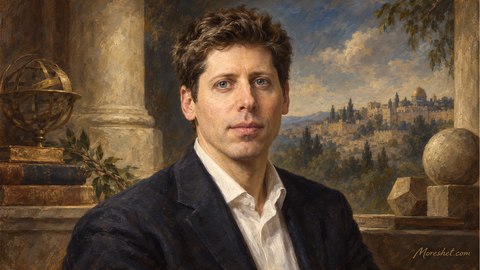
Avram Hershko
The physician and biochemist who helped explain selective protein breakdown
Avram Hershko, born in 1937, pursued a question once treated as secondary: how does a cell break down proteins it no longer needs? Research with Aaron Ciechanover and Irwin Rose revealed a vital regulatory mechanism and earned the three scientists the 2004 Nobel Prize in Chemistry. Their work established that protein destruction is selective and organized, no less important than protein production.
From childhood in Hungary to Israeli science
Born in Karcag, Hungary, Hershko survived a ghetto and a camp in Austria with his mother and brother. His father endured forced labor and captivity. The family reunited after the war and immigrated to Israel in 1950. Hershko earned medical and research doctorates at the Hebrew University, undertook postdoctoral work in the United States and joined the Technion’s medical faculty in 1972.
How the cell marks its targets
Hershko and his colleagues investigated why a particular form of protein breakdown requires energy. By separating and reconstituting components, they identified a process in which the small protein ubiquitin attaches to target proteins. Certain ubiquitin chains help direct those targets to the proteasome for degradation. Cells can thereby remove damaged proteins and also dismantle regulatory proteins whose work is finished.
This is more than cellular housekeeping. Changing a protein’s abundance can determine when a cell divides or how it responds to its environment. Understanding the pathway opened directions for disease research and for medicines acting on the system. It provided a foundation for medical progress, not one universal solution to the diseases associated with it.
A legacy carried through students
Hershko combined medical understanding with precise biochemical experiments and trained generations of researchers. His collaboration with Ciechanover began in doctoral training and developed into an international scientific achievement. It illustrates the value of institutions willing to support fundamental questions before their practical importance is obvious.
Why this legacy belongs in Moreshet
Moreshet includes Hershko for an Israeli contribution that changed the understanding of the cell. His story at Moreshet.com connects survival, education and the building of scientific communities. Its central achievement is the knowledge he helped give the world: a detailed explanation of a mechanism on which living systems depend.