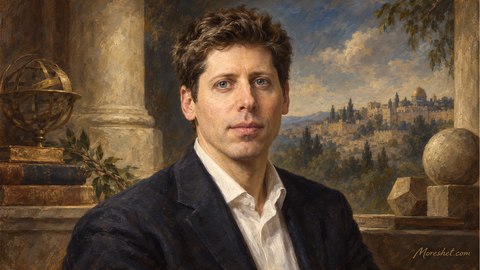
Aaron Ciechanover
Ubiquitin researcher connecting fundamental cell biology with medicine
Aaron Ciechanover, born in 1947, helped make a discovery that changed the understanding of cellular life. With Avram Hershko and Irwin Rose, he identified essential elements of the system that marks proteins for destruction. Their 2004 Nobel Prize in Chemistry recognized work that developed from an Israeli laboratory into a central direction in biology and medicine.
From clinical training to basic mechanisms
Ciechanover grew up in Haifa in a family of Polish immigrants who valued education and Jewish culture. After losing his parents at a young age, he received support from his brother and aunt. He studied medicine at the Hebrew University, served as a military physician and entered research at the Technion under Hershko. Following further training with Harvey Lodish in the United States, he returned to develop his scientific career in Israel.
Controlled destruction rather than accidental decay
Cells must replace damaged proteins and regulate how long functional proteins remain active. The researchers demonstrated how ubiquitin participates in selectively marking proteins. Appropriate tags direct targets toward the proteasome, where they are broken down. This controlled removal helps cells change their activity at the necessary time and place.
The pathway became essential to understanding cell division, quality control and diseases involving disrupted regulation. It also helped provide a scientific basis for treatments directed at protein degradation. The achievement should not be confused with a blanket medical promise: understanding a mechanism opens possibilities, while each treatment requires its own evidence.
Passing knowledge onward
Ciechanover combined research with teaching, scientific mentorship and public engagement. His career illustrates the productive relationship between medicine and basic science: concern for patients can coexist with a return to molecular questions whose answers may expand future treatment options.
Why this legacy belongs in Moreshet
Ciechanover belongs in Moreshet for a contribution combining experimental creativity, collaboration and international influence. Moreshet.com places that achievement within the history of Israeli higher education and its capacity to produce knowledge useful far beyond national borders. His work is a concrete example of how careful investigation of a seemingly narrow question can transform a much wider field.