Ayn Rand
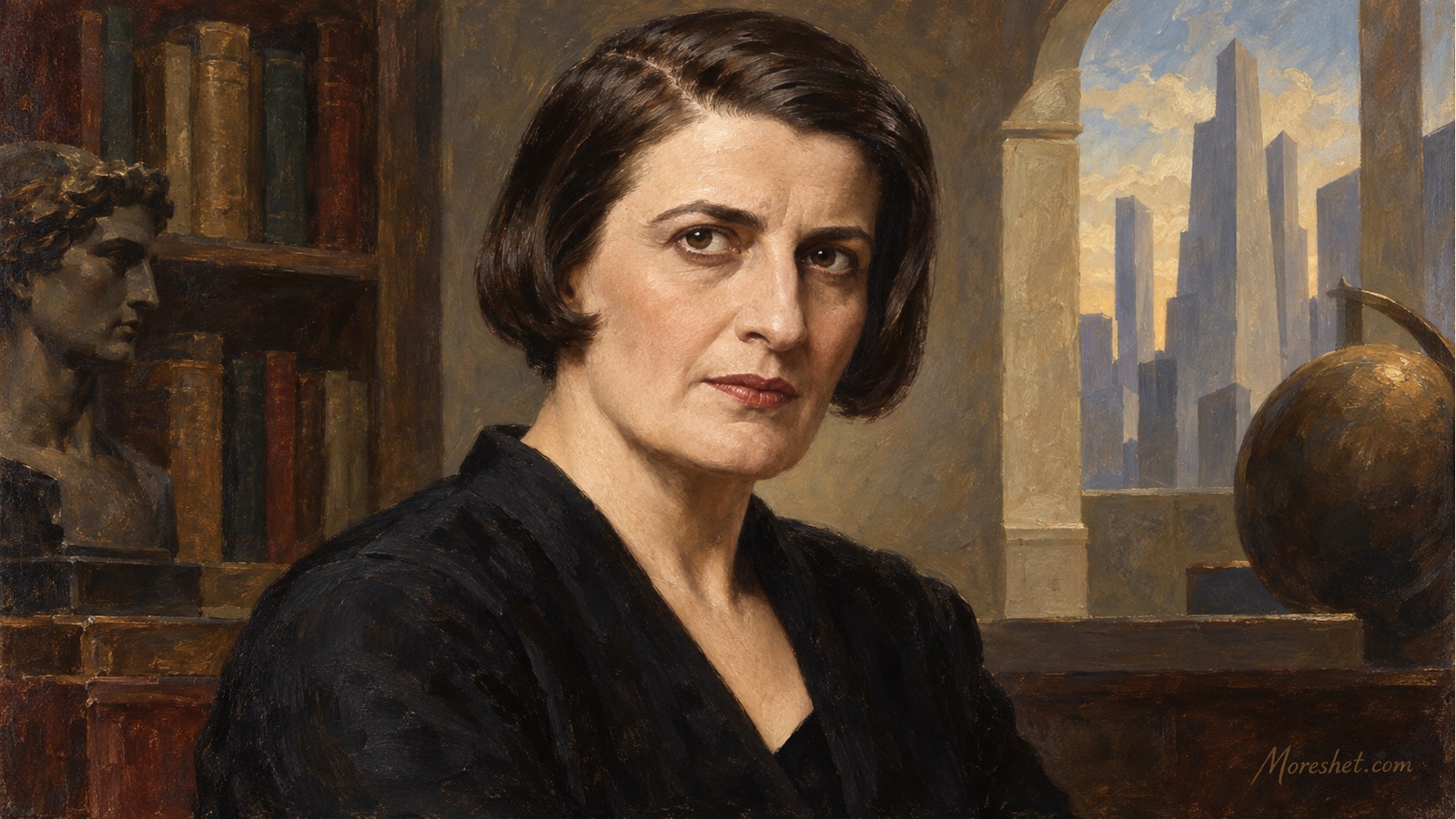
Ein Rand — AI-generated artistic portrait · Moreshet.com
Russian-born Jewish-American novelist and philosopher, author of The Fountainhead and Atlas Shrugged, creator of Objectivism and one of the most influential modern voices on individualism, reason, capitalism and creative achievement
Ayn Rand, born Alisa Zinovyevna Rosenbaum, was a Russian-born Jewish-American novelist, screenwriter, playwright and philosopher. She is best known for the novels We the Living, The Fountainhead and Atlas Shrugged, and for the philosophical system she developed under the name Objectivism. In her fiction and essays she placed at the center of moral life the thinking, productive, independent individual, and the right of a person to live by reason, purpose, creative work and responsibility for one’s own life.
Rand was an unusual figure: a Jewish girl born in Tsarist Russia, a witness to the Bolshevik Revolution and the nationalization of her family’s property, an immigrant who came to the United States hoping to write for the movies, and eventually one of the most widely read philosophical novelists of the 20th century. Her books have sold tens of millions of copies, inspired intense admiration and sharp opposition, and influenced readers, entrepreneurs, business leaders, politicians, artists and ideological movements in the United States, Israel and beyond. Her importance to Jewish and Israeli heritage does not come from religious observance or Jewish communal leadership, but from her modern Jewish life story and from the powerful effect her ideas had on debates about liberty, enterprise, state power, markets, creativity and the moral status of the individual.
Jewish childhood in Saint Petersburg
Rand was born on February 2, 1905, in Saint Petersburg, then the capital of the Russian Empire, into a bourgeois Jewish family. Her father, Zinovy Zakharovich Rosenbaum, was a successful pharmacist, and her mother, Anna Borisovna Kaplan Rosenbaum, came from an educated Jewish background. Ayn was the eldest of three daughters. The home in which she grew up combined education, professional aspiration and an urban Russian-European culture, but also the limits and vulnerability of Jewish life inside a changing and often hostile political order.
From childhood she was drawn to adventure stories, heroic figures and silent films, especially Hollywood movies. She preferred stories in which a single person of will, talent and courage stands against a hostile world. Her early love of Romantic literature, especially Victor Hugo and Edmond Rostand, shaped her literary imagination for the rest of her life: literature was not merely a record of what exists, but a dramatic presentation of what the human being can and should be according to the artist’s deepest values.
As a teenager Rand concluded that she was an atheist and that reason should stand at the center of human life. This position distanced her from religion, but it did not erase the Jewish background into which she was born. Her life remained connected to the condition of the modern Jew in the 20th century: a person moving between Russia, Europe and America, between persecution and migration, between Jewish family origin and universal philosophical ambition, and between the memory of oppression and an uncompromising belief in individual freedom.
The Russian Revolution and opposition to collectivism
The Communist Revolution of 1917 was a decisive turning point in Rand’s life. Her father’s pharmacy was nationalized, the family’s economic condition declined rapidly, and the family fled to Crimea during the Russian Civil War. In the eyes of the young Rand, the seizure of family property and the subordination of the individual to the state became formative experiences. From these events grew her lifelong hostility to coercive collectivism, especially Soviet communism.
After the family returned to Petrograd, Rand studied history and philosophy at Petrograd State University, later Leningrad State University. There she encountered Plato, Aristotle, Nietzsche and the philosophical questions that would occupy her for decades. She admired Aristotle as a thinker of reality, identity, reason and knowledge, and sharply rejected philosophical traditions she believed led to mysticism, collectivism or the subordination of the individual to abstractions above him.
Her Russian years were not merely background for her novels; they shaped the core of her worldview. When she later wrote about a state that sacrifices the individual in the name of the collective, about productive people persecuted by a bureaucratic system, and about a society that punishes excellence in the name of compulsory equality, she wrote from personal memory of revolution, nationalization, scarcity and fear.
America and the choice of the name Ayn Rand
In 1925 Rand received a visa to visit relatives in the United States, and in February 1926 she arrived in New York. She had planned not to return to the Soviet Union. Soon afterward she moved to Hollywood, because she saw American cinema as a world of imagination, drama and creative freedom. The move from Soviet Russia to America was for her not only geographical; it was a passage from coercion to possibility.
During this period she adopted the pen name Ayn Rand. The precise origin of the first name and surname has been discussed by biographers and scholars, but it is clear that the name served as a new literary and American identity. It allowed her to begin again as a writer in English, without entirely severing the link to her original surname Rosenbaum, which she later said was the source of the shortened surname Rand.
In Hollywood, a chance meeting with director Cecil B. DeMille, then working on The King of Kings, led to work as an extra and then as a junior screenwriter. On the set she met the young actor Frank O’Connor, whom she married in 1929. Although her path in the film industry was difficult, the Hollywood experience shaped her writing: broad dramatic structure, cinematic scenes, larger-than-life characters and a visual sense of moral confrontation.
From stage and early fiction to The Fountainhead
Rand’s first significant success was the play Night of January 16th, a courtroom drama in which members of the audience served as the jury and determined the ending. The play already showed her interest in moral judgment, individual decision and ideological drama. In 1936 she published We the Living, a novel with autobiographical elements about a young woman in Soviet Russia struggling against the totalitarian state and the price it extracts from individual life.
In 1938 she published Anthem in England, a short dystopia about a society in which the word “I” has disappeared from language. Although it did not become a major commercial success at first, it later became one of Rand’s clearest fictional statements against the erasure of the individual inside the collective. In these early works the themes that would follow her throughout her life were already present: freedom, identity, creation, self-respect and resistance to systems that demand the sacrifice of a person’s life to the group.
The great breakthrough came with The Fountainhead, published in 1943 after many rejections. Its hero, architect Howard Roark, refuses to compromise his professional vision even when the society around him rejects him. The novel became a bestseller, gave Rand fame and financial independence, and was adapted into a 1949 film for which Rand wrote the screenplay. For many readers, Roark became a symbol of the independent creator who does not seek permission from the crowd.
Atlas Shrugged and the formation of Objectivism
In 1957 Rand published Atlas Shrugged, the book she regarded as her greatest achievement. The vast philosophical novel imagines a world in which the producers, inventors and creative leaders withdraw from a society that exploits them, effectively declaring a strike of the human mind. John Galt, his long speech, and Dagny Taggart became foundational figures in the Objectivist imagination.
Atlas Shrugged was not only a novel. It was a vehicle for an entire worldview: reality exists independently of wishes; reason is the central means of human knowledge; a person’s life is an end in itself; creation and production are moral values; and a free society should rest on individual rights, private property and voluntary exchange. After the book appeared, Rand gradually moved from fiction into nonfiction, lectures, essays and public advocacy of her philosophy.
A group of students and admirers gathered around Rand, including Nathaniel and Barbara Branden, Leonard Peikoff, Alan Greenspan and others. The Nathaniel Branden Institute, The Objectivist Newsletter, The Objectivist and Rand’s lectures spread her ideas to a broad public. The Objectivist movement experienced internal tensions and personal ruptures, but it ensured that Rand would not remain only a successful novelist; she became the founder of an ideological movement associated directly with her name.
The philosophy: reality, reason, self-interest and freedom
Rand called her philosophy Objectivism. In metaphysics, she held that reality exists independently of consciousness. In epistemology, she argued that reason, grounded in sense perception and valid concepts, is the human means of knowledge. In ethics, she defended rational egoism: a person should not sacrifice himself to others or sacrifice others to himself, but should live by thought, productivity, purpose and self-esteem.
In political philosophy, Rand defended laissez-faire capitalism and a limited government whose proper role is to protect individual rights against the initiation of force. She opposed communism, fascism, socialism, broad welfare statism, theocracy and anarchism. She regarded the rights to life, liberty, property and the pursuit of happiness as the foundations of a moral society.
Rand also developed an aesthetic theory she called Romantic Realism. In her view, art should present the human being not merely as he appears in everyday life, but as he can be when his values, choices and aspirations are given dramatic form. Her heroes are therefore not ordinary naturalistic characters, but large ideological figures: the architect, industrialist, scientist, entrepreneur, the person who says “I” even under enormous social pressure.
Reception, criticism and public influence
Rand was, and remains, a controversial figure. Her books won a vast readership but also drew strong literary and philosophical criticism. Some critics saw her characters as one-dimensional, her rhetoric as overly polemical, and her philosophical arguments as lacking sufficient academic rigor. In academic philosophy she was long ignored or dismissed, although scholarly interest in Rand and Objectivism has grown since her death.
Yet her influence cannot be measured only by academic reception. Her books continued to sell in the millions, were cited in public debate, and influenced libertarians, free-market conservatives, entrepreneurs, business leaders and readers seeking a moral defense of creation, success and personal responsibility. Atlas Shrugged and The Fountainhead became formative books for many, even as others saw them as a source of troubling or one-sided ideas.
Rand’s historical importance lies precisely in this intensity. She created a powerful emotional and intellectual language for individualism, reason and free enterprise. Even her opponents have had to reckon with the fact that her ideas continue to appear in debates about capitalism, technology, regulation, entrepreneurship, the state and liberty.
Rand and Israel
Rand’s ideas also had a significant presence in Israel, especially among free-market, right-leaning and libertarian circles, and among entrepreneurs and technology-oriented readers. In a country where questions of state power, security, solidarity, economics and individual freedom are especially charged, Rand’s thought offered a sharp vocabulary for private initiative, economic liberty and opposition to governmental centralization.
In the 1970s, Rand attracted public attention in Israel in part through the philosopher Moshe Kroy, whose book Living According to Reason introduced Hebrew readers to his interpretation of Objectivism. Later, periodicals, websites and intellectual circles continued to engage with her work. In 2012 the Ayn Rand Center Israel was established, promoting educational activities, lectures, translation, essay contests and discussion of her ideas in Hebrew.
One notable Israeli expression of this continuing influence is the Atlas Award, given since 2016 to outstanding Israeli start-up companies. The existence of an Israeli award inspired by Atlas Shrugged shows that Rand became in Israel not only a translated author, but a point of reference in debates about innovation, entrepreneurship, technology, excellence and economic creation.
Final years and continuing legacy
In the 1960s and 1970s Rand continued to publish essays, lecture and appear in the media. Her major nonfiction works include For the New Intellectual, The Virtue of Selfishness, Capitalism: The Unknown Ideal, The Romantic Manifesto, Introduction to Objectivist Epistemology and Philosophy: Who Needs It. Much of her nonfiction grew out of articles in Objectivist periodicals and responses to readers’ questions.
Her health declined in later years. After decades of heavy smoking she was diagnosed with lung cancer, and her husband Frank O’Connor died in 1979. Rand died in New York City on March 6, 1982, and was buried at Kensico Cemetery. After her death, Leonard Peikoff inherited her estate and continued presenting Objectivism as he understood it. In 1985 the Ayn Rand Institute was founded, and other institutions later emerged to publish, teach, criticize and develop her ideas.
Decades after her death, Rand remains a live presence in public discourse. Her books are read in schools and universities, distributed in translation, studied and criticized, and referenced in popular culture. Few philosophical novelists have succeeded in creating bestselling fiction, an ideological movement, a political language and a continuing global argument.
Why this legacy belongs in Moreshet
Ayn Rand merits inclusion in Moreshet because her life connects several central experiences of modern Jewish history: birth into a Jewish family in Eastern Europe, encounter with totalitarian revolution, migration to America, the creation of a new identity, and a body of writing that influenced millions of readers. Although she was not religious and her philosophy is not Jewish in the traditional sense, she was a modern Jewish figure who made questions of liberty, reason, creation and the individual central to global conversation.
Moreshet.com documents Rand because Jewish and Israeli heritage includes Jewish writers and thinkers in the Diaspora whose influence extended far beyond the Jewish community itself. Ayn Rand’s place in Moreshet rests on her literary and philosophical contribution, her influence on debates in Israel and abroad about capitalism, entrepreneurship, personal freedom and individual responsibility, and the fact that her books and ideas continue to make people rethink the relationship between person, state, society, creation and power.